
Data-Driven Sales Strategy: How to Use CRM Analytics to Inform Your Plan
In the competitive landscape of modern business, where every lead counts and margins tighten, sales strategy stands as the cornerstone of sustainable growth. Leaders across industries now recognise that a robust data-driven sales strategy transforms raw numbers into actionable intelligence. By harnessing CRM analytics, organisations can uncover hidden patterns in customer behaviour, refine their approach, and achieve higher conversion rates. This shift from intuition to evidence-based decisions marks the difference between stagnation and expansion.
Mr. Rahul Limaye, a veteran with over three decades in sales and growth, captured this essence when he stated: “A sales strategy defines your market positioning and clarifies how you communicate the value of your products or services to your target audience.” His insight underscores why sales strategy must evolve with data at its core. Platforms like deAsra support and engage entrepreneurs through practical resources, including the Dream Big podcast series that features such experts. For deeper exploration, discover valuable insights on sales growth strategies.

Understanding CRM Analytics in a Data-Driven Sales Strategy
CRM analytics refers to the systematic examination of data captured within customer relationship management systems. These tools track interactions, deals, customer preferences, and performance metrics across the entire customer journey. When integrated into a data-driven sales strategy, this information reveals what drives purchases, where prospects disengage, and which tactics yield the strongest results.
Businesses gain clarity by monitoring key indicators such as lead sources, engagement levels, and deal progression. For instance, analytics dashboards highlight which channels generate the most qualified leads or where bottlenecks slow down the pipeline. This visibility empowers leaders to allocate resources more effectively and adjust tactics in real time. The result is a more efficient operation that responds swiftly to market shifts.
Identifying Trends with CRM Analytics
One of the strongest advantages of a data-driven sales strategy lies in spotting emerging trends before they become obvious. CRM analytics processes historical and current data to detect patterns in buying cycles, seasonal fluctuations, or shifts in customer priorities. Sales teams can then anticipate needs and tailor outreach accordingly.
Consider how analytics might show a rise in interest from a specific industry segment during certain quarters. Armed with this knowledge, businesses refine messaging, adjust pricing models, or introduce targeted offers. Such proactive steps strengthen the sales strategy and position the organisation ahead of competitors who rely solely on guesswork.
Mr. Rahul Limaye emphasised the value of ongoing insight: “It’s an ongoing necessity. Your business generates data daily—purchases, non-purchases, competitor insights.” This perspective reinforces the need for continuous monitoring within any data-driven sales strategy.
Optimising the Sales Funnel through Data Insights
The sales funnel represents the path from initial awareness to final purchase. CRM analytics illuminates each stage, exposing drop-off points and conversion leaks. By examining metrics like stage-to-stage progression rates and time spent in each phase, leaders pinpoint friction areas.
For example, if a large percentage of leads stall at the proposal stage, analytics might reveal inadequate follow-up or mismatched expectations. Teams can then implement automated reminders, personalised content, or training to address these issues. This targeted refinement accelerates movement through the funnel and boosts overall efficiency.
Optimisation extends to segmentation. CRM analytics groups customers by behaviour, value, or demographics, allowing customised nurturing. High-potential leads receive priority attention, while others follow tailored sequences. The outcome is a smoother progression and improved resource use.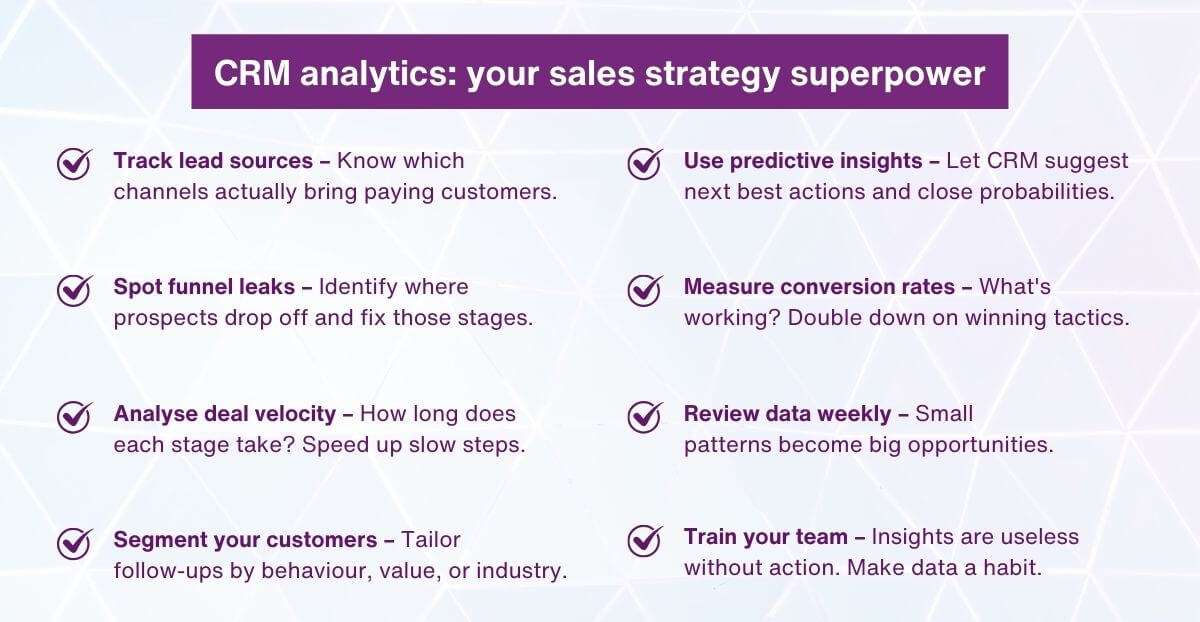
Improving Conversion Rates with a Data-Driven Sales Strategy
Conversion rates measure success at turning prospects into customers. A data-driven sales strategy elevates these figures by grounding every decision in evidence. CRM analytics identifies high-performing tactics—such as email sequences that prompt replies or calls that close deals—and scales them across the team.
Predictive features in modern CRM systems forecast outcomes based on past patterns. Sales professionals receive recommendations on next best actions, from timing outreach to selecting the right offer. This guidance reduces guesswork and increases win probabilities.
Regular review of conversion data also supports experimentation. Teams test variations in pitches, pricing, or channels, then measure results through analytics. Successful approaches become standard practice, steadily lifting rates over time.
Integrating Frameworks into Your Sales Strategy
Effective implementation often draws on established frameworks to structure the data-driven sales strategy. deAsra’s resources outline proven models that guide businesses toward transformation. Explore 5 sales strategy frameworks to align data insights with structured planning. These approaches complement CRM analytics by providing clear pathways to apply findings.
Practical Steps to Build Your Data-Driven Sales Strategy
Begin with a thorough audit of your current CRM setup. Ensure data entry remains consistent and complete, as accurate inputs form the foundation of reliable analytics. Define core metrics aligned with business goals—such as lead-to-opportunity conversion or average deal size—and configure dashboards to track them prominently.
Train teams to interpret reports and act on insights. Encourage regular reviews where findings inform pipeline management and forecasting. Integrate tools that automate alerts for anomalies, enabling quick responses.
Foster a culture that values data over opinion. When decisions rest on CRM analytics, confidence grows, and results follow. Periodic assessments keep the sales strategy relevant amid changing conditions.
Conclusion
Mastering a data-driven sales strategy equips leaders to navigate complexity with precision. Through CRM analytics, businesses identify trends, optimise the sales funnel, and improve conversion rates in measurable ways. This approach delivers clarity, efficiency, and lasting growth. deAsra supports and engages entrepreneurs with tools and knowledge to implement these principles effectively. Embrace data today, and watch your sales strategy deliver stronger outcomes tomorrow.

FAQs
1. What exactly is a data-driven sales strategy?
A data-driven sales strategy relies on factual insights from sources like CRM analytics rather than assumptions. It uses trends, customer behaviour, and performance metrics to guide decisions, refine processes, and achieve better results in customer acquisition and retention.
2. How does CRM analytics help identify trends?
CRM analytics examines historical and real-time data to reveal patterns in purchases, engagement, and preferences. This allows businesses to spot shifts early, adapt offerings, and align their sales strategy with actual market demands.
3. Why is optimising the sales funnel important?
Optimising the sales funnel removes obstacles that cause prospects to leave. By using CRM analytics to locate weak stages and apply fixes, companies speed up progression, reduce losses, and strengthen the overall sales strategy.
4. Can small businesses benefit from CRM analytics?
Yes, even modest operations gain advantages. Simple CRM analytics features highlight top leads, track interactions, and guide resource allocation, making a data-driven sales strategy accessible and impactful without complex setups.
5. How often should sales data be reviewed?
Review sales data weekly or bi-weekly for timely adjustments. Regular checks ensure the data-driven sales strategy remains responsive to new information and supports continuous improvement in conversion rates and funnel performance.