How to create a brand style guide for a small business
A brand style guide is a short document that records how a brand looks and sounds. It covers the logo, colours, fonts, images, and tone of voice, so that everyone who creates content for the business follows the same rules.
Many small businesses carry these rules in the owner’s head. That works until someone else starts making posters, posts, or packaging. This guide explains how to create a brand style guide in six steps, with a simple one-page layout.
Key takeaways
- A brand style guide records the visual and verbal rules that keep a brand consistent.
- It is also called brand guidelines or a brand book, and the terms overlap.
- A small business needs only a short guide, often one to two pages.
- The guide should include the logo, colours, fonts, images, voice, and clear dos and don’ts.
- A guide only works when it is shared, stored in one place, and updated from time to time.

What is a brand style guide?
A brand style guide is a reference document for a brand’s look and voice. It tells designers, staff, and partners how to use the logo, which colours to choose, and how to write.
The terms brand guidelines, brand style guide, and brand book overlap. Many businesses use them interchangeably. Some people use brand book for a fuller document that also includes the brand story, purpose, and strategy.
For a small business, one simple document is enough. It should be short, clear, and easy to open when needed.
Why does a small business need a brand style guide?
Brands lose consistency when many people create content without clear rules. One poster uses a new shade, another uses a different font, and the tone changes from post to post. Customers notice, even if they cannot say why.
A style guide solves this. It saves time, because people do not have to ask the same questions again. It also helps new staff, freelancers, and printers get it right the first time.
In addition, a guide protects the work you have already done on your identity. deAsra’s guide to brand consistency explains why repeated use builds recognition.
What does a brand style guide include?
A good guide covers a few core areas. The table below lists each section and what to record.
| Section | What to record | Example |
| Brand basics | Purpose, audience, and personality words | Warm, simple, honest |
| Logo rules | Versions, clear space, and misuse | Use the light version on dark backgrounds |
| Colours | Main, supporting, and accent colours with codes | One main colour and one accent |
| Fonts | Fonts for headings and body text | One headline font and one plain body font |
| Images | The style of photos and graphics | Natural light and close-up shots |
| Voice and tone | How the brand writes and speaks | Friendly, clear, never pushy |
| Dos and don’ts | Common mistakes and the right choice | Never stretch the logo |
| File locations | Where to find logos and templates | One shared folder |
You do not need every section on day one. Start with the logo, colours, fonts, and voice. Add more as the business grows.
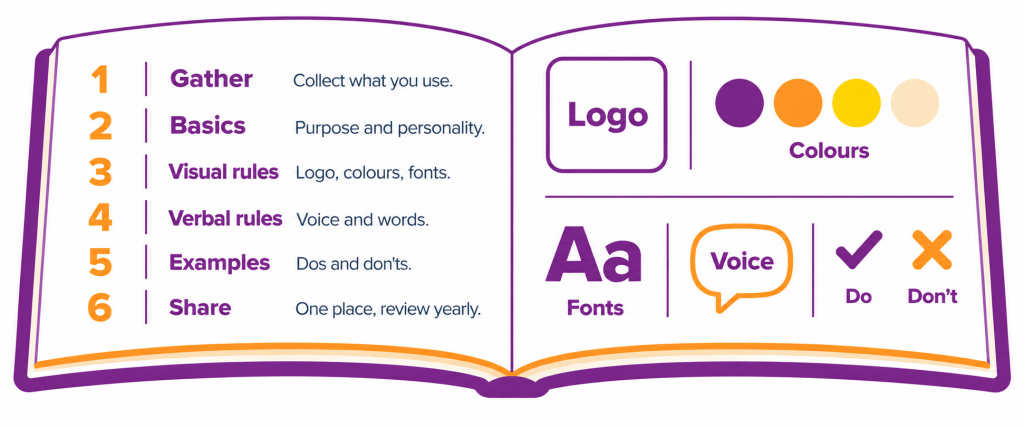
How to create a brand style guide in six steps
Six steps take you from scattered choices to a simple document. Work through them in order.
Step 1: Gather what you already use. Collect your logo files, packaging, social posts, and printed items. Note what you use most often. You are documenting current choices, not starting from scratch. deAsra’s brand identity guide helps if some parts are still missing.
Step 2: Write the brand basics. State the purpose of the business in one or two sentences. Describe your customer, and choose three words for your personality. These basics guide all later choices.
Step 3: Document the visual rules. Record the logo versions and the space to keep around them. Add the colour codes for each colour, the fonts, and the image style. deAsra’s guide to choosing brand colours explains how to build the palette and record the codes.
Step 4: Document the verbal rules. Describe how the brand speaks. List words to use and words to avoid, and note how formal to be. deAsra’s guide to brand voice and personality can help.
Step 5: Add examples and dos and don’ts. Show a few correct uses, such as a sample post or a label. Add the most common mistakes, with the right alternative. Real examples teach faster than long text.
Step 6: Share it and keep it current. Store the guide in one shared place. Give it to staff, freelancers, and printers. Review it once a year, or when the brand changes.
What does a one-page brand style guide look like?
A one-page guide is often enough for a small business. The layout below shows an original, illustrative example for a home bakery. Replace each item with your own choices.
| Area | Illustrative decision |
| Purpose | Fresh, honest home baking for family celebrations |
| Personality | Warm, simple, trustworthy |
| Logo | Use the dark version on light backgrounds, and keep clear space around it |
| Main colour | Warm brown, code #7A4B2A |
| Supporting colour | Cream, code #FFF4E0 |
| Accent colour | Soft pink, code #F4A6B7, for buttons and highlights only |
| Fonts | One friendly font for headings and one plain font for text |
| Images | Natural light, close-ups, and no heavy filters |
| Voice | Friendly and clear, using we and you, never pushy |
Use this as a simple template for your own. Add a page of examples when you can.
What do brand guidelines examples look like?
Brand guidelines work best when they contain clear, specific rules. The examples below are generic and original. They show the kind of rules that help.
- Logo: do not stretch it, change its colours, or place it on a busy photo.
- Colour: use the main colour for headings and the accent only for buttons.
- Fonts: use the heading font only for titles and the body font for all other text.
- Images: choose bright, natural photos, and avoid cluttered backgrounds.
- Voice: use short sentences, speak to the customer as you, and avoid jargon.
Specific rules are easy to follow and easy to check.
How to keep the style guide short and usable
A guide that nobody reads has no value. Keep it short, so people actually use it.
- Aim for one to two pages at the start.
- Use plain words and simple visuals.
- Show examples, not only rules.
- Put the colour codes and font names in one clear spot.
- Link to the logo and template files.
Check that a new team member can use the guide on their first day. If they cannot, simplify it.
How to share and use the style guide
A guide only works when people can find it and know it exists. Share it with every person who creates content for the business.
- Store it in one shared place, and name one owner.
- Share it with designers, printers, and freelancers before each job.
- Introduce it to new staff during their first week.
- Use it as a checklist before publishing posts and printing items.
deAsra’s guide to packaging design as branding shows how a guide helps on products and labels.
When should you update the style guide?
A style guide is a living document. Review it once a year. Also update it when you add a product line, change the logo, or enter a new platform.
Record the date of each change, and tell everyone who uses the guide. Remove old versions, so nobody uses outdated rules.
What mistakes should a small business avoid?
A few common mistakes reduce the value of a style guide.
- Making the guide too long and complex.
- Skipping examples and dos and don’ts.
- Recording colours by name, without exact codes.
- Keeping the guide on one person’s computer.
- Never updating it as the brand changes.
- Not sharing it with outside helpers.
Conclusion
A brand style guide protects the look and voice of a business. It saves time, keeps content consistent, and helps new people get things right.
The process is simple. Gather what you use, write the basics, and document the visual and verbal rules. Then add examples, share the guide, and review it each year.
Start this week by writing down your logo rules, colour codes, and three personality words on a single page. Share it with one person who creates your content.
Your next step

Frequently asked questions
What is a brand style guide?
It is a short reference document that records how a brand looks and sounds. It covers the logo, colours, fonts, images, and tone of voice.
How to create a brand style guide for a small business?
Gather your current assets, write the brand basics, and document the visual and verbal rules. Add examples, share the guide, and review it each year.
What is the difference between brand guidelines and a brand book?
The terms overlap, and many businesses use them interchangeably. A brand book is sometimes a fuller document that also covers the brand story, purpose, and strategy.
How long should a brand style guide be?
A small business can start with one to two pages. Add more detail as the business grows.
What should a brand style guide include?
Include the brand basics, logo rules, colours with codes, fonts, image style, voice and tone, and dos and don’ts. Also note where the files are stored.