Unique selling proposition: what it is and how to find yours
A unique selling proposition (USP) is the specific reason a customer should buy from one business instead of another. It is also called a unique selling point. The USP meaning in marketing is simple: one clear promise that rivals do not make in the same way.
Many small businesses struggle to say what makes them different. This guide explains how to find a unique selling proposition in six steps, with a worksheet and sample lines to guide the process.
Key takeaways
- A unique selling proposition is one clear, true reason to choose a business over its competitors.
- The strongest USPs sit where customer needs, business strengths, and competitor gaps overlap.
- Talking to customers and studying three competitors gives enough evidence to start.
- A good USP is specific, provable, and short enough to say in one breath.
- Testing the USP with a few customers before using it everywhere avoids costly mistakes.

What is a unique selling proposition?
A unique selling proposition is a short statement of the main benefit a business offers and why it is different. It answers one question from the customer: why should I buy from you?
A USP is not a slogan. It is the idea behind the slogan. It guides what a business says on its website, its social media, its packaging, and in its sales conversations.
A USP can rest on many things. Examples include speed, quality, a specific customer group, a guarantee, a local advantage, or a special way of working. It must be true, and customers must care about it.
Why does a small business need a USP?
Customers often compare several similar options. Without a clear difference, they choose on price or habit. A USP gives them a better reason to choose.
A USP also saves effort. Once the main promise is clear, decisions about content, offers, and design become easier. The business can say no to ideas that do not support the promise.
In addition, a clear USP makes word-of-mouth easier. Customers can repeat one simple reason when they recommend the business to a friend.
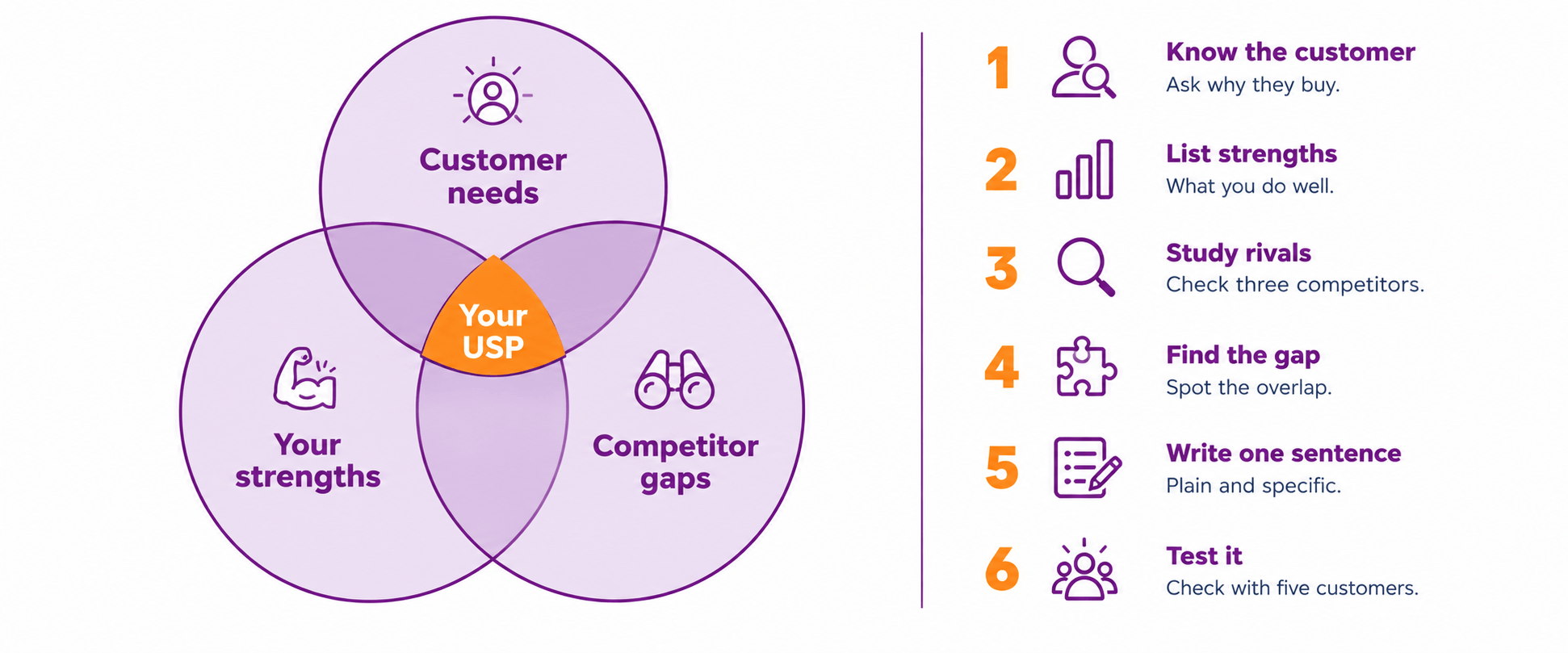
How to find your unique selling proposition in six steps
Six steps lead from research to one clear sentence. Each step builds on the last, so work through them in order.
Step 1: Know the customer. Ask five to ten existing customers why they chose the business. Note the problems they wanted solved and the doubts they had before buying. deAsra’s guide to market research methods explains simple ways to gather these answers.
Step 2: List what the business offers. Write down everything the business does well. Consider the product, the service, the speed, the location, the people, and the way of working. Mark the strengths that customers mentioned in step one.
Step 3: Study competitors. Choose three similar businesses. Read their websites, social profiles, and customer reviews. Note what they promise and which claims appear again and again.
Step 4: Find the gap. Look for the point where three things overlap. The customer needs it, the business can deliver it, and competitors do not promise it clearly. This overlap is the raw material for the USP.
Step 5: Write one clear sentence. Use this simple formula. “For [customer], we offer [main benefit], unlike [alternative] that [gap].” Then trim it into plain words that a customer can repeat. Avoid vague words such as best, quality, or leading.
Step 6: Test and use it. Share the sentence with five customers. Ask whether it is clear and believable. Adjust it based on their answers. Then use it on the website, in social media bios, on packaging, and in sales conversations.
What makes a unique selling proposition strong?
A strong USP passes a few simple tests. Use the checklist below before finalising the sentence.
|
Test |
Question to ask |
Pass if |
| Specific | Does it name a clear benefit? | A customer can picture the result |
| Provable | Can the business keep the promise every time? | Evidence or a guarantee backs it |
| Relevant | Do customers care about it? | Customers mentioned it in step one |
| Different | Can competitors say the same thing? | Rivals do not make the same claim |
| Short | Can it be said in one breath? | It fits in about 20 words or fewer |
If a draft fails two or more tests, return to step four and look for a sharper gap.
How is a USP different from a tagline or a brand story?
These three terms are related but not the same. The table below shows how they differ.
| Term | What it is | Where it is used |
| Unique selling proposition | The core reason to choose the business | Behind all messages, and in sales conversations |
| Tagline | A short, memorable line that hints at the promise | Logo, packaging, and ads |
| Brand story | The longer story of why the business exists | About page and social media |
The USP comes first. A tagline and a brand story then express it in different ways. deAsra’s guide to writing a brand story shows how to build the longer version.
What do unique selling proposition examples look like?
The lines below are illustrative samples only. They show the shape of a good USP for different small businesses. Replace each claim with one that the business can prove.
| Business type | Illustrative USP line |
| Home bakery | Eggless celebration cakes baked to order and delivered the same day within the city. |
| Phone repair shop | Screen repairs done while you wait, with a written guarantee. |
| Tailor | Alterations ready in 48 hours, or the next one is free. |
| Tuition centre | Small batches of six students, so every child gets personal attention. |
| Grocery store | Fresh vegetables from local farms, delivered to your door each morning. |
Each line names a customer need, a clear benefit, and a point of difference. None of them uses vague words.
Where should a business use its USP?
A USP works best when customers see it in many places. Use the same core message on each touchpoint, in the form that suits it.
- The homepage headline and the first lines of the About page.
- Social media bios and profile descriptions.
- Product packaging and printed material.
- The opening lines of a sales pitch or an inquiry reply.
deAsra’s brand identity guide shows how to keep these touchpoints consistent.
What mistakes should a small business avoid?
A few common mistakes weaken a USP. The table below shows what goes wrong and what to do instead.
| Mistake | Why it hurts | Better approach |
| Using vague words like best or quality | Every competitor says the same | Name a specific, measurable benefit |
| Copying a competitor’s claim | Customers see no difference | Find a gap rivals do not cover |
| Competing on the lowest price only | Others can always cut prices further | Pair price with another clear benefit |
| Making several promises at once | The message becomes diluted | Focus on one main promise |
| Promising what the business cannot deliver | Trust falls after the first order | Make only claims the team can keep |
| Never revisiting the USP | The market and customers change | Review it once a year |
Trust is the base of any promise. deAsra’s guide to building customer trust explains how to keep it after the first sale.
Conclusion
A unique selling proposition gives a small business one clear reason to be chosen. It turns a vague wish to stand out into a sentence that guides every message.
The process is simple. Learn what customers want, list the business strengths, study three competitors, and find the gap. Then write one clear sentence and test it.
Start this week by asking five customers why they chose the business. Their answers are the first draft of the USP.
Your next step

Frequently asked questions
What is a unique selling proposition?
It is a short statement of the main benefit a business offers and why it differs from competitors. It answers one question from the customer: why should I buy from you?
What is the USP meaning in marketing?
In marketing, a USP is the single clear promise that sets a business apart. It guides messaging across the website, social media, packaging, and sales conversations.
How to find your unique selling proposition?
Ask customers why they chose the business, list its strengths, and study three competitors. Find the gap where customer needs, business strengths, and competitor gaps overlap. Then write one clear sentence and test it with a few customers.
Is a unique selling point the same as a unique selling proposition?
Yes. Both terms describe the same idea, which is the specific reason to choose one business over another. The word proposition stresses the promise made to the customer.
Can a small business have more than one USP?
A business can have several strengths, but one main promise works best. A single clear message is easier for customers to remember and repeat.