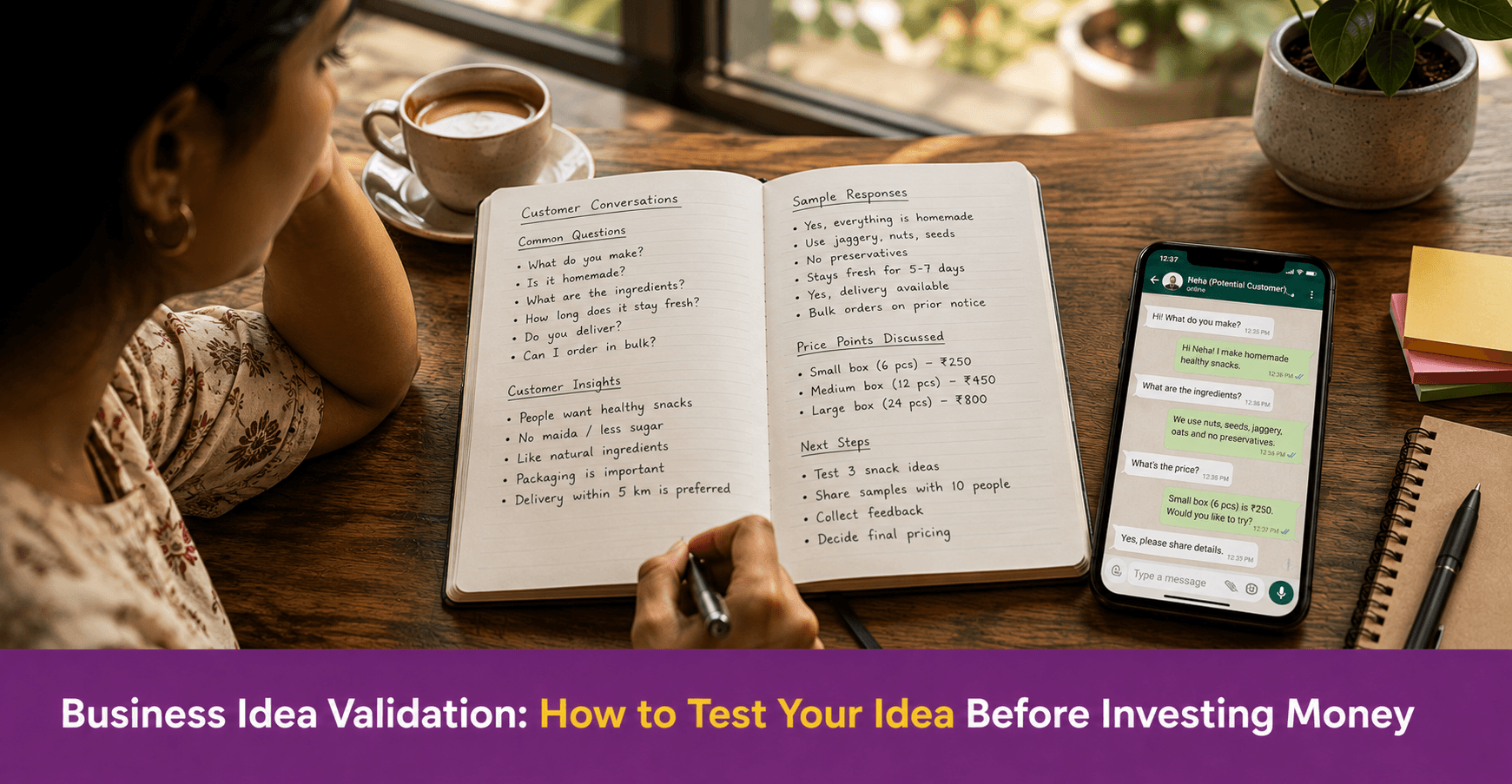
Business Idea Validation: How to Test Your Idea Before Investing Money
Business idea validation tests whether real demand exists for your product or service. It happens before you spend money on stock, equipment, premises, or registration. For first-time entrepreneurs, validation answers one question: will people actually pay for this? This guide covers low-cost validation methods, what signals confirm an idea is worth pursuing, and what signals suggest adjustment is needed.
Key Takeaways
- Business idea validation does not require a finished product. It requires evidence that people will pay for a solution to the problem you are solving
- The fastest validation method is a direct conversation with 10 to 15 people who match your target customer profile — not a survey, but an actual conversation about how they currently handle the problem
- A pre-order, a deposit, or a paid pilot is stronger validation than any amount of positive feedback. Someone who pays, even a small amount, signals genuine intent
- Validation is not a one-time step. It continues through the early months as you learn which customers buy, at what price, and how often
- A business idea that fails validation is not a failure — it is information. Most successful entrepreneurs made significant adjustments based on early validation findings

What Is Business Idea Validation and Why Does It Matter?
Business idea validation tests whether a business idea has real market demand. It happens before significant resources are committed. It is the step between having an idea and building a business around it.
It matters because the most common and costly mistake first-time entrepreneurs make is assuming demand exists. Many businesses launch with a product the founder believes people want. They invest in inventory, equipment, or a shop. Then they discover customers are not interested at the price or format offered. Validation surfaces this information before money is spent.
However, validation does not need to be expensive or time-consuming. A week of structured conversations and a simple test offer reveals more than months of planning without customer contact.
What Does a Validated Business Idea Look Like?
A validated business idea has three characteristics. First, real people with the relevant problem have confirmed it is a genuine and frequent problem for them. Second, those people have shown willingness to pay. They have not just expressed interest — they have taken an action that signals intent. Third, the price they are willing to pay allows the business to operate profitably.
An idea is not validated by positive reactions alone. Friends and family saying “what a great idea” is not validation. A potential customer saying “I would definitely buy that” is not validation. However, a customer placing a pre-order, paying a deposit, or agreeing to be a pilot customer at a specific price — that is validation.
Therefore, the goal of validation is to move from enthusiasm to evidence as quickly and cheaply as possible.
How Do You Validate a Business Idea Step by Step?
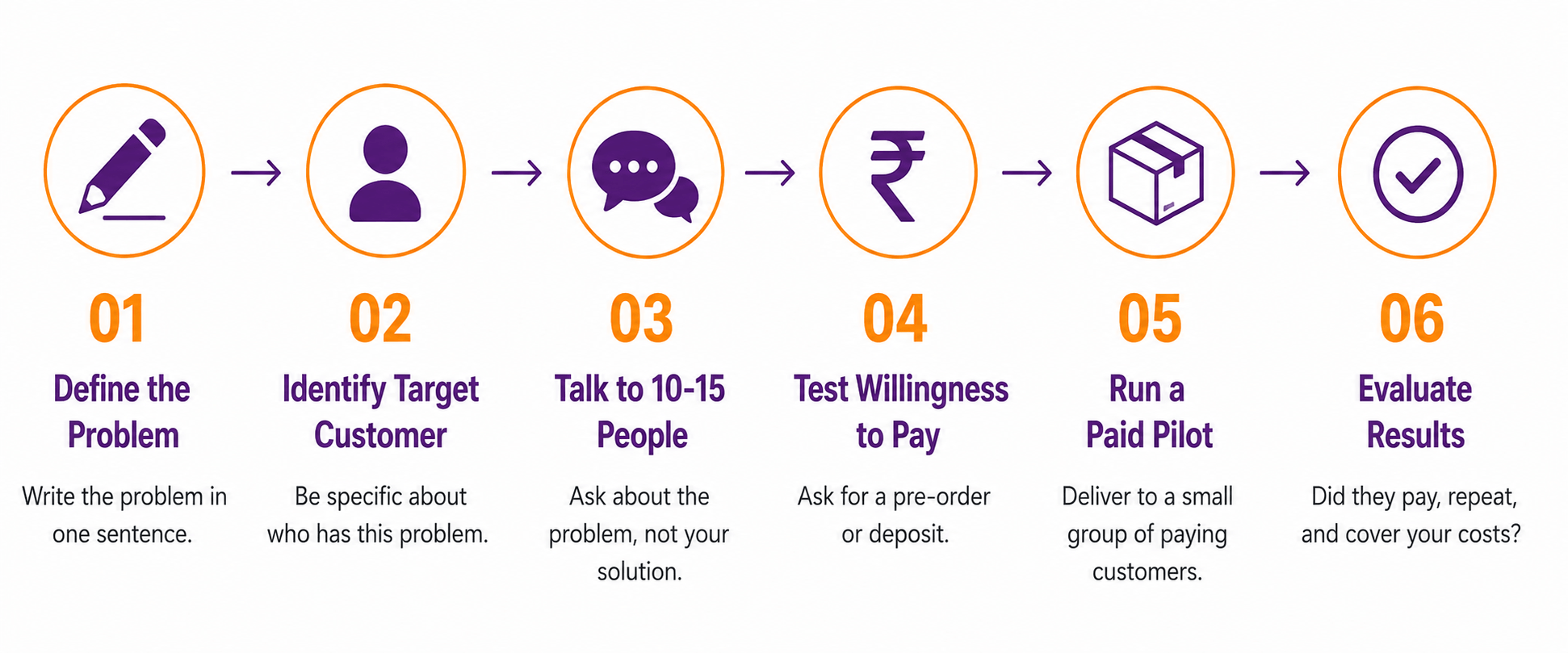
Step 1: Define the problem clearly- Write down in one sentence the specific problem your business solves, for whom, and how often it occurs. This becomes the foundation of every validation conversation and test.
For example: “Working professionals in Pune who cannot cook spend ₹150 to ₹300 per day on outside food that is neither healthy nor home-style.”
Step 2: Identify your target customer specifically- Define who the ideal customer is in concrete terms — their age, location, daily routine, income level, and the specific situation in which they experience the problem. The more specific this definition, the more useful the validation findings will be.
Step 3: Talk to 10 to 15 potential customers- Find people who match your target customer profile. Then have a direct conversation with each of them. Do not pitch your idea. Instead, ask about how they currently handle the problem. Ask what they find frustrating about existing solutions. Ask how much they currently spend on alternatives.
Listen for these signals: do they describe the problem unprompted and with emotion? Do they mention workarounds they use that are inconvenient or expensive? Do they ask when your solution will be available? These are positive validation signals.
Step 4: Test willingness to pay- After understanding the problem, describe your solution briefly. Then ask: “If I offered this for ₹X, would you be interested in trying it?” Note the price at which interest shifts to hesitation. Also ask whether they would pre-order or pay a deposit now. A yes to either is meaningful validation.
Step 5: Run a minimum viable offer- Before building the full business, test a simplified version with a small group of paying customers. A home baker can take five paid cake orders using their existing kitchen before buying a commercial oven. A tiffin service validates before buying packaging in bulk by running a two-week paid pilot with 10 customers.
Step 6: Evaluate what the results tell you- After the pilot or the validation conversations, answer three questions. First, did customers pay without significant hesitation? Second, did the price they paid allow you to cover your costs and earn a margin? Third, did any of them want to continue or order again? If yes to all three, the idea has sufficient validation to proceed. If no to any, identify what needs to change before investing further.
What Are the Fastest Low-Cost Validation Methods?
Different business types suit different validation approaches. Here are the most practical methods for Indian small businesses:
| Validation Method | How It Works | Best For | Cost |
| Customer interviews | Direct conversations with 10-15 target customers about the problem | All business types | Zero |
| Pre-orders or deposits | Offer the product before it is ready and collect payment or commitment | Product businesses | Zero to low |
| Paid pilot | Deliver the service to a small group of paying customers before full launch | Service businesses | Low |
| Landing page test | Create a simple page describing the offer and measure how many people inquire or sign up | Online or digital businesses | Zero with free tools |
| Social media test post | Post about the product on Instagram or WhatsApp and measure response and inquiries | Any business with an existing audience | Zero |
| Google Trends check | Check whether search interest in the product or problem is growing, stable, or declining | Any business | Zero — use trends.google.com |
Of these, customer interviews and a paid pilot are the most reliable. However, a Google Trends check combined with direct customer conversations covers most of what a first-time entrepreneur needs to decide confidently.
What Are the Signs That a Business Idea Needs Adjustment?
Not every validation exercise produces a green light. However, a failed validation is more useful than an untested assumption. Here are the most common adjustment signals:
Customers are interested but not willing to pay your target price: This suggests the value proposition is not strong enough at that price, or the wrong customer segment is being targeted. Try adjusting the price, the format, or the target customer profile.
Customers already have a solution they are satisfied with: If potential customers are happy with a current solution, your business needs a clear reason for them to switch. Without a specific advantage over the existing solution, the business will struggle to acquire customers.
The problem exists but is not frequent enough: If customers experience the problem only occasionally, they are unlikely to build a regular buying habit. Validation should reveal how often the problem occurs and whether that frequency supports a sustainable business.
The price customers are willing to pay does not cover costs: If the market price does not allow profitable operation, the cost structure needs to change before proceeding. Not after investing in full-scale operations.
Conclusion
Business idea validation replaces assumption with evidence. It is the step between having an idea and committing money to it. Therefore, before buying stock, signing a lease, or registering, spend one to two weeks talking to potential customers and running a small paid test.
Look for three signals: paying customers, repeat interest, and a price that covers costs with a margin. In addition, the absence of these signals is equally informative. It tells you what needs to change before investment is justified.
However, validation is not a guarantee. It reduces risk, not uncertainty. A validated idea still requires execution, consistency, and adjustment as the business grows and the market responds.
Your Next Step

Frequently Asked Questions
What is business idea validation and why is it important?
Business idea validation tests whether real demand exists for your product or service before you spend money on it. It matters because most new businesses fail not because the product is poor. They fail because the founder assumed demand without testing it. Validation surfaces this information cheaply — through customer conversations and a small paid test — before significant money is committed.
How do I validate a business idea with no budget?
Talk directly to 10 to 15 people who match your target customer profile. Ask how they currently handle the problem, what frustrates them about existing options, and what they spend on alternatives. Then describe your solution and ask whether they would pay for it at a specific price. This zero-cost approach produces more useful validation data than any survey or report.
What is the difference between market research and business idea validation?
Market research gathers information about the broader market — size, trends, competitors, and customer demographics. Business idea validation tests whether your specific idea, at your specific price, will attract paying customers in your specific location. Both are useful. However, validation is more direct. It produces evidence of actual purchase intent, not just information about the market.
How long does business idea validation take?
A basic validation — 10 to 15 customer interviews plus a small paid pilot — takes one to two weeks. This is enough to identify whether genuine demand exists and at what price. More complex validations, such as testing multiple product formats or targeting multiple customer segments, take longer. However, most first-time entrepreneurs can complete sufficient validation to make a confident decision within two weeks.
What counts as proof that a business idea is validated?
The strongest proof is a paying customer. This is someone who pays for your product or service before the full business is operational. A pre-order, a deposit, or a paid pilot customer all count. Positive verbal feedback and expressions of interest do not count as validation. Also, the price must allow the business to cover costs and earn a margin. An idea that generates customers at an unprofitable price is not yet validated.