
Credit gap for unincorporated enterprise: Case of a low-hanging small fruit
India’s most-cited MSME credit gap is about ₹25 lakh crore, from IFC (2018) and the 2019 U. K. Sinha committee report from RBI. For the 7.7 crore unincorporated enterprises that make up the overwhelming majority of the country’s non-farm business population, the number that comes out of the 2025 enterprise survey is ₹0.57 lakh crore — some 46 times smaller. The difference is not a disagreement about correctness of estimate, and it is not a disagreement about which enterprises are being counted. It is a difference about what question a credit gap answers.
1. Whose gap, and which question
A credit gap is a counterfactual, not an observation. What can be observed is how much credit enterprises hold; a gap exists only relative to a claim about how much they ought to hold. The published Indian estimates make that claim by modelling the need based on business characteristics: IFC’s 2018 study uses capital expenditure plus three months of operating costs for essentially every commercially viable MSME, and arrives at an addressable gap of ₹25.8 lakh crore. The RBI’s Expert Committee under U. K. Sinha reports ₹20–25 lakh crore in 2019, but its demand figure is footnoted to IFC (2018) — so the two most-quoted Indian numbers are one estimate, not two.
IFC defines unregistered MSMEs as those that do not file with District Industry Centres, and attributes ₹31.34 trillion of its ₹36.7 trillion of addressable demand — 85% — to them. That is the same tier ASUSE covers, and ASUSE’s universe is the larger of the two. What differs is the conditioning. Apply the benchmarks used in this post to every enterprise rather than only to those reporting credit as a top-priority problem, and the estimate rises to ₹11.1–13.2 lakh crore — within a factor of two of the published figures. Almost the entire difference, between ₹11.1–13.2 lakh crore and ₹0.57 lakh crore, arises from the focus of the query, not from the population itself.
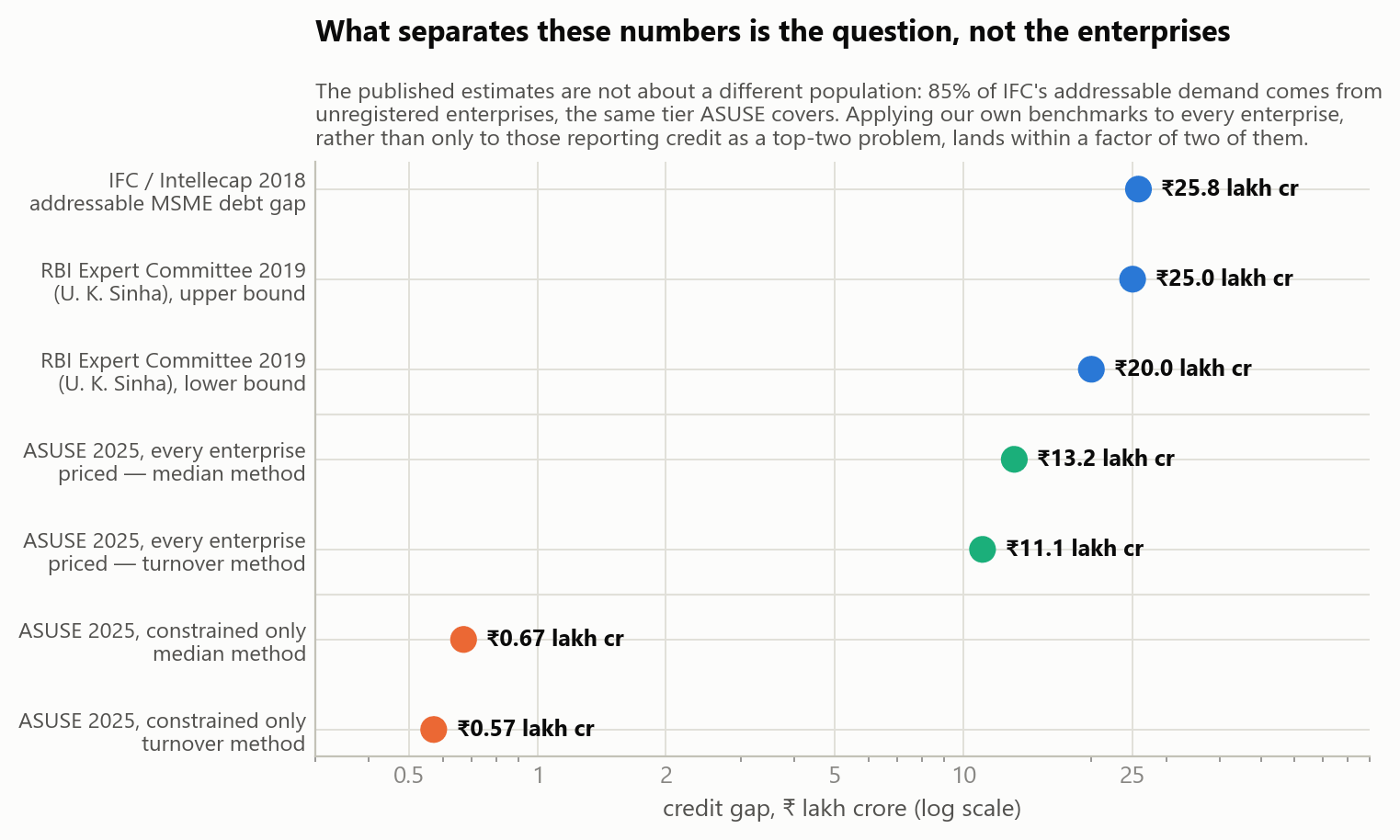
Figure 1. Published estimates and this one, with the conditioning removed and restored. Logarithmic axis.
2. What the survey can and cannot see
ASUSE 2025 enumerates 658,840 enterprises representing 768 lakh unincorporated non-agricultural units. It records credit outstanding at the enterprise by source — ₹191,076 crore institutional, a further ₹49,263 crore from moneylenders and family — and turnover for every unit. Crucially, Block 2 asks whether the enterprise faced any problem in the last year and, if so, records at most two of the most severe. Credit, unavailability or high cost, is one of nine problems considered.
This is a severity ranking, not a needs assessment. An enterprise that would use a loan but is more troubled by power cuts or unpaid bills is not counted as credit constrained. Only 143 lakh enterprises (19% of the universe) reported facing any problem at all, and among those, credit was a top-two concern for 39 lakh — 27%. Non-recovery of financial dues is named more often than credit, and by more enterprises as their single most severe problem, which is itself a working-capital complaint in different clothing.
So what follows is a priority-need gap and a lower bound: the cost of financing the 38.8 lakh enterprises (5.1% of the tier) for which credit is a binding, top-priority constraint. For a lending programme with finite capacity that is arguably the more useful target than total notional unmet demand. It should not be called the credit gap of the sector.
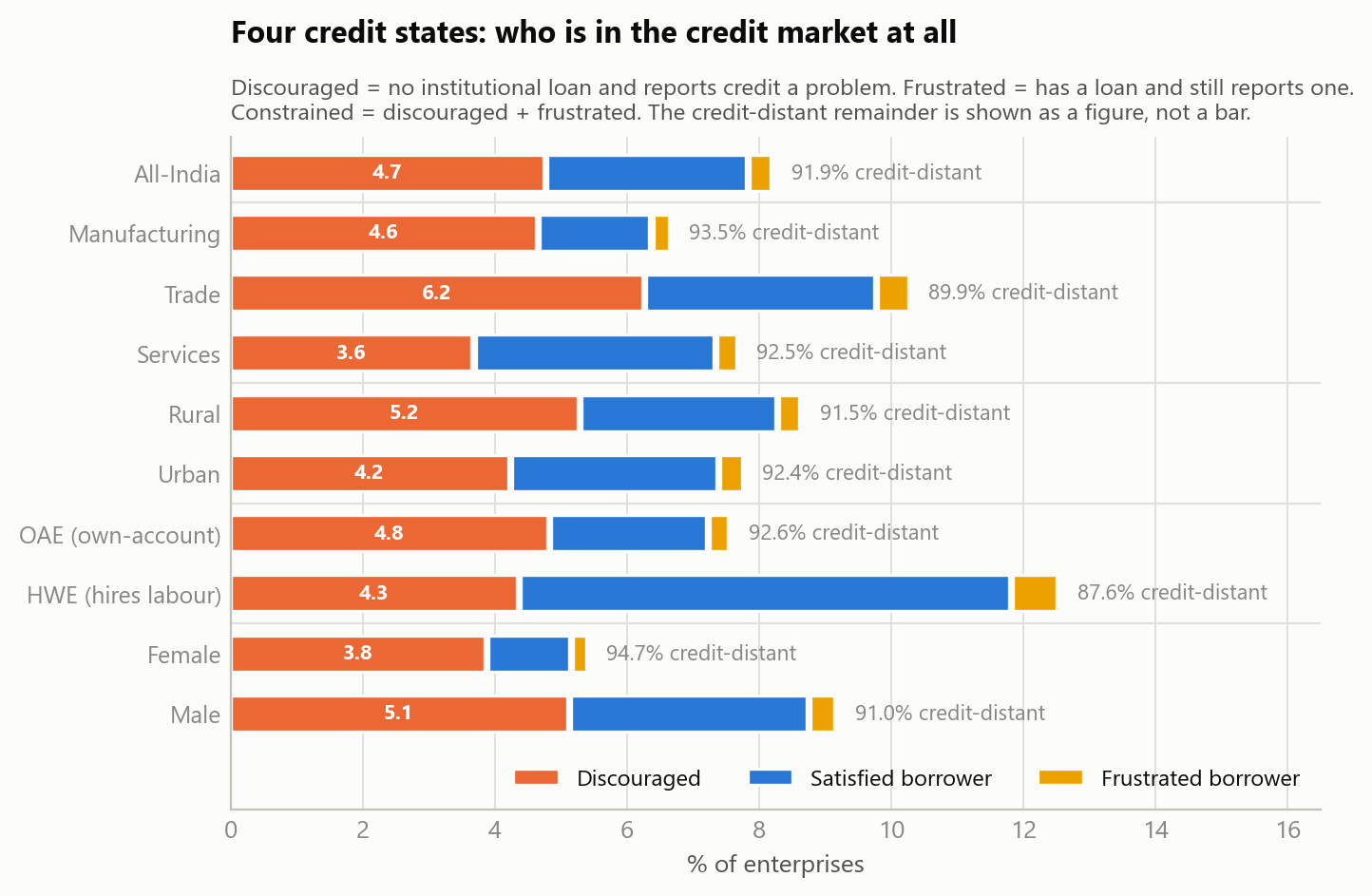
Figure 2. Four credit states, from whether an enterprise borrows and whether it ranks credit among its two worst problems. The credit-distant majority is printed, not drawn.
3. The estimate
Constrained enterprises are compared against what comparable served enterprises in the same sector actually hold. Method A gives each the median institutional loan of satisfied borrowers in its sector; Method B gives it their credit-to-turnover ratio, applied to its own turnover. Enterprises already above benchmark contribute zero, so both are conservative. The results are ₹56,584 crore and ₹66,512 crore — 23–26% of the credit this tier would then hold, and an implied ticket of ₹1.46–₹1.71 lakh per enterprise. That is MUDRA scale, not SME lending.
Proportionally the shortfall is concentrated where enterprises are smallest and least formal. Own-account units carry a gap equal to 41–57% of their financed market against 5–15% for enterprises that hire; rural units 39% against 18% urban on the median method; single-worker enterprises 38% falling to 7% at ten workers and above. Across states it runs from 2% in Kerala to 69% in Bihar and 59% in Uttar Pradesh, which has the largest enterprise population in the country and the lowest institutional borrowing rate of any major state at 0.92%.
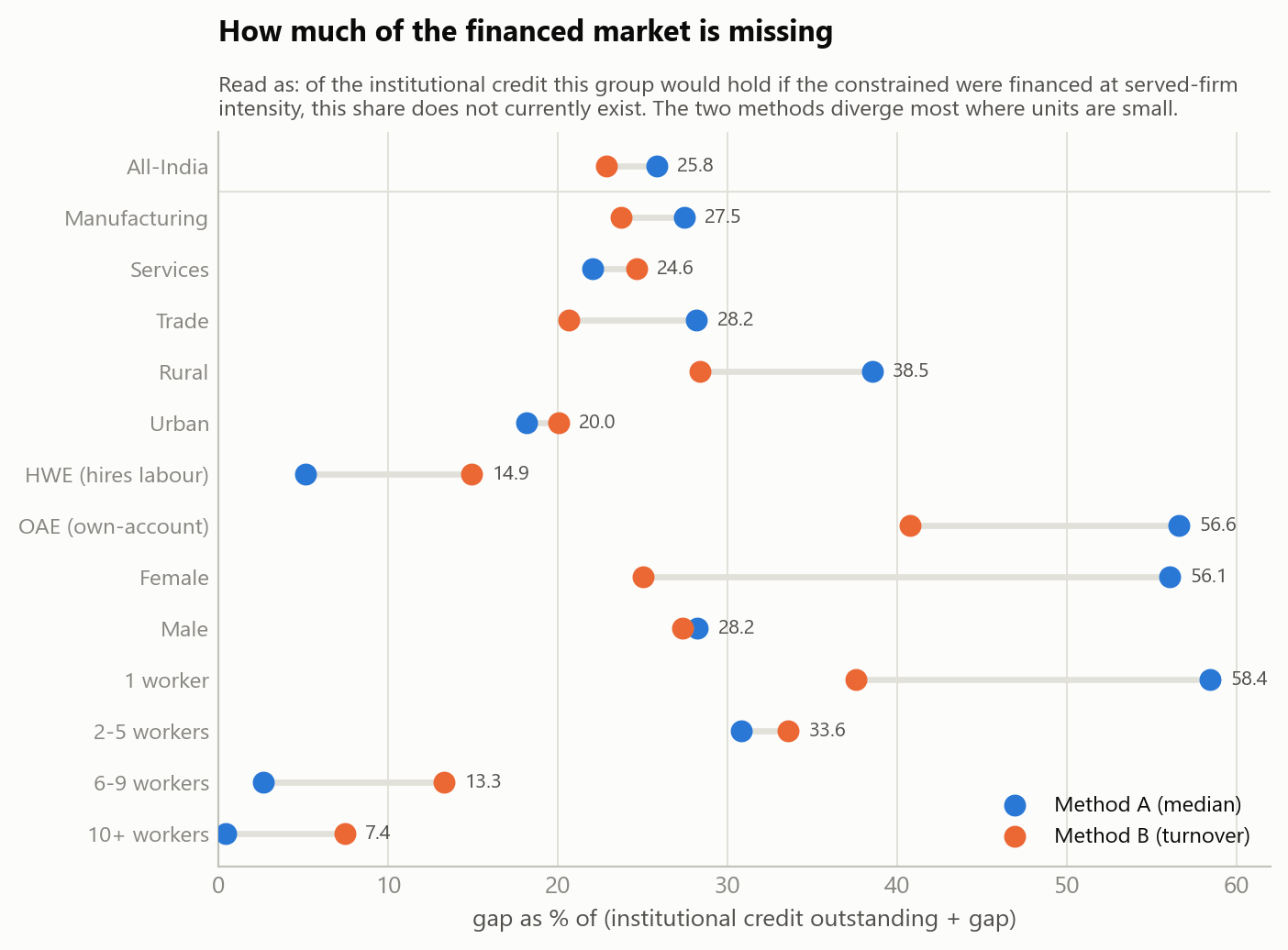
Figure 3. The gap as a share of the financed market, every cut, both methods.
At activity level the pool is concentrated rather than diffuse, which matters for anyone designing a product. Retail trade alone accounts for 29% of the national gap; the six largest activities — retail trade, food & beverage service, land transport, wholesale trade, food products, and repair of goods — account for 67% between them. These are not exotic segments. They are the shops, kitchens, vehicles and workshops of the ordinary local economy, and the enterprises in them are asking for working capital in amounts a bank branch would recognise.
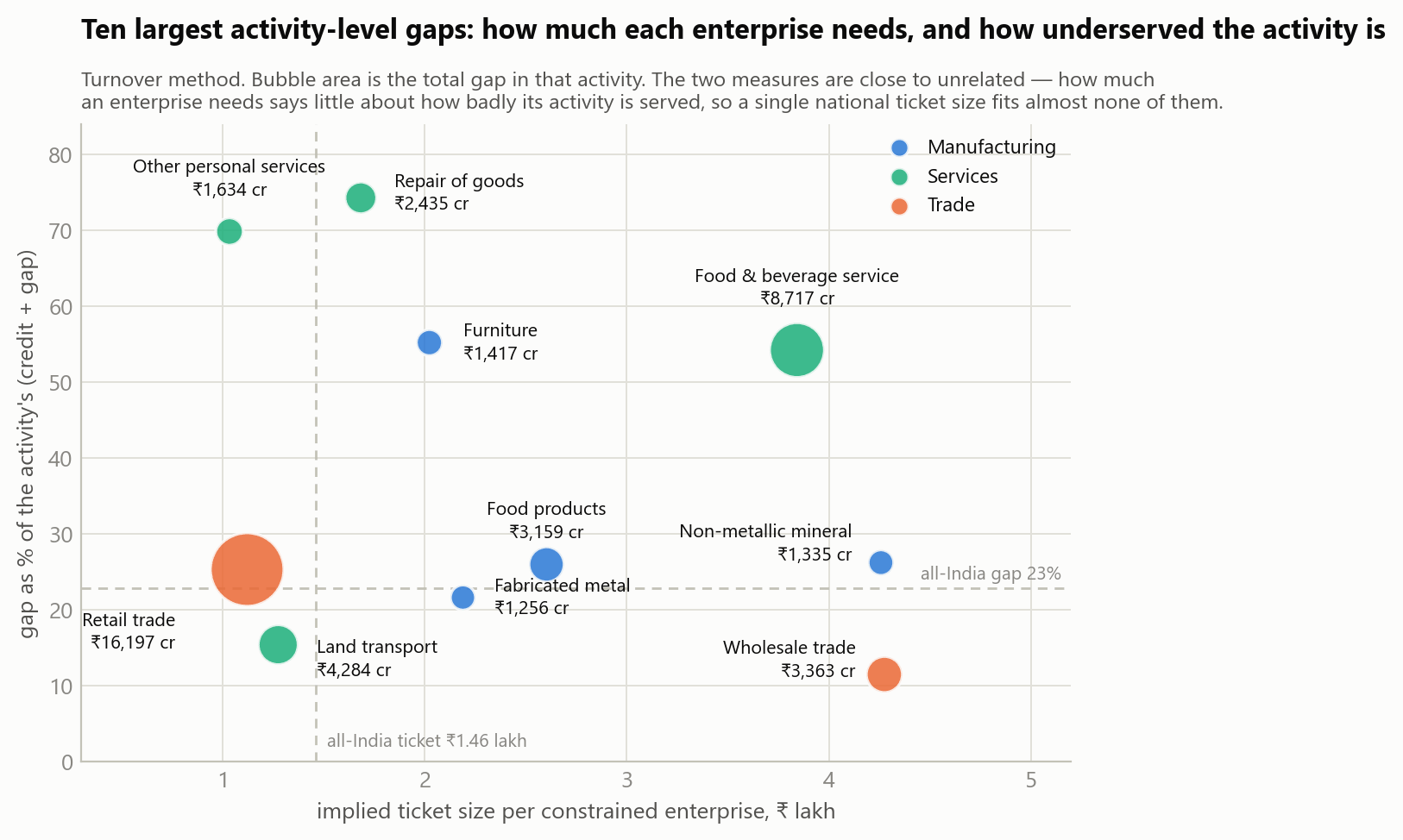
Figure 4. Credit gap – Sectoral view
Women proprietors are where the two methods part company, and the divergence is the finding. Women run 205 lakh proprietary enterprises and borrow at 1.42% against 3.93% for men, but the shortfall prices at ₹13,459 crore on the median method and only ₹3,522 crore on turnover — a factor of 3.8, against almost no gap between methods for men. Their enterprises are small own-account units whose turnover cannot carry a median-sized loan. Financing them to the median is a commitment four times larger than financing them in proportion to what they sell, and which of those a scheme intends is a decision the single-number version hides.
4. The constrained are not smaller versions of the served
It matters who ends up in the constrained pool, because both methods benchmark them against enterprises that borrow. They are not the same animal. A satisfied borrower has roughly twice the median turnover of a discouraged one (₹8.93 lakh against ₹4.20 lakh), twice the workers, and about twice the value added per worker (₹281,786 against ₹133,438).
But the margin runs the other way. Value added as a share of turnover is 21.5% among discouraged enterprises and 25.2% among the credit-distant, against 14.6% among satisfied borrowers. Lenders are not selecting high-margin businesses; they are selecting large ones with high output per worker. That is a rational thing for a lender to do — scale and labour productivity are what service a loan — but it means the benchmark is demanding, and the median method is the more exposed of the two, since it hands a fixed sector loan to a firm turning over a fraction of the benchmark firm’s revenue.
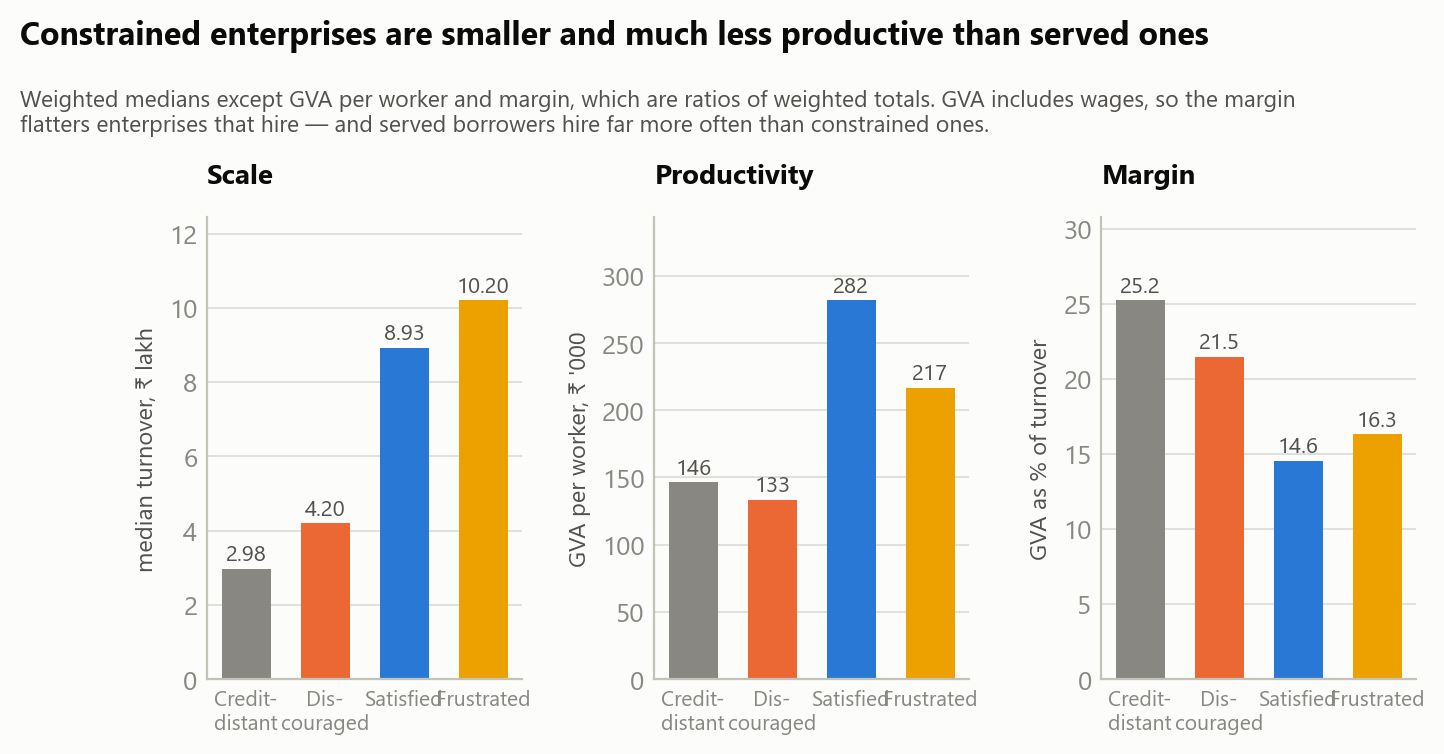
Figure 5. The four credit states on scale, productivity and margin.
The borrowers who already have credit and still call it a top-two problem make the same point from the other side. They hold a smaller median loan than satisfied borrowers (₹1.30 lakh against ₹1.80 lakh) on a larger median turnover. They are marginal borrowers with a foot in the door, not successful firms outgrowing their bank.
A cross-section cannot say whether these enterprises are unproductive because they are starved of credit or excluded from credit because they are unproductive. The association is solid; the direction of causation is not identified here, and nothing below assumes one.
5. What it would cost, and what it would buy
Set against the banking system the sum is trivial. The entire gap is 0.75% of business bank credit in India and 0.32% of all bank credit outstanding. No plausible constraint on lendable funds explains why a shortfall this size persists. This is not a resource question. It is a distribution question. At the same time, it is important to ask why this low hanging fruit remains yet unpicked. Is it because terms at which this credit can be made available are not acceptable to enterprises or it is simply a matter of time?
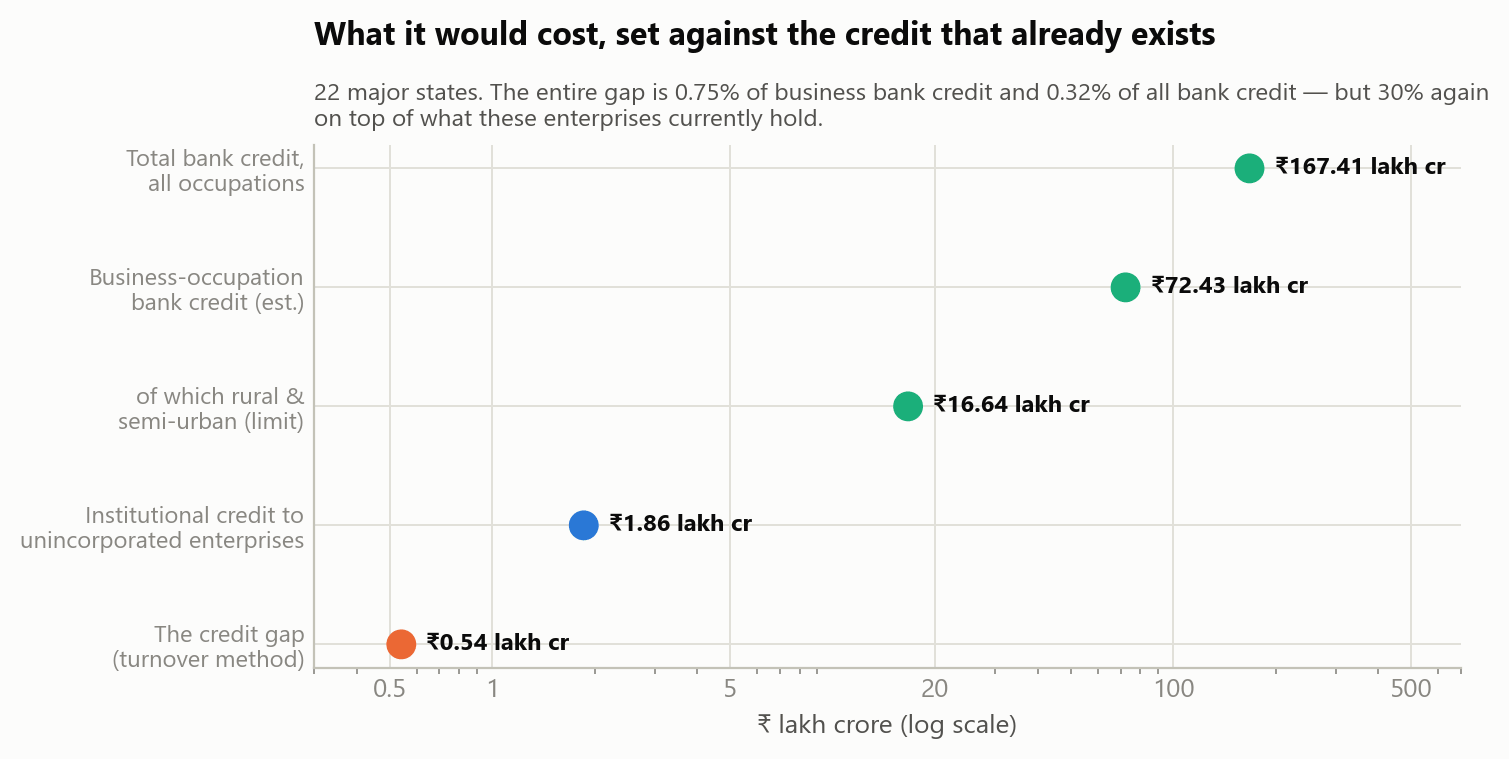
Figure 6. The gap set against the credit stock it would have to come out of.
But it is worth being honest about what filling it would deliver. Credit to the tier would rise by about 30% on the turnover method, 35% on the median. Value added would not. Constrained enterprises account for 4.8% of the tier’s ₹19.6 lakh crore of value added, so even if newly-financed enterprises used credit exactly as productively as currently-financed ones — which the previous section suggests they would not — the sector’s value added would rise by about 3.3%. Discount for the productivity gap and it is nearer 1.6%. But credit is a stock and value added is a flow. In rupee terms, filling the credit gap of ₹ 0.57 lakh crore would provide added gross value of ₹0.32 lakh crore a year, which is certainly not unimpressive.
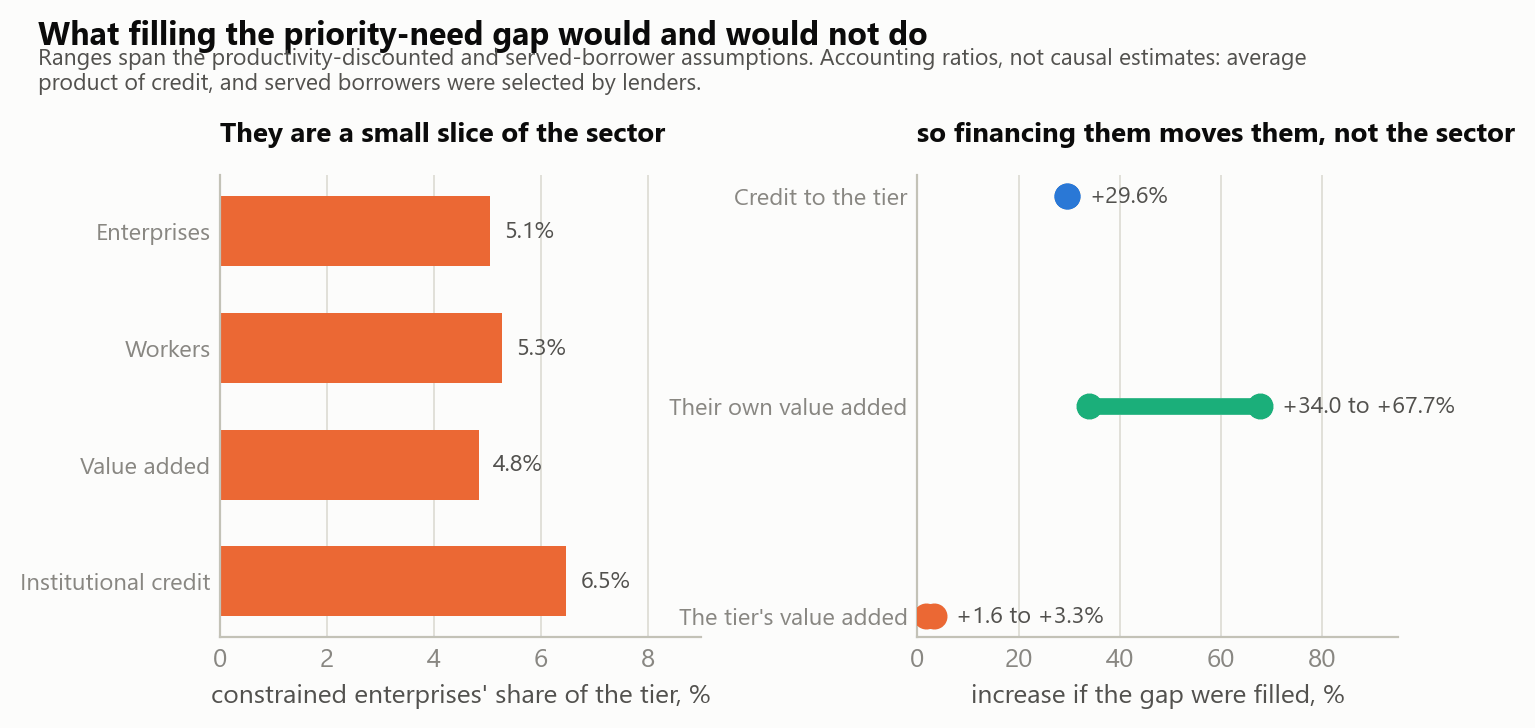
Figure 7. Constrained enterprises’ share of the sector, and what financing them would move.
For the enterprises themselves it is a different matter entirely. Their own value added would rise by 34–68%. That is the case for doing it, and it is a distributional case rather than an aggregate one: a large gain for five per cent of enterprises, which is about 39 lakh enterprises.
The employment arithmetic runs the same way. Financing the constrained pool at the turnover benchmark would support something like 23 lakh additional workers, with a defensible range of 11 to 46 lakh depending on whether the incremental activity ends up looking like the enterprises being financed or like the ones already borrowing. Restated per enterprise it is about 0.6 of a worker each — constrained units going from an average of 1.7 workers to 2.3, against 3.1 among enterprises that already borrow. That is the honest scale of it: not a national employment programme, but a modest thickening of a very large number of very small businesses. These are also, overwhelmingly, not payroll jobs — they are proprietors and family labour in enterprises averaging under two workers.
These are simply back-of-envelope calculations and more rigorous approach will spell out different numbers. What is likely to remain same is the direction – there is a small segment of enterprises for which more credit would make a considerable difference and will also have consequences on their employment generation. But in the total scheme of things, even for unincorporated enterprises, what needs to happen is an achievable magnitude with returns which are modest, but not inconsequential.
Interestingly, the ₹0.57 lakh crore institutional credit gap is strikingly close to the ₹0.5 lakh crore of outstanding credit the tier holds from non-institutional sources — though the constrained enterprises themselves account for only ₹3,484 crore of that, so this is a comparison of magnitudes rather than a straight substitution. What the constrained do show is a heavier reliance on such sources: 11.6% of discouraged enterprises borrow non-institutionally, against 4.5% of the credit-distant and 5.5% of satisfied borrowers. Perhaps, it is not the problem of interest rates only. If creditworthiness of these enterprises can be demonstrated, more credit will readily flow, substituting likely expensive non-institutional borrowing at the margin.
Three things follow for policy. First, because the constrained differ from the served, this is not a matter of extending the same product to more people — it is a question of finding terms of supply that fit smaller, lower-productivity, thinner-collateral borrowers, at an average ticket under two lakh rupees. Second, it is not solely credit policy. Lenders are currently selecting the more efficient enterprises, and doing so rationally; anything that raises the productivity of the constrained pool — reliable power, faster payment of dues, market access — widens the set of enterprises that are bankable on ordinary terms, and does so without asking anyone to lend against their judgement. Third, and consequently, closing this gap has to be compatible with market discipline. The selection we observe is not obviously a failure. A programme that overrode it wholesale would be lending into precisely the segment where output per worker is lowest, and the aggregate return, as the arithmetic above shows, would be modest.
The honest summary is that this is a small but well-identified – on gender, sector, location dimensions – problem affecting a specific five per cent of India’s smallest enterprises, worth solving on its own terms and unlikely to move any national aggregate. That is a less exciting claim than ₹25 lakh crore. It has the advantage of being solvable.
Method, benchmarks, sensitivities, sectoral and state detail, and the full set of caveats are in the companion technical note.