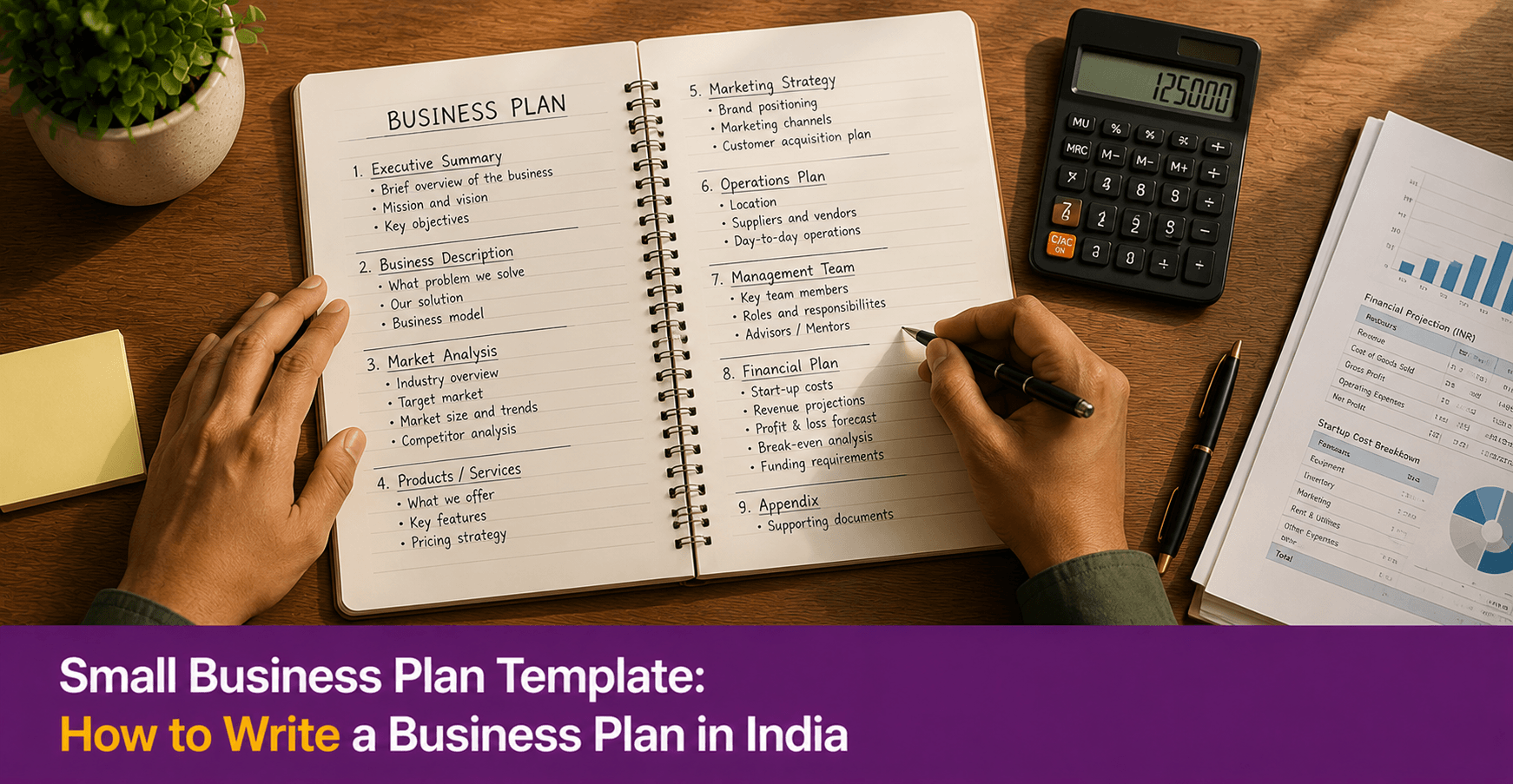
Small Business Plan Template: How to Write a Business Plan in India
A business plan is a written document that describes what your business does, who it serves, how it makes money, what it costs to run, and what you want to achieve. First-time entrepreneurs in India often skip this step, assuming it is only needed for bank loans. A business plan is equally useful as a thinking tool. It forces you to identify gaps, test assumptions, and make decisions before spending money. This guide walks you through a simple small business plan template with Indian examples.
Key Takeaways
- A business plan does not need to be long or complex. A clear, honest one to two page document covering your idea, customer, revenue model, costs, and goals is enough for most small businesses
- The most important section of any business plan is the customer definition. A business that cannot clearly describe its customer has a planning problem, not a writing problem
- A business plan should include realistic financial projections, not optimistic ones. Banks and scheme evaluators check whether your numbers reflect reality
- Writing a business plan before investing in stock, equipment, or premises often reveals assumptions that need testing before money is spent
- A business plan is a living document. Update it every six to twelve months as the business grows and circumstances change

What Is a Business Plan and Why Does a Small Business Need One?
A business plan answers six questions: what does the business do, who does it serve, how does it make money, what does it cost to run, who runs it, and what does it aim to achieve. Answering these questions in writing forces clarity that verbal planning does not.
First-time entrepreneurs often discover the value of a business plan after a problem arises. A pricing model that does not cover costs, a customer who does not buy as expected, or a cash flow gap that appears three months in — these surface during planning. Identifying them on paper costs nothing to fix. Discovering them after launch does.
A business plan also serves practical purposes. Banks require one for loan applications. Government schemes like PMEGP and Mudra loans require a project report or business plan as part of the application. Investors and potential partners use it to evaluate the business before committing resources.
What Does a Simple Business Plan Template Include?
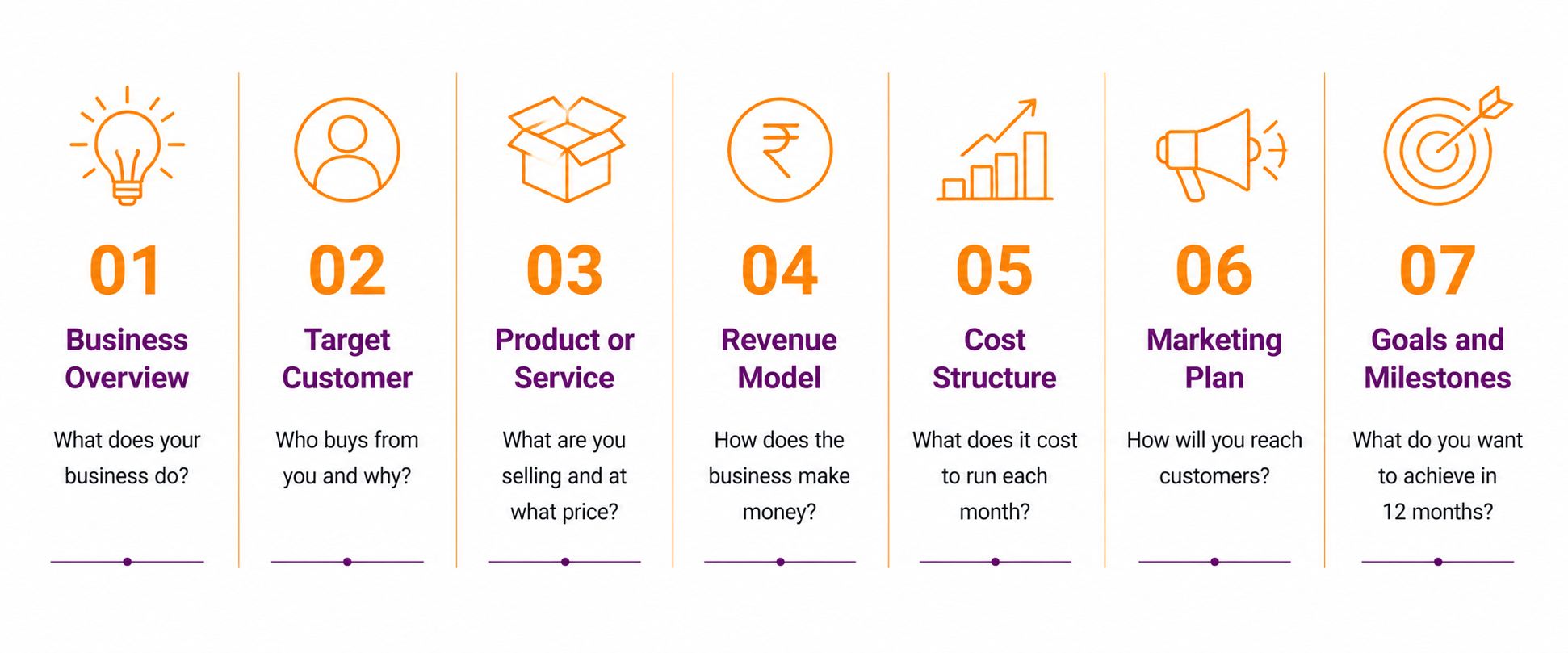
A simple small business plan template has seven sections. Each section answers a specific question about the business.
| Section | Question It Answers |
| Business Overview | What does the business do and what problem does it solve? |
| Target Customer | Who buys from the business and why? |
| Product or Service | What exactly is being sold and at what price? |
| Revenue Model | How does the business make money? |
| Cost Structure | What does it cost to run the business each month? |
| Marketing Plan | How will the business reach its target customers? |
| Goals and Milestones | What does the business aim to achieve in the next 12 months? |
This structure works for any type of small business — product-based, service-based, food, retail, manufacturing, or home-based. Adjust the depth of each section based on the complexity of the business and the purpose of the plan.
How Do You Write Each Section of a Business Plan?
Section 1: Business Overview- Write two to three sentences describing what the business does and the problem it solves. Keep it factual and specific.
Example: “Priya’s Kitchen is a home-based tiffin service in Kothrud, Pune. It delivers fresh, home-cooked meals to working professionals and students Monday to Saturday. It addresses the need for healthy, affordable daily meals among people who cannot cook at home during the working week.”
Section 2: Target Customer- Describe your ideal customer in specific terms — their age range, location, income level, and what drives their purchase decision. The more specific this section is, the more useful the rest of the plan becomes.
Example: “Target customers are working professionals aged 22 to 40 living within 3 kilometres of Kothrud. Pune, earning ₹20,000 to ₹50,000 per month, who value home-style cooking and want a reliable daily meal option without the cost or complexity of restaurant delivery.”
Section 3: Product or Service- List what you are selling, the variants available, and the price for each. Include what makes your offering different from alternatives already available to the customer.
Example: “Standard tiffin plan: dal, rice, sabzi, roti — ₹100 per meal. Premium plan with extra sabzi and dessert — ₹130 per meal. Monthly subscription (26 meals) available at 10% discount. No competitor in the area offers home-style Maharashtrian cooking at this price point.”
Section 4: Revenue Model- Explain how the business generates income. State your pricing, expected number of customers, and projected monthly revenue at different customer levels.
Example: “At 30 customers on the standard plan and 10 on the premium plan: (30 x ₹100 x 26) + (10 x ₹130 x 26) = ₹78,000 + ₹33,800 = ₹1,11,800 gross monthly revenue.”
Section 5: Cost Structure- List all monthly expenses required to run the business. Divide them into fixed costs (same every month regardless of sales) and variable costs (increase with output).
Example fixed costs: Gas cylinder subscription ₹900, packaging ₹2,500, delivery person salary ₹8,000. Total fixed: ₹11,400. Example variable costs: Raw ingredients ₹35 per meal. At 40 customers x 26 meals: ₹36,400. Total monthly cost estimate: ₹47,800.
Section 6: Marketing Plan- State how you will reach your target customer. List the specific channels and the actions you will take in the first 90 days.
Example: “WhatsApp broadcast to existing contacts — Week 1. Instagram page with daily menu posts — from Day 1. Pamphlet distribution in target apartment complexes — Week 2. Referral offer: existing customer gets one free meal for each new customer they refer — from Month 1.”
Section 7: Goals and Milestones State what you want to achieve in the next 3, 6, and 12 months. Make each goal specific and measurable.
Example: “Month 3: 25 active daily customers. Month 6: 50 active daily customers, recover initial setup investment. Month 12: 80 daily customers, hire one additional cooking assistant, apply for Udyam Registration and Mudra loan for kitchen equipment upgrade.”
What Financial Information Should a Business Plan Include?
Include three financial figures at minimum: startup cost, monthly operating cost, and monthly break-even sales.
Startup cost: The one-time investment needed before the business can start operating. This includes equipment, initial stock, licenses, and any setup expenses.
Monthly operating cost: All fixed and variable costs to run the business for one month at your expected sales volume.
Break-even point: The revenue level at which the business covers all costs without profit or loss. This is the minimum the business must achieve each month to be viable.
For a bank loan or government scheme application, you will also need to project revenue and costs over three years. Keep projections conservative and grounded in real market data. Evaluators check whether numbers are realistic, not impressive.
What Makes a Business Plan Credible?
A credible business plan has three qualities: specificity, honesty, and evidence.
Specificity means naming real numbers, real locations, and real customers rather than general statements. “Working professionals in Kothrud, Pune” is specific. “Urban working professionals across India” is not useful at the small business planning stage.
Honesty means projecting realistic rather than optimistic figures. A plan that projects 500 customers in Month 1 with no marketing budget is not credible to a bank or scheme evaluator. A plan that projects 30 customers in Month 1 based on actual conversations with potential customers is.
Evidence means basing your assumptions on something observable. If you claim demand exists, show why. Point to a competitor’s customer queue, a gap in the local market, or feedback from potential customers you have spoken to.
Conclusion
A business plan does not need to be a lengthy formal document to be useful. A clear, honest one to two page plan covering your idea, customer, revenue model, costs, and goals gives you a working foundation before spending money on stock, equipment, or marketing.
The most valuable part of writing a business plan is not the document. It is the thinking it forces. Gaps in your pricing, assumptions about customer behaviour, and underestimated costs all surface during the writing process. Identifying them on paper is significantly cheaper than discovering them after the business has launched.
Your Next Step

FAQs
What should a business plan for a small business include?
A small business plan covers seven sections: business overview, target customer, product or service, revenue model, cost structure, marketing plan, and 12-month goals. Each answers a specific question about how the business works. A one to two page document covering all seven is sufficient for most small businesses.
How do I write a simple business plan for a first-time entrepreneur in India?
Start with your business overview in two sentences, then describe your target customer specifically. List your products or services with prices. Calculate your expected monthly revenue and costs. Define how you will reach customers in the first 90 days. Set three specific goals for months 3, 6, and 12. Keep the language plain and the numbers realistic. A simple plan written honestly is more useful than a complex one written optimistically.
Do I need a business plan to get a Mudra loan or PMEGP grant in India?
Yes. Both the Mudra loan and the PMEGP scheme require a project report or business plan as part of the application. Include your business description, target market, product or service details, cost estimates, and three-year revenue projections. Banks and scheme evaluators check whether the plan is realistic and whether the business has a viable market.
How long should a business plan be for a small business?
A business plan for a small business at the starting stage should be one to two pages. It does not need to be long to be effective. Clarity and honesty matter more than length. A concise plan with specific numbers is more credible to banks and evaluators than a lengthy document with vague projections.
How often should I update my business plan?
Update your business plan every six to twelve months. As the business grows, your costs change, your customer profile becomes clearer, and your goals evolve. A business plan written at launch will not reflect the reality of the business six months later. Regular updates keep the plan useful as a management tool rather than just a document produced once and filed away.