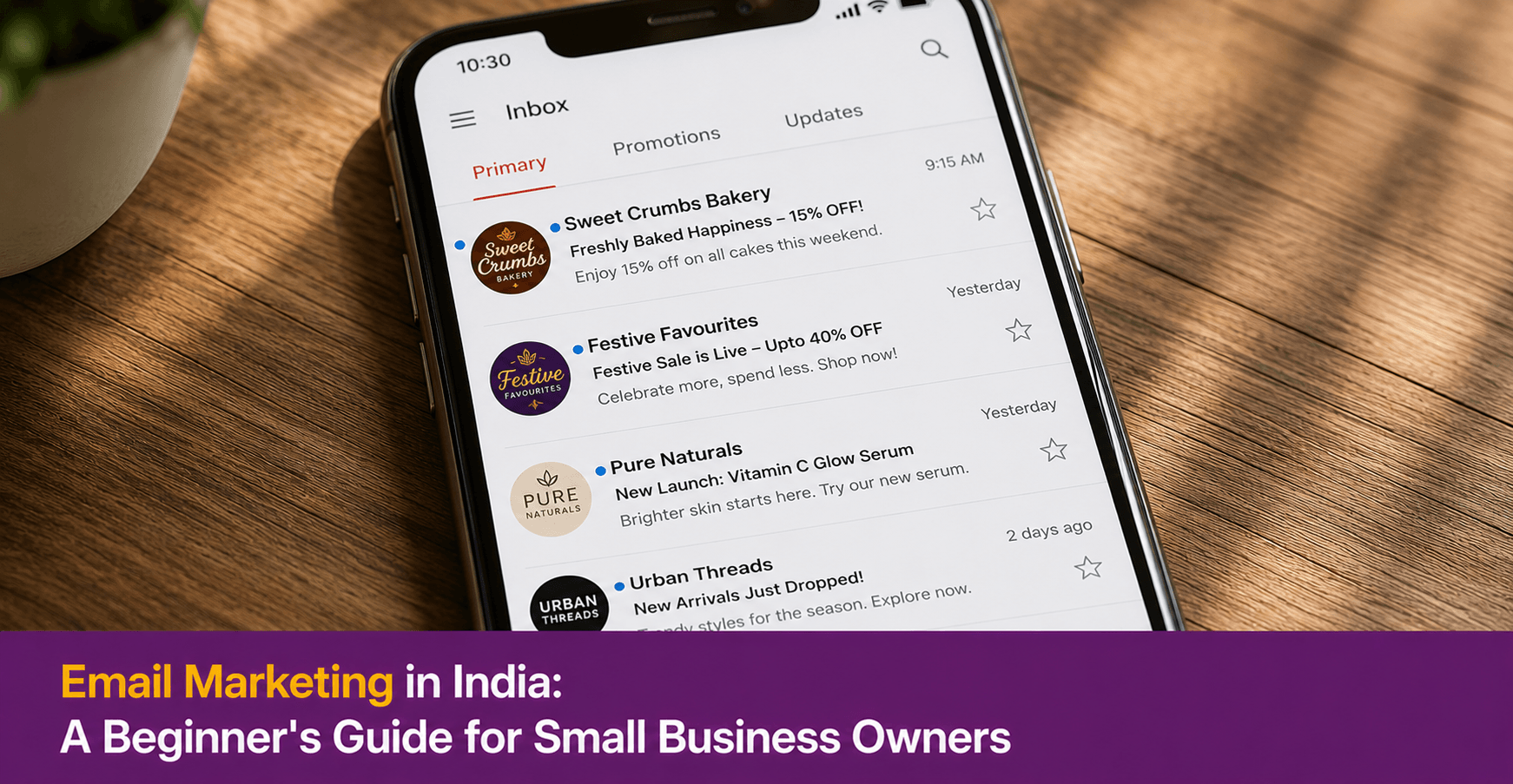
Email Marketing in India: A Beginner’s Guide for Small Business Owners
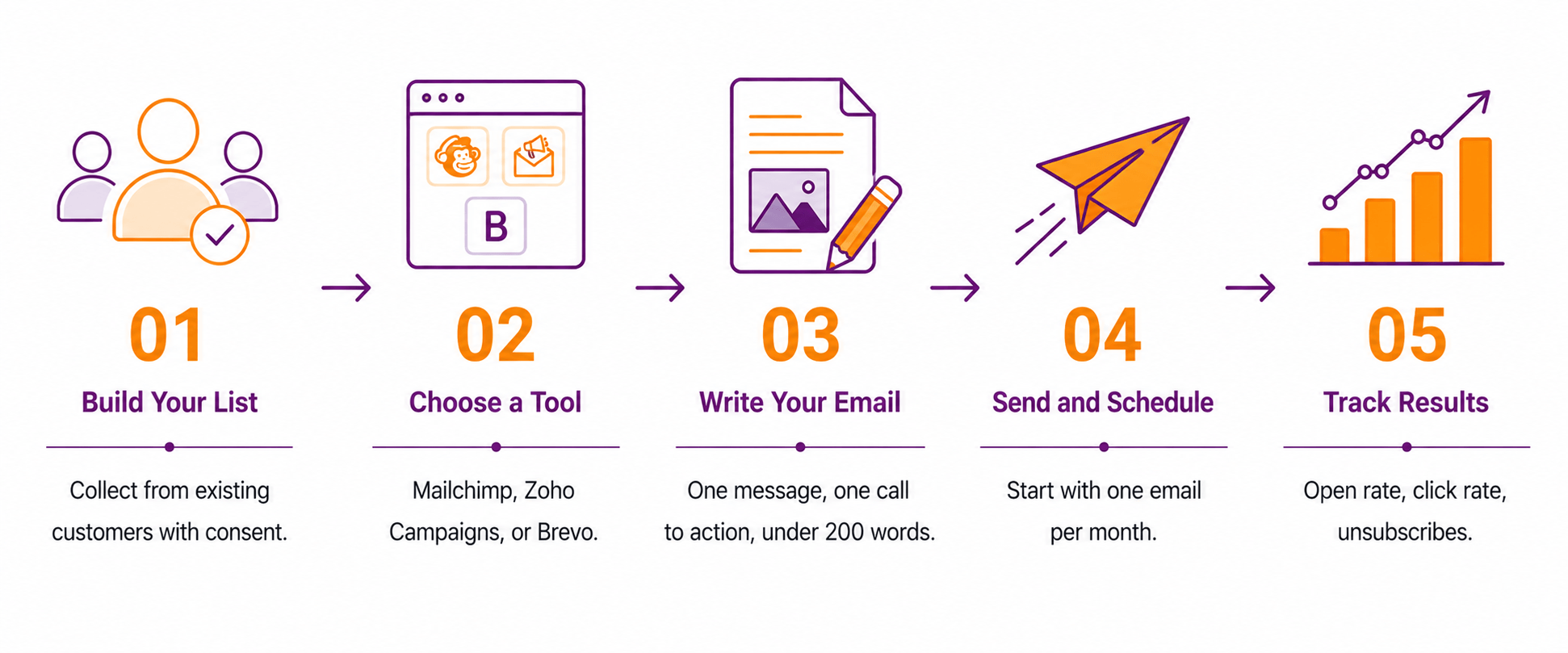
Email marketing is the practice of sending targeted messages directly to a list of customers or prospects via email, to promote products, share updates, or build an ongoing relationship with your audience. For small business owners in India, email marketing is one of the few digital channels where you own your audience — unlike social media, where algorithm changes can reduce your reach overnight. This guide covers how to start email marketing from scratch, including building a list, choosing a tool, writing emails, and measuring results.
Key Takeaways
- Email marketing gives you direct access to your audience without depending on a social media algorithm to distribute your content
- Building an email list starts with collecting addresses from existing customers — not buying a list, which is both ineffective and potentially illegal under Indian data protection rules
- Free email marketing tools like Mailchimp, Zoho Campaigns, and Brevo are sufficient for most small businesses starting out
- An email marketing campaign needs three things: a relevant subject line that gets the email opened, a clear message body with one main point, and a single call to action
- Consistency matters more than frequency. One well-written email per month to an engaged list outperforms four poorly written emails per week

What Is Email Marketing and Why Does It Work for Small Businesses?
Email marketing is sending structured, intentional messages to a list of people who have agreed to receive communication from your business. It differs from a personal Gmail broadcast in two ways: it uses a dedicated email marketing platform that manages subscriptions, unsubscribes, and delivery, and it tracks how many people opened the email, clicked a link, or made a purchase.
It works for small businesses because email reaches customers directly. A WhatsApp broadcast message competes with personal chats. An Instagram post competes with hundreds of other posts in a feed. An email arrives in a dedicated inbox the customer checks with intent. When the email is relevant and well-written, this directness translates into higher engagement and conversion than most other channels.
Email marketing in India is growing as more customers across Tier 1, 2, and 3 cities rely on email for business and personal communication. For product-based businesses, service providers, and subscription-based businesses, email is particularly effective for repeat sales and customer retention.
How Do You Build an Email List for Your Small Business?
Build your email list by collecting addresses from people who already interact with your business. Never buy an email list. Purchased lists have low engagement rates and violate India’s Digital Personal Data Protection Act, 2023, which requires explicit consent before sending marketing communications.
Collect from existing customers: Ask customers for their email address at the point of sale, order confirmation, or delivery. Explain briefly why you are collecting it: “I’ll send you updates about new products and offers.” Most customers who trust your business will share their email willingly.
Add a sign-up option on WhatsApp and Instagram: Include a simple message in your WhatsApp business profile or Instagram bio asking followers to join your email list for exclusive updates or offers. Link to a free sign-up form created using Mailchimp or Google Forms.
Offer something in exchange: A small incentive increases sign-up rates. A home bakery might offer a free recipe. A clothing retailer might offer a first-order discount. A service business might offer a free checklist or tip sheet. The incentive does not need to be expensive — it just needs to feel valuable to your specific customer.
Use your Google Business Profile: Add a link to your email sign-up form in your Google Business Profile posts or product listings. Customers who find your business through local search are already interested in what you offer.
Which Email Marketing Tool Should a Small Business Use?
Choose an email marketing tool based on your list size and the features you need. All three tools below have free plans suitable for small businesses starting out.
| Tool | Best For | India-specific Feature |
| Mailchimp | Beginners — easiest interface | English templates, integrates with Shopify and WooCommerce |
| Zoho Campaigns | Businesses already using Zoho tools | Indian rupee billing, strong India-based support |
| Brevo (formerly Sendinblue) | Businesses with larger lists | Transactional email support, good deliverability in India |
For most Indian small businesses starting email marketing, Zoho Campaigns is the strongest free option. Its free plan allows up to 2,000 contacts and 6,000 emails per month, it has India-based customer support, and it integrates well with Zoho Books if you already use that for accounting.
How Do You Write an Email That Gets Read?
An email that gets read needs three things: a subject line that earns the open, a body that delivers one clear message, and a call to action that tells the reader what to do next.
Step 1: Write a subject line under 50 characters- The subject line determines whether the email gets opened. Keep it specific and relevant to the reader. “New arrivals this week” is weak. “Your Diwali kurta is here — limited stock” is specific. Avoid words like “free,” “urgent,” or multiple exclamation marks — these trigger spam filters.
Step 2: Open with the most important information- Do not build up to the point. State it in the first sentence. Readers scan emails quickly. If the first line does not tell them something relevant, they close the email.
Step 3: Keep the body focused on one message- Each email should cover one topic: one product, one offer, one announcement, or one piece of useful information. Emails that try to cover three or four topics lose the reader’s attention before they reach the call to action.
Step 4: Include one clear call to action- Tell the reader exactly what to do next. “Shop now,” “Claim your offer,” “Reply to this email to book,” or “Visit our store this Saturday” are all clear. Avoid multiple calls to action in the same email — it creates confusion about what the reader should do.
Step 5: Keep it short- Most small business marketing emails should be under 200 words. Customers do not read long emails from brands. They scan for the key message and the action. A short, clear email performs better than a detailed, comprehensive one.
How Often Should You Send Marketing Emails?
Send one to two emails per month when starting out. This frequency keeps your business visible without overwhelming subscribers or triggering unsubscribes.
Once you have data on open rates and click rates, adjust based on what your audience responds to. If open rates are high and unsubscribes are low, your audience is engaged and you can increase frequency. If open rates are falling and unsubscribes are rising, reduce frequency or improve relevance.
The most important thing at the start is consistency. Sending one email every month for six months builds a habit with your audience and gives you enough data to understand what content they find valuable. Sending five emails in the first week and then going silent for two months produces the opposite effect.
How Do You Measure Whether Your Email Marketing Is Working?
Email marketing platforms track four key metrics automatically. Here is what each one tells you:
| Metric | What It Measures | What Is Considered Good |
| Open rate | Percentage of recipients who opened the email | 25-35% for small business lists |
| Click rate | Percentage of recipients who clicked a link in the email | 2-5% is typical; above 5% is strong |
| Unsubscribe rate | Percentage who unsubscribed after receiving the email | Below 0.5% per email is healthy |
| Bounce rate | Percentage of emails that could not be delivered | Below 2% indicates a clean list |
Check these metrics after every email. A low open rate means your subject lines need work. A low click rate means your call to action or body content is not compelling enough. A high unsubscribe rate means the content is not relevant to your list, or you are sending too frequently.
 Conclusion
Email marketing in India gives small business owners a direct channel to their customers that does not depend on a social media algorithm. Starting requires three things: a list of customers who have given consent, a free email marketing tool, and a clear, focused message sent consistently.
The most common mistake beginners make is trying to do too much at once — large lists, complex campaigns, and multiple emails per week before they have figured out what their audience responds to. Start with a small list of existing customers, one email per month, and one clear call to action per email. Build from there based on what the data shows.
Your Next Step
deAsra’s free Digital Marketing Checklist gives you a step-by-step framework for every digital marketing channel — including email — with practical actions for each stage from setup to performance tracking. It is built specifically for Indian small business owners getting started with digital marketing.
FAQs
How do I start email marketing for my small business in India?
Start by collecting email addresses from existing customers with their consent. Sign up for a free tool like Zoho Campaigns or Mailchimp. Create a simple email with one clear message and one call to action. Send it to your list and track the open rate and click rate. Begin with one email per month and increase frequency once you have data on what your audience responds to.
Is email marketing effective for small businesses in India?
Yes, particularly for businesses with repeat customers or a subscription-based model. Email reaches customers directly in their inbox without competing with social media feeds. It is effective for promoting new products, sharing offers, and maintaining customer relationships between purchases. The channel works best when the list is built from genuine customer opt-ins rather than purchased contacts.
What is the best free email marketing tool for small businesses in India?
Zoho Campaigns offers the strongest free plan for Indian small businesses — up to 2,000 contacts and 6,000 emails per month, with India-based support and rupee billing. Mailchimp is the easiest to use for beginners. Brevo suits businesses with larger lists that need to send a limited number of emails daily. All three are free to start and require no technical setup.
How often should a small business send marketing emails?
Start with one email per month. This keeps your business visible without overwhelming subscribers. Once you have six months of data on open rates and unsubscribes, adjust frequency based on audience response. Most small business email lists perform best with two to four emails per month when the content is relevant and well-targeted.
Is it legal to send marketing emails in India?
Yes, but only to people who have given explicit consent to receive marketing communications from your business. India’s Digital Personal Data Protection Act, 2023 requires businesses to obtain clear consent before sending marketing emails. Buying email lists and sending to contacts who did not opt in is a violation of this law and typically produces very low engagement regardless of legality.