
How to Build Customer Trust to Increase Loyalty and Repeat Sales
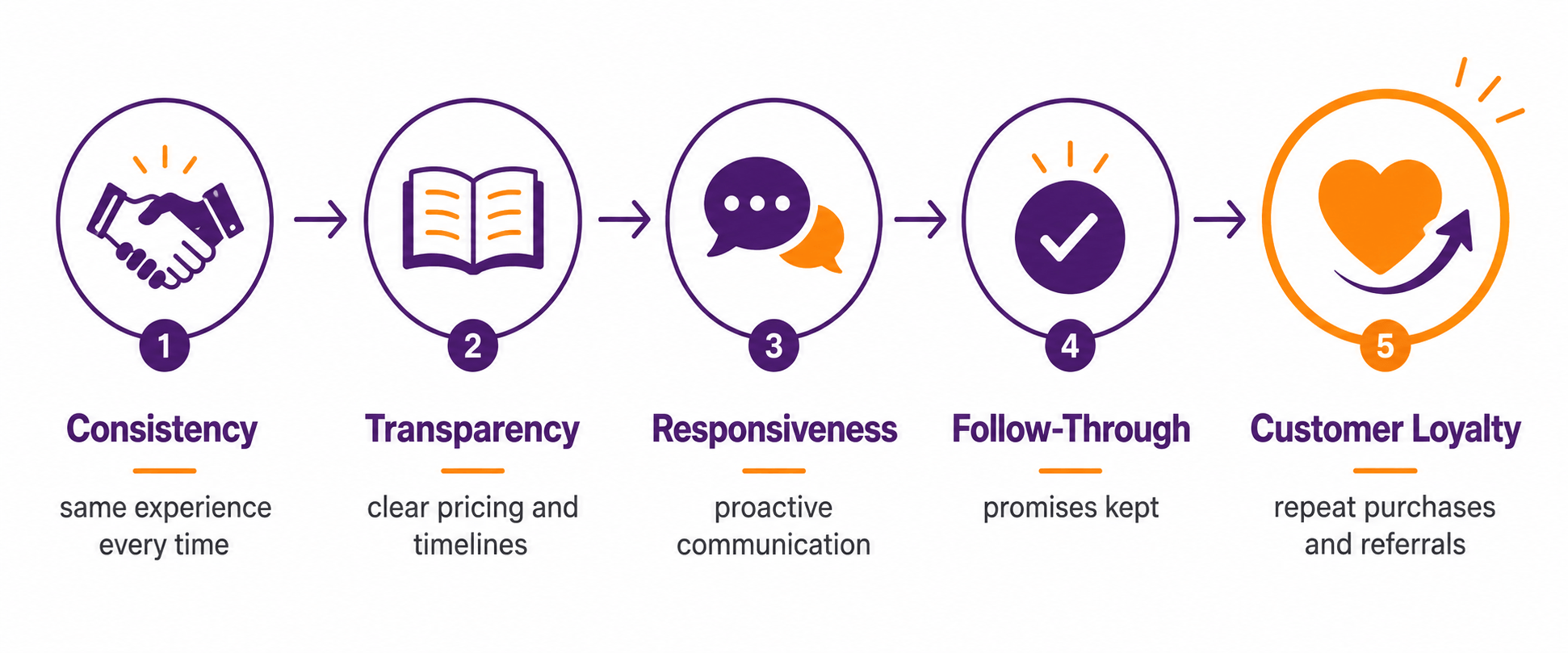
Customer trust is built through consistency, transparency, and reliable follow-through, not through marketing claims alone. A customer trusts a business when their experience repeatedly matches what was promised. Once that trust is established, it directly drives customer loyalty: repeat purchases, higher tolerance for price increases, and word-of-mouth referrals. This guide covers the specific behaviours that build trust and how they translate into measurable customer loyalty.
Key Takeaways
- Customer trust is built cumulatively, through every interaction matching what was promised, not through a single marketing message
- Transparency about pricing, product limitations, and delivery timelines builds more trust than overpromising and underdelivering
- Consistency across every customer touchpoint, from first contact to after-sales support, is what converts a one-time buyer into a repeat customer
- How a business responds to mistakes and complaints has a greater impact on trust than how it behaves when everything goes well
- Customer loyalty is the measurable outcome of trust: repeat purchases, referrals, and reduced price sensitivity

What Builds Customer Trust?
Customer trust is built through five specific behaviours: consistency, transparency, responsiveness, follow-through on promises, and honest handling of mistakes. Each of these is demonstrated through action, not communicated through messaging.
A business earns trust the same way a person does: by doing what they say they will do, repeatedly, over time. A customer who orders a product and receives exactly what was described, on the timeline promised, updates their internal assessment of the business as reliable. A customer who receives something different from what was advertised, or experiences a delay with no communication, updates their assessment in the opposite direction. Trust accumulates or erodes one interaction at a time.
Why Does Transparency Matter More Than Persuasion?
Transparency builds trust faster than persuasive marketing because it removes the customer’s need to verify claims independently. When a business is upfront about pricing, including any additional costs, and honest about what a product can and cannot do, the customer does not need to discover discrepancies later.
Overpromising creates a trust deficit even when the core product is good. A business that advertises “guaranteed results in 7 days” when the realistic timeline is 3 weeks creates disappointment regardless of whether the eventual outcome is positive. The customer’s trust is damaged by the gap between expectation and reality, not by the quality of the result itself.
Transparent pricing, honest delivery timelines, and clear communication about product limitations consistently outperform persuasive language in building long-term customer relationships. Customers remember whether a business was straightforward with them more than they remember the specific words used in marketing.
How Does Consistency Across Touchpoints Build Trust?
Consistency builds trust because it allows customers to predict what they will experience with a business, and predictability is the foundation of reliability. A customer who has a good experience once has limited information. A customer who has a good experience five times in a row has evidence the business can be relied upon.
This consistency needs to hold across every touchpoint a customer has with the business: the product or service itself, response time to inquiries, the tone of communication, billing accuracy, and after-sales support. A business that delivers excellent products but responds inconsistently to customer queries creates uncertainty. A business that communicates well but has variable product quality creates the same uncertainty from a different angle.
The practical implication is that trust-building is not the responsibility of a single department or interaction. It requires the same standard of reliability across sales, delivery, support, and follow-up.
How Should a Business Handle Mistakes to Maintain Trust?
How a business responds to a mistake has more impact on customer trust than the mistake itself. Every business makes errors — a delayed delivery, a defective product, a billing mistake. What customers evaluate is whether the business acknowledges the error, communicates clearly about it, and resolves it without requiring excessive effort from the customer.
A business might respond to a complaint defensively, minimise the issue, or require the customer to repeatedly explain the problem. Doing so damages trust even further than the original mistake did.” A business that acknowledges the error promptly, explains what will be done to resolve it, and follows through builds trust even from a negative starting point.
This is counterintuitive but consistent across customer behaviour research. Customers who have a problem resolved well often report higher trust in a business than customers who never had a problem at all. This is because the resolution demonstrates reliability under pressure.
How Does Customer Trust Convert into Customer Loyalty?
Customer trust converts into customer loyalty through three measurable outcomes: repeat purchase behaviour, reduced price sensitivity, and increased referral activity.
Repeat purchases:
A customer who trusts a business has lower perceived risk in buying from it again. They do not need to re-evaluate alternatives each time, which reduces the effort required to make a repeat purchase decision.
Reduced price sensitivity:
Trusted businesses retain customers even when competitors offer lower prices, because the customer values the certainty of a known, reliable experience over the uncertainty of an unverified alternative. This is one of the most direct financial benefits of customer trust — it reduces the need to compete purely on price.
Referral activity:
Customers refer businesses they trust because recommending an unreliable business carries social risk for the person making the recommendation. High trust directly increases the likelihood of word-of-mouth referrals, which typically convert at a higher rate than other acquisition channels because the new customer inherits some of the existing trust through the referral.
What Practical Steps Build Customer Trust?
Communicate proactively, not just reactively:
If a delivery is delayed or a product is out of stock, inform the customer before they have to ask. Proactive communication signals reliability even when the news itself is not positive.
Set realistic expectations and meet them:
Underpromise on timelines and delivery where possible. A business that consistently meets or exceeds stated expectations builds trust faster than one that occasionally exceeds inflated promises.
Make pricing and policies clear upfront:
Hidden charges, unclear return policies, or ambiguous terms create friction that erodes trust at the point of purchase, even before the product is delivered.
Respond to complaints with ownership, not defensiveness:
Acknowledge the issue, explain the resolution, and follow through. How a complaint is handled is remembered longer than the complaint itself.
Maintain consistency across every channel:
Whether a customer interacts through a website, a phone call, social media, or in person, the quality of communication and service should not vary based on the channel.
For a structured approach to converting customer trust into measurable revenue growth, refer to deAsra’s guide on building a sales strategy, which covers how trust-building fits into a broader customer acquisition and retention plan.
Conclusion
Customer trust is the foundation customer loyalty is built on. It is established through consistent, transparent, and reliable behaviour across every interaction, not through a single marketing effort or promotional offer. The businesses that build the strongest customer loyalty are not necessarily the ones with the lowest prices or the most aggressive marketing. They are the ones whose customers can predict, with confidence, what their experience will be every time they engage with the business.
The practical work of building trust happens in the details: clear pricing, honest timelines, proactive communication, and a genuine response to mistakes when they occur. These behaviours compound over time into the measurable outcomes that define customer loyalty: repeat purchases, reduced price sensitivity, and referrals.
Your Next Step
Building customer trust is one part of a broader sales growth strategy. deAsra’s free Sales Growth Checklist provides a structured framework covering market understanding, customer relationships, and the practical actions that drive sustainable sales growth for small businesses.

FAQs
How do small businesses build customer trust?
Small businesses build customer trust through consistency, transparency, and reliable follow-through on promises. This includes clear pricing, honest delivery timelines, proactive communication when issues arise, and consistent service quality across every customer touchpoint. Trust accumulates through repeated positive interactions over time rather than through a single marketing message.
What is the difference between customer trust and customer loyalty?
Customer trust is the belief that a business will reliably deliver what it promises. Customer loyalty is the behavioural outcome of that trust, expressed through repeat purchases, reduced sensitivity to competitor pricing, and willingness to refer the business to others. Trust is the cause; loyalty is the measurable effect.
How does handling complaints affect customer trust?
How a business handles a complaint has a greater impact on customer trust than the complaint itself. Businesses that acknowledge mistakes promptly, communicate clearly about the resolution, and follow through often build stronger trust than if no problem had occurred. Because the resolution demonstrates reliability under pressure.
Why do customers stay loyal to a business even with higher prices?
Customers remain loyal to trusted businesses even at higher prices because trust reduces perceived risk. A known, reliable experience is often valued more than the uncertainty of switching to an unverified, lower-priced alternative. This reduced price sensitivity is one of the most direct financial benefits of building customer trust.
What is the fastest way to lose customer trust?
The fastest way to lose customer trust is a gap between what is promised and what is delivered, particularly around pricing, product quality, or delivery timelines. A single instance of overpromising can be more damaging to trust than a slower, more transparent process that meets expectations accurately.