
Small Franchise Business in India: What It Is and How to Start
A franchise business is a model where you run your own outlet using an established brand’s name, products, systems, and support, in exchange for a fee and a share of your revenue. In India, small franchise businesses are available across sectors like food, education, retail, and wellness, with investment requirements starting from as low as ₹50,000. For a first-time entrepreneur, a franchise reduces many of the risks of starting from scratch because the brand, product, and operating system already exist.
Key Takeaways
- A franchise business gives you the right to operate under an established brand’s name and systems, in exchange for an initial fee and ongoing royalty payments
- Small franchise businesses in India are available from ₹50,000 upward, making entry possible at different budget levels
- The most active franchise sectors in India are food and beverage, education, retail, and wellness
- Choosing the right franchise requires evaluating market demand in your area, the franchisor’s track record, training and support provided, and the terms of the franchise agreement
- A franchise agreement in India typically lasts 3 to 10 years and outlines your rights, obligations, royalty structure, and exit conditions

What Is a Franchise Business and How Does It Work in India?
A franchise business works through a legal agreement between two parties: the franchisor (the brand owner) and the franchisee (you, the business operator). The franchisor grants you the right to use their brand name, sell their products or services, and follow their operating systems. In return, you pay an upfront franchise fee and ongoing royalty fees, which are typically a percentage of your monthly revenue.
In India, there is no dedicated franchise law. Franchise agreements are governed by general contract law, the Indian Contract Act, and in some cases intellectual property law where trademarks and brand identity are involved. This makes it essential to read and understand the franchise agreement carefully, ideally with a legal advisor, before signing.
The franchisor’s responsibilities include providing training, marketing support, brand guidelines, and an operations manual. Your responsibility as a franchisee is to follow the franchisor’s standards, maintain brand consistency, and meet the performance expectations outlined in the agreement.
What Types of Small Franchise Businesses Are Available in India?
Small franchise business ideas in India span a wide range of sectors, with entry costs varying significantly by brand and format.
| Sector | Examples | Entry Level Investment |
| Food and Beverage | Tea kiosks, quick service restaurants, cloud kitchens | Low to medium |
| Education and Training | Preschools, coaching centres, skill development | Low to medium |
| Retail | Apparel, consumer goods, pharmacy | Medium to high |
| Wellness and Beauty | Salons, fitness centres, skincare | Low to medium |
| Services | Cleaning, courier, repair, pest control | Low |
Food and beverage, education, retail, and wellness are the most active franchise sectors in India in terms of both availability and franchisee returns. For a first-time franchisee with a limited budget, service-based and food kiosk formats offer lower entry costs and simpler operations compared to full retail or dine-in formats.
How Is Buying a Franchise Different from Starting Your Own Business?
Buying a franchise is different from starting your own business in one fundamental way: you are operating a proven model, not building one from scratch.
When you start your own business, you develop your product, build your brand, figure out your customer base, and create your operating systems through trial and error. When you buy a franchise, those elements already exist. The franchisor has tested the model, documented the processes in an operations manual, and built a customer base that recognises the brand.
The trade-off is control and cost. As a franchisee, you follow the franchisor’s standards — product specifications, pricing guidelines, store layout, and marketing materials. You cannot make significant changes to the brand or offering without the franchisor’s approval. You also pay a share of your revenue as royalties throughout the agreement period, which reduces your net profit compared to an independent business at the same revenue level.
For a first-time entrepreneur in India, the structure and support of a franchise model can offset these trade-offs, particularly in the early months when an independent business would still be figuring out its operations.
How Do You Evaluate and Choose the Right Franchise Business in India?
Choosing the right small franchise business in India starts with researching market demand in your specific location, not just selecting a brand you recognise or a sector you like.
Check demand in your area first:
A well-known national brand may not perform well in your locality if there is no customer demand for that product or service. Survey potential customers in your area and study what similar businesses are doing in nearby locations before committing to a brand.
Evaluate the franchisor’s track record:
Look for franchisors who have active outlets already operating, a documented onboarding process, and franchisees you can speak to directly. A credible franchisor should be able to clearly explain why their franchise is a better investment than alternatives, highlight training and support offered, and share realistic performance data from existing outlets.
Review what support the franchisor provides:
A reliable franchisor provides a structured onboarding journey covering application, approval, training, and launch. They also supply franchise manuals, standard operating procedures (SOPs), compliance standards, and ongoing marketing support. Avoid franchisors who cannot provide clear documentation or who offer vague answers about operational support.
Understand the full cost structure:
The initial franchise fee is only part of the investment. Factor in setup costs (equipment, interiors, stock), working capital for the first 3 to 6 months, and the ongoing royalty fee. Use the Franchise ROI formula to evaluate whether an opportunity makes financial sense: Franchise ROI = (Franchise Net Profit / Franchise Setup Cost) x 100.
Read the franchise agreement carefully:
The agreement defines your territory rights, royalty structure, renewal terms, and exit conditions, including whether you can sell the franchise later and under what conditions. In India, franchise agreements typically run for 3 to 10 years. Have a legal advisor review the agreement before signing.
What Are the Steps to Start a Small Franchise Business in India?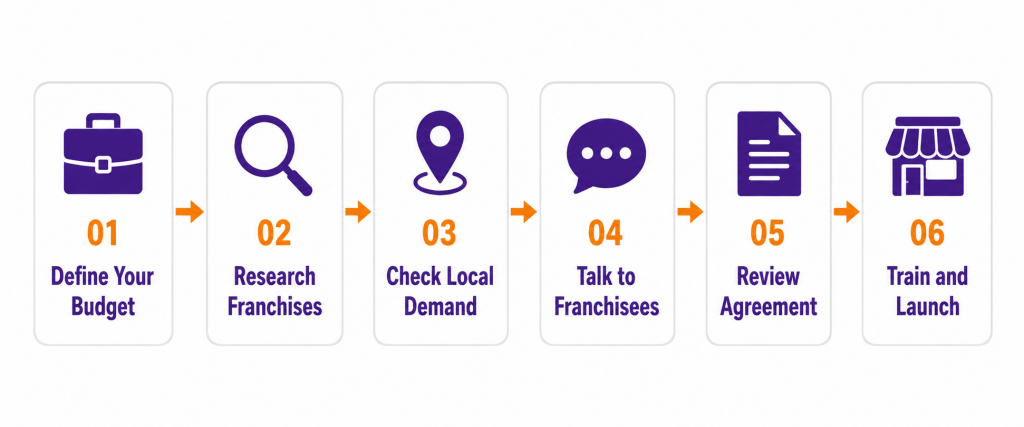
Step 1: Define your budget and preferred sector
Determine the total amount you can invest, including setup costs, working capital, and the franchise fee. Cross-reference this with sectors that have active demand in your location. ₹50,000 to ₹5 lakh opens options in services, food kiosks, and education; ₹5 lakh to ₹25 lakh covers mid-range food and retail formats.
Step 2: Research franchise opportunities
Use franchise portals, business expos, and brand websites to identify franchisors in your chosen sector. Shortlist 3 to 5 options and request their franchise disclosure document, which outlines investment requirements, support structure, and franchisee obligations.
Step 3: Evaluate market demand in your location
Before finalising a brand, research demand for that product or service in your specific area. Study foot traffic, competition, and local customer preferences. Avoid selecting a location based solely on low rent or personal familiarity.
Step 4: Speak to existing franchisees
Contact franchisees already operating under the brand you are considering. Ask about actual earnings versus projected, quality of franchisor support, challenges they faced during launch, and whether they would choose the same brand again.
Step 5: Review and sign the franchise agreement
Have the franchise agreement reviewed by a legal advisor. Confirm the royalty structure, territory exclusivity, renewal terms, and exit clauses before signing.
Step 6: Complete training and launch
Most franchisors provide structured training before launch. Follow the onboarding process fully, including completing all documentation, SOPs, and compliance requirements before opening. A well-prepared launch sets the foundation for consistent operations.
Conclusion
A small franchise business in India is a structured way to start a business using an established brand and operating system. The key advantage is that the product, processes, and brand recognition already exist — your role as a franchisee is to implement them correctly and build a local customer base.
The most important decisions happen before you sign the agreement: choosing a sector with genuine demand in your area, evaluating the franchisor’s credibility and support structure, understanding the full cost of entry, and reviewing the legal terms carefully. Franchise businesses in India span a wide range of investment levels and sectors, making it possible to find an option that matches your budget and local market.
A franchise agreement is a long-term commitment, typically 3 to 10 years. Taking the time to research thoroughly before committing significantly reduces the risk of choosing an opportunity that does not fit your location, budget, or capabilities.
Your Next Step
deAsra’s free Franchise for Business Growth Checklist gives you a structured framework to evaluate franchise opportunities, understand what a good franchisor should provide, and prepare for a successful franchise launch. It is built specifically for Indian entrepreneurs exploring franchise as a business model.
FAQs
What is a franchise business in India and how does it work?
A franchise business allows you to operate under an established brand’s name and systems in exchange for a franchise fee and ongoing royalty payments. The franchisor provides training, marketing support, and an operations manual. You follow their standards and pay a percentage of your revenue as royalties. Franchise agreements in India are governed by general contract law, as there is no specific franchise legislation.
How much investment is required to start a small franchise business in India?
Investment in a small franchise business in India starts from ₹50,000 for service-based and food kiosk formats. Mid-range food and retail franchises require ₹5 lakh to ₹25 lakh. Larger formats in sectors like wellness or branded retail can require significantly higher investment. The total cost includes the franchise fee, setup expenses, and working capital for the initial months.
What are the best franchise business ideas in India for beginners?
Food kiosks, tea and beverage chains, preschools, coaching centres, and home services are among the more accessible franchise options for first-time entrepreneurs in India. These formats have lower entry costs, simpler operations, and active demand across Tier 1, 2, and 3 cities. The right sector depends on local market demand and your available investment.
What should I check before signing a franchise agreement in India?
Before signing, verify the royalty structure, territory exclusivity, renewal terms, and exit conditions. Check whether the franchisor has a documented onboarding process, franchise manuals, and SOPs. Speak to existing franchisees about their experience. Have a legal advisor review the agreement. Avoid franchisors who cannot provide clear documentation or transparent performance data from existing outlets.
How long does a franchise agreement last in India?
Franchise agreements in India typically last between 3 and 10 years, depending on the brand and sector. The agreement outlines renewal terms, which may require a renewal fee or renegotiation of royalty rates. Exit conditions, including whether you can sell the franchise to a third party, are also specified in the agreement and should be reviewed before signing.