
The Top Employee Training Trends Shaping 2026
Employee training stands at the centre of organisational strategy in 2026. Indian businesses of every size now view targeted development as essential for building adaptable teams that deliver consistent results. This forward-looking exploration examines the latest innovations in corporate training and provides clear steps for practical implementation, especially useful for leaders balancing growth ambitions with resource realities.

1. Skills-Based Approaches Gain Prominence
Employee training today moves decisively away from rigid job titles toward building specific skill portfolios. Organisations identify high-value capabilities such as strategic thinking, collaboration with AI systems, and confident decision-making in uncertain conditions.
This shift enables teams to remain flexible as roles evolve rapidly. For smaller enterprises, the transition aligns naturally with existing practices of hands-on guidance. Clear expectations set from the first day help new team members contribute effectively without requiring extensive formal structures. deAsra supports and engages nano and micro businesses by sharing grounded strategies that turn basic skill development into measurable productivity gains.
2. AI Enhances Rather Than Replaces Human Guidance
Online employee training benefits enormously from AI tools that create personalised learning pathways and deliver instant, relevant feedback. These systems review performance patterns and recommend focused practice activities, allowing human facilitators to concentrate on deeper interpretation and relationship-building aspects.
Trainers add unique value through emotional intelligence and contextual facilitation that technology cannot replicate. In compact teams, AI can serve as a helpful assistant alongside peer mentoring and direct founder involvement. The combination makes employee training more continuous and seamlessly integrated into everyday responsibilities.
3. Context Matters More Than Ever in Leadership Development
Effective employee training programs now tailor content to the specific industry, company scale, and cultural setting. Leadership requirements differ significantly between a manufacturing operation, a technology venture, and a customer-facing retail business. Generic models struggle to address these distinct pressures and decision environments.
Ms. Sajiri noted in the deAsra DreamBIG podcast that training succeeds when it clearly communicates “how things work here,” accounting for team size and organisational maturity. deAsra supports and engages small businesses through resources that promote documented yet adaptable onboarding processes suited to real-world constraints.
4. Learning Integrates Seamlessly into Daily Work
The strongest employee training occurs directly within the natural rhythm of work rather than in isolated sessions. Brief interventions lasting five to ten minutes, combined with just-in-time prompts and on-the-job scenarios, replace lengthy off-site workshops.
This method increases immediate application and reduces disruption. Small organisations have long relied on observation and quick skill-sharing among colleagues, which mirrors this trend closely. Online employee training delivered through mobile-friendly, bite-sized formats further supports busy teams by making development convenient and relevant.
5. Coaching Evolves into a Strategic Tool
Employee training programs increasingly position coaching as a proactive driver of leadership pipelines across multiple levels. Rather than addressing performance shortfalls after they appear, coaching now prepares emerging and mid-level leaders to handle complexity and contribute to long-term business objectives.
Clear metrics track the translation of new capabilities into actual workplace behaviours. Leaders can then focus greater attention on critical roles where capability development produces the highest organisational return. This strategic orientation helps businesses maximise the value of every employee training initiative.
6. Measurable Impact Becomes Essential
Stakeholders now insist on visible connections between employee training and tangible business outcomes. Simple tracking of skill application, productivity shifts, error reduction, and retention patterns replaces reliance on basic satisfaction feedback.
Resource-limited teams can begin with straightforward observations of task completion speed or quality improvements before and after focused sessions. The deAsra blog on creating a culture of continuous learning offers helpful direction on establishing modest yet meaningful measurement practices that fit smaller operations without sophisticated tools.
7. Human Capabilities Retain Central Importance
Even with growing technological integration, employee training places renewed emphasis on core human strengths. Qualities such as empathy, ethical judgment, resilience in challenging situations, and effective collaboration stand out as essential differentiators.
These capabilities enable teams to make sense of complex environments and exercise positive influence. In smaller settings, open dialogue and shared purpose naturally nurture these attributes, transforming employee training into an opportunity for strengthening team relationships and collective confidence.
8. Blended Formats Deliver Smarter Journeys
Successful employee training programs feature thoughtfully designed combinations of methods where each component serves a defined purpose. Initial diagnostics identify needs, interactive workshops encourage deep practice and reflection, while digital elements handle concept introduction and ongoing reinforcement.
Online employee training proves particularly valuable for delivering consistent foundational material efficiently. This intelligent blending accommodates varying time availability and learning preferences, producing more engaging and effective development experiences across different business scales.
9. Credibility Shifts Toward Relevance and Adaptability
Respect for trainers and internal guides now stems primarily from their demonstrated awareness of current workplace dynamics and willingness to evolve. Continuous personal development in areas such as digital fluency and emerging industry patterns carries greater weight than length of service alone.
Leaders who share practical, up-to-date insights inspire stronger participation in employee training. The same principle applies whether the guidance comes from external specialists or business owners directly supporting their teams.
10. Purpose Aligns Learning with Broader Goals
Employee training increasingly connects individual skill growth to wider organisational values, sustainability efforts, and positive societal contributions. Team members show higher engagement when they understand how their development supports meaningful outcomes beyond daily tasks.
Practices that promote inclusion and responsible technology adoption gain prominence. This alignment helps build deeper loyalty and resilience, particularly valuable in diverse Indian workforces facing rapid economic changes.
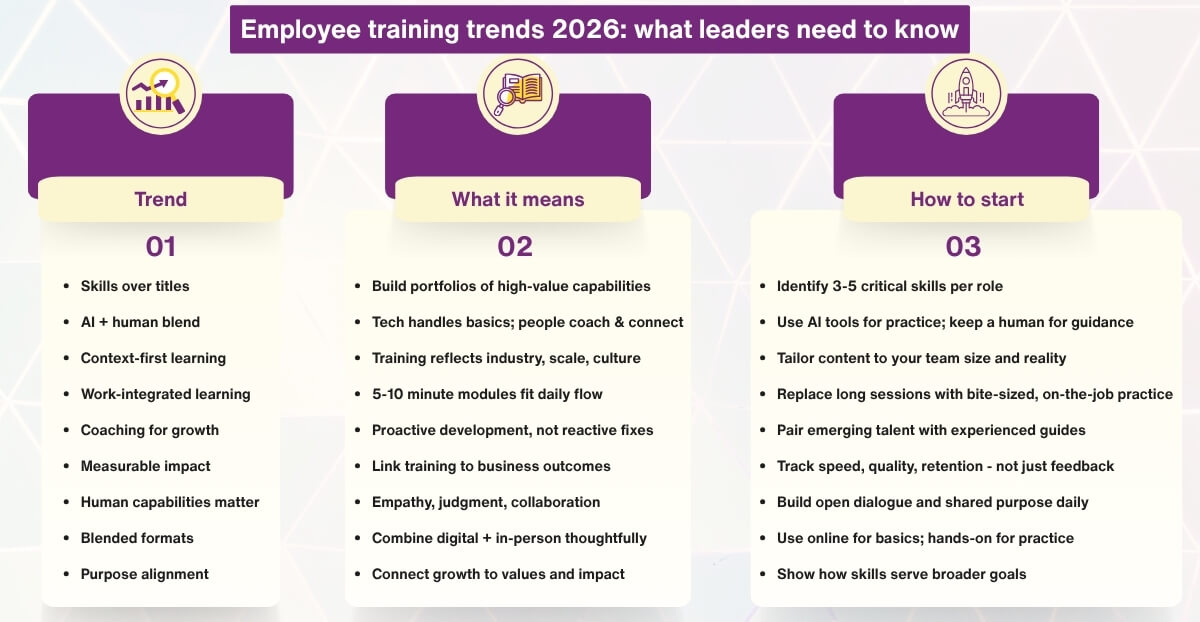
Practical Steps for Implementation in 2026
Leaders can start by mapping the specific skills most critical for current performance and future readiness. Direct employee training resources toward roles where gaps would create significant business risk. Leverage existing team expertise for practical, hands-on guidance while introducing suitable online employee training options for flexibility.
Maintain light documentation of expectations and progress to support consistency without creating unnecessary bureaucracy. Encourage transparent conversations so individuals feel safe raising development needs or career aspirations. deAsra supports and engages small businesses by providing accessible conversations through its DreamBIG podcast series that address real training and retention questions faced by entrepreneurs.
Conclusion
Employee training in 2026 offers organisations a powerful lever for building resilient, capable teams equipped to navigate ongoing change. Leaders who adopt skills-focused, context-sensitive, and intelligently blended methods create lasting competitive advantages.
Whether managing a nano enterprise or a larger establishment, success depends on treating development as a thoughtful investment linked to clear business priorities. Practical, human-centred approaches combined with appropriate technology deliver the best outcomes. deAsra continues to support and engage Indian business leaders through resources and discussions that make modern employee training achievable and effective, helping organisations grow stronger through their people.

FAQs
1. What makes skills-based employee training more effective than traditional role-based methods?
Skills-based employee training develops precise capabilities that transfer across changing responsibilities. It equips teams to adapt quickly to new demands and delivers clearer contributions to organisational performance compared with approaches tied strictly to fixed job descriptions.
2. How can small businesses implement online employee training without large budgets?
Small teams benefit from selecting accessible mobile-friendly modules, short videos, and interactive quizzes that require minimal investment. Pairing these with existing peer guidance and brief leader-led discussions creates practical online employee training that fits daily operations and produces noticeable skill improvements.
3. Why has learning in the flow of work become important for employee training programs?
Team members prefer development that supports rather than interrupts their primary responsibilities. Brief, targeted activities woven into regular tasks lead to higher application rates and greater acceptance, making employee training programs more sustainable and directly useful.
4. How should organisations measure the success of their employee training?
Observe practical changes such as faster task completion, fewer errors, improved collaboration, and steadier retention levels. Combining these indicators with occasional team conversations provides sufficient insight to refine employee training based on genuine business contributions.
5. What role does culture play in sustaining effective employee training?
A positive culture where leaders actively participate in learning and maintain open communication turns employee training into an expected and valued activity. Recognition of progress and connection to shared purpose increase engagement and support longer-term talent retention.