
Business Tax Deadlines 2026: A Complete Calendar for Your Fiscal Year
The Business Tax Deadlines 2026 calendar has arrived, bringing clarity and structure to what can often feel like a complex maze of compliance obligations. With the Union Budget 2026 introducing staggered deadlines and extended timelines for revised returns, businesses now have more breathing room to ensure accuracy in business income tax filings. This comprehensive guide serves as your complete reference for business tax deadlines 2026, helping industry leaders across sectors stay ahead of penalties, safeguard cash flow, and maintain strong financial governance.
As the new Income Tax Act, 2025, takes effect from 1 April 2026, these updates aim to simplify compliance while encouraging timely adherence. For business income tax matters, understanding these dates is essential to avoid interest under Section 234A, late fees under Section 234F, and the inability to carry forward losses. deAsra supports and engages entrepreneurs through practical resources and expert guidance, making business tax management more approachable for growing enterprises.
In an episode of the deAsra dreamBIG podcast, Mr. Amit Lomte emphasised the foundational role of proper records, stating: “Books of accounts are a gateway to growth and have a multifold effect on business success.” This insight highlights why staying on top of business tax deadlines 2026 matters beyond mere compliance—it directly influences funding access, investor confidence, and long-term scalability.

Understanding the Key Changes in Business Tax Deadlines 2026
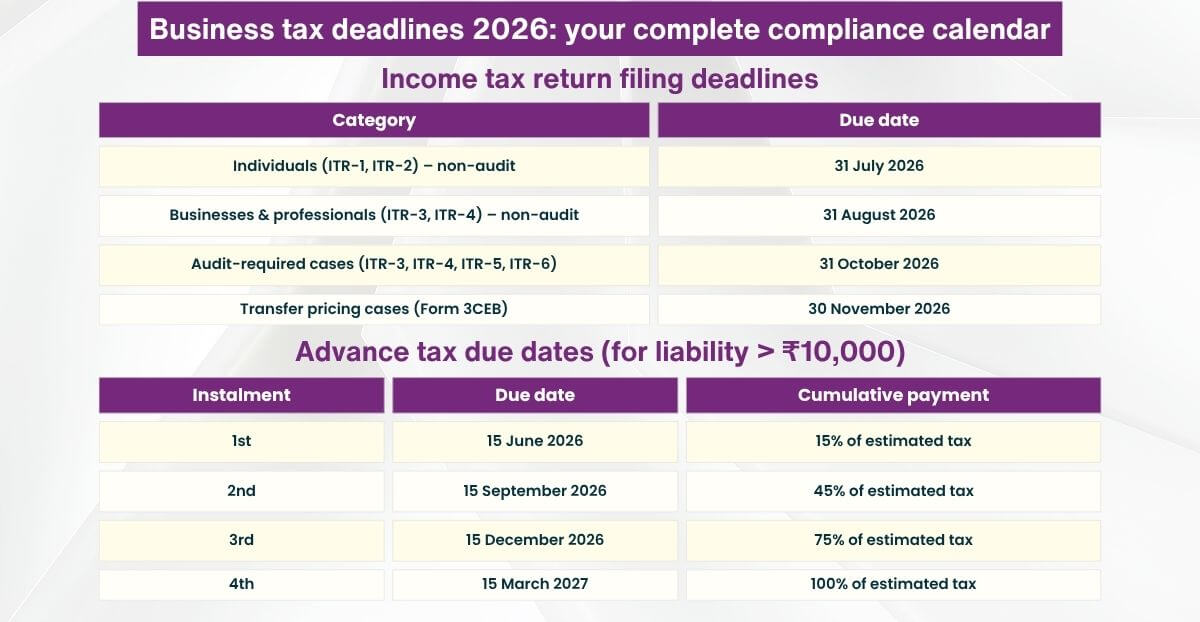
The Budget 2026 brought welcome adjustments to ease the burden on non-audit businesses. Previously aligned deadlines have now been staggered, giving businesses with business income tax obligations extra time without compromising overall efficiency. For FY 2025-26 (corresponding to Assessment Year 2026-27), the core deadlines reflect this thoughtful approach.
Non-audit individuals typically file by 31 July 2026 using ITR-1 or ITR-2. However, businesses and professionals without audit requirements—often filing ITR-3 or ITR-4—now have until 31 August 2026. This extension recognises the additional preparation needed for business income tax computations, including profit and loss statements, deductions, and reconciliations. Audit-required cases shift to 31 October 2026, while those involving transfer pricing reports (Form 3CEB for international or specified domestic transactions) extend to 30 November 2026. Companies generally align with 31 October 2026, or later if transfer pricing applies.
These staggered business tax deadlines 2026 reduce peak-season pressure on tax professionals and portals, allowing more accurate filings. Advance tax payments remain quarterly (15 June, 15 September, 15 December, and 15 March), ensuring steady liability discharge throughout the year.
Consequences of Missing Business Tax Deadlines 2026
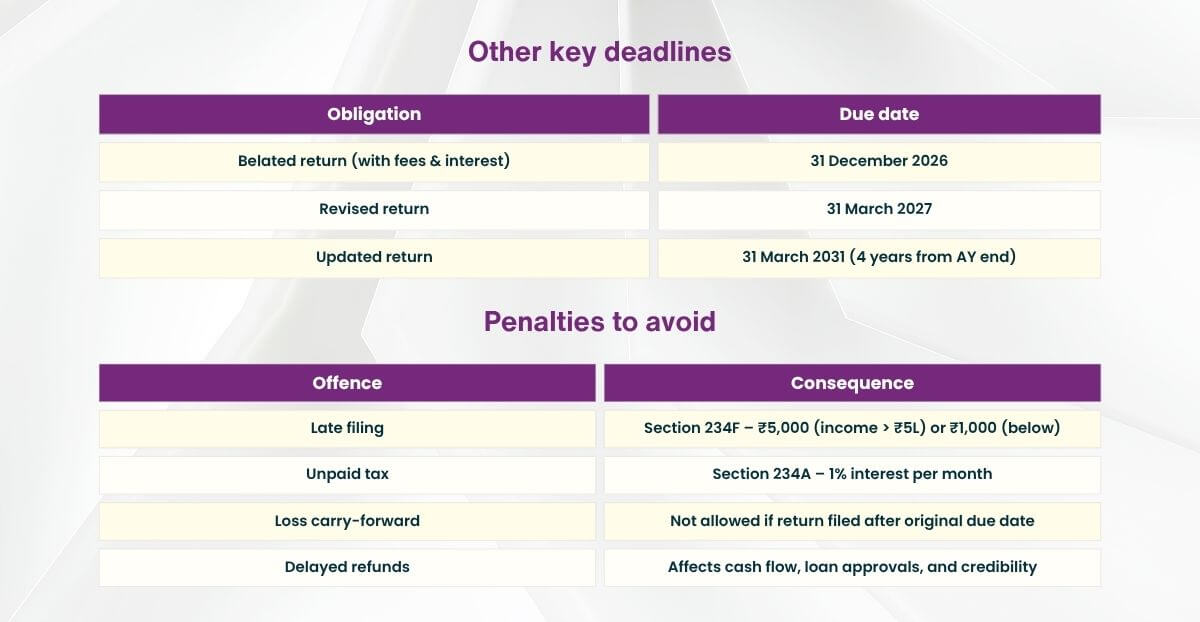
Failing to meet business tax deadlines 2026 carries tangible repercussions that extend far beyond immediate fines. Interest at 1% per month (or part thereof) under Section 234A applies to unpaid taxes from the original due date. Late filing fees under Section 234F reach Rs. 5,000 for income exceeding Rs. 5 lakh, or Rs. 1,000 otherwise.
A critical impact involves loss carry-forward provisions. Business losses, capital losses from assets like stocks or properties, and other eligible set-offs cannot be carried forward to offset future profits if the return misses the original deadline. This restriction can significantly increase future business income tax liabilities.
Additional risks include delayed refunds, complications in loan approvals, visa processes, or partnerships that scrutinise timely compliance.
Planning Your Compliance Calendar Effectively
To navigate business tax deadlines 2026 successfully, build a month-by-month roadmap. Start early with accurate bookkeeping using digital tools for reconciliation, invoicing, and GST compliance. Gather documents like financial statements, invoices, bank records, and depreciation schedules well in advance.
For GST-registered businesses (mandatory above certain turnover thresholds), monthly or quarterly returns continue alongside income tax obligations. Reconcile the Input Tax Credit regularly to maximise benefits and avoid mismatches.
If errors appear after filing, revised returns can now be submitted until 31 March 2027 (extended from 31 December). Belated returns remain possible until 31 December 2026, though with fees and interest. Updated returns offer a final window up to 31 March 2031 (four years from the AY end) for additional disclosures, though they limit certain claims.
Presumptive taxation under Section 44AD simplifies processes for eligible small businesses (turnover up to Rs. 3 crore), allowing 6% or 8% deemed profit without detailed books. This option eases business income tax compliance significantly.
Integrate these steps into your operations for seamless adherence. Resources like those from deAsra make this practical—explore their accounting and taxation support for AI-powered tools and expert mentoring. For detailed filing guidance, refer to this helpful step-by-step guide on how to file business taxes.
Conclusion
Mastering business tax deadlines 2026 transforms compliance from a chore into a strategic advantage. The updated calendar from Budget 2026 provides flexibility, particularly for non-audit cases, while reinforcing the importance of timely action. By planning, maintaining accurate records, and leveraging expert support, businesses can minimise risks, optimise deductions, and focus on growth. Stay proactive—your financial discipline today shapes opportunities tomorrow.

FAQs
1. What is the main deadline for non-audit businesses under business tax deadlines 2026?
Non-audit businesses and professionals filing ITR-3 or ITR-4 must submit by 31 August 2026 for FY 2025-26 (AY 2026-27). This extension from Budget 2026 gives extra time for accurate business income tax preparation compared to the standard 31 July for salaried individuals.
2. What happens if I miss the original business tax deadlines in 2026?
You can file a belated return by 31 December 2026, but expect interest at 1% per month on unpaid tax and a late fee up to Rs. 5,000. Losses cannot be carried forward, increasing future business income tax burdens.
3. How has the revised return deadline changed for business income tax in 2026?
Revised returns to correct errors can now be filed until 31 March 2027, an extension from the previous 31 December. This provides more flexibility for businesses to refine business tax submissions after initial filing.
4. Do companies have different business tax deadlines in 2026?
Yes, domestic companies generally file by 31 October 2026. If transfer pricing reports apply, the deadline extends to 30 November 2026, aligning with other complex cases under business income tax rules.
5. How can businesses avoid penalties related to business tax deadlines in 2026?
Maintain organised records, reconcile accounts regularly, pay advance tax on time, and use digital tools or expert guidance. deAsra supports and engages through resources that simplify compliance and help maximise deductions effectively.