Standard operating procedure: how to write SOPs for a small business
A standard operating procedure, or SOP, is a written set of steps for doing a task the same way every time. It tells your team what to do, in what order, and what a good result looks like.
In this guide, SOP means standard operating procedure, not a statement of purpose for a study application. Below, you will learn what an SOP is, which format to choose, and how to write one in six steps. A simple SOP template and a worked example are included.
Key takeaways
- A standard operating procedure is a short, written routine for a repeated task.
- SOPs make quality consistent, speed up training, and make delegation easier.
- Start with tasks that repeat often, cost money when wrong, or live in one person’s head.
- Write each step in plain words, and ask someone new to test it.
- Keep every SOP in one shared place, with an owner and a review date.

What is a standard operating procedure?
A standard operating procedure is a document that explains how to complete a routine task. Examples include opening a shop, handling a refund, or packing an order.
A good SOP is short and specific. It answers four questions: who does the task, what steps to follow, how to check the result, and what to do if something goes wrong.
An SOP is not a policy. A policy states a rule, such as “all refunds need approval”. An SOP explains how to carry out the work that follows the rule.
Why do small businesses need SOPs?
Small teams often run on memory and habit. That works until someone is absent, leaves, or joins. A written procedure removes that risk.
- Quality stays consistent, because everyone follows the same steps.
- New hires learn faster, which supports your onboarding process.
- Delegation becomes easier, since the instructions already exist.
- Mistakes fall, because the checks are written down.
- The business depends less on one or two key people.
Which tasks should you write an SOP for first?
You do not need an SOP for every task. Begin with the work that gives the most benefit.
- Anything that repeats daily or weekly.
- Work where a mistake costs money or customers.
- Jobs that only one person knows how to do.
- Duties you plan to hand over to someone else.
Start with three to five SOPs. Add more once the habit is in place.
What is the SOP format?
There is no single SOP format. Pick the one that matches the task. The table below compares the four common formats.
|
Format |
Best for |
Example |
| Simple checklist | Short routine tasks with no decisions | Opening the shop |
| Step-by-step list | Tasks with a fixed order | Packing and dispatching an order |
| Hierarchical list | Tasks with sub-steps or choices | Handling a refund request |
| Flowchart | Tasks with several decision points | Responding to a customer complaint |
For most small businesses, the simple checklist and the step-by-step list cover nearly every need.
How to write an SOP: step by step
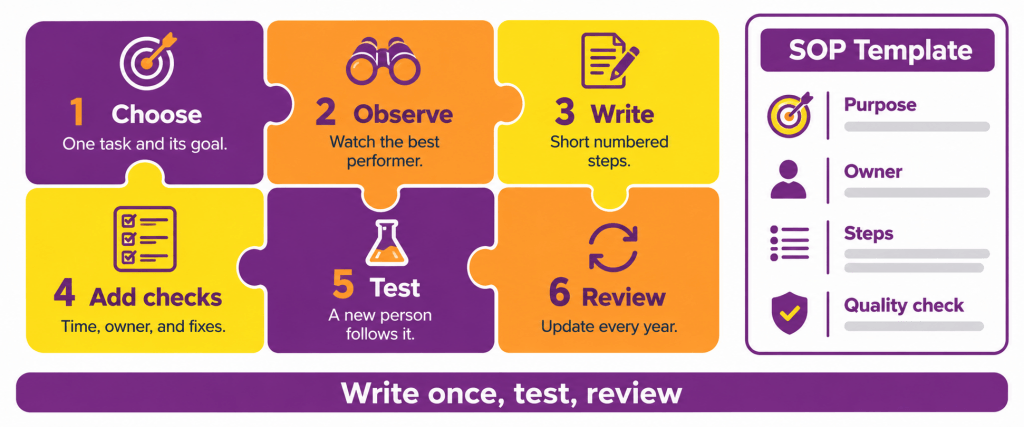
Follow these six steps to write a standard operating procedure that people will actually use.
Step 1: Choose one task and state its goal. Write one line about what the task achieves. For example, “Close the shop safely and record the day’s cash.” A clear goal keeps the SOP focused.
Step 2: Observe the task being done. Watch your best performer, or do the task yourself, and note every step. Ask the person who does the work. They know the details that managers often miss.
Step 3: Write the steps in plain language. Start each step with an action word, such as “count”, “check”, or “lock”. Keep one action in each step, and number the steps in order.
Step 4: Add the details that prevent errors. Name who is responsible and how long each step should take. Add a quality check, and note what to do if something goes wrong.
Step 5: Test it with someone new. Ask a person who has not done the task to follow the SOP exactly. Every question they ask shows a gap. Fix the gaps and test again.
Step 6: Store it, share it, and review it. Keep all SOPs in one shared place that everyone can reach. Add an owner, a version number, and a review date. Review the SOP whenever the process changes, and at least once a year.
What should an SOP template include?
A simple SOP template needs only a few sections. Keep each section short.
- Title of the task.
- Purpose, in one line.
- Scope, meaning who and what the SOP covers.
- Owner, version number, and review date.
- Materials or access needed.
- Numbered steps.
- Quality check.
- What to do if something goes wrong.
You can reuse this layout for every task. Over time, your SOPs will look alike, which makes them easier to read.
Sample SOP: closing a small shop
The example below is illustrative. Adapt the steps and timings to your own business.
Purpose: close the shop safely and record the day’s cash. Owner: store supervisor. Version: 1.0.
| Step | Action | Time (minutes) |
| 1 | Stop new billing and tell customers the shop is closing. | 5 |
| 2 | Count the cash and match it with the day’s sales record. | 15 |
| 3 | Place the cash in the safe and lock it. | 5 |
| 4 | Clean the counters and tidy the shelves. | 20 |
| 5 | Switch off lights, fans, and equipment. | 5 |
| 6 | Lock the doors and set the alarm. | 5 |
| Total | 55 |
Quality check: the cash count matches the sales record. If it does not, recount once, write down the difference, and tell the owner before leaving.
Disclaimer: Some tasks, such as food handling, workplace safety, or financial record keeping, are governed by rules. Check the requirements that apply to your business before you finalise an SOP for those tasks.
How do SOPs help with training and delegation?
An SOP turns a task into a lesson. A new employee can read it, watch the task once, and then try it with the SOP in hand. This fits neatly into an employee training plan.
SOPs also make delegation safer. You can hand over a task with clear steps and a clear quality check. As a result, you spend less time answering the same questions.
What mistakes should you avoid?
- Writing long documents that nobody reads.
- Writing the SOP without asking the people who do the work.
- Storing SOPs in a place that few people can find.
- Never updating the SOP after the process changes.
- Leaving the SOP without an owner.
These issues often appear in the list of common team management challenges. Fixing them early saves time later.
Conclusion
A standard operating procedure makes good work repeatable. It gives your team a clear way to do each routine task, and it gives you a base for training, delegation, and quality checks.
Keep the process simple. Choose one task, observe it, write short numbered steps, and test them with someone new. Then store the SOP in one place and review it regularly. For more ideas on running your team, read these effective team management strategies.
Pick one routine task this week and write its SOP using the template above. Ask a colleague to test it before you share it with the whole team.
Your next step

Frequently asked questions
What is an SOP?
An SOP is a standard operating procedure. It is a written set of steps that explains how to complete a routine task the same way every time.
How to write an SOP?
Choose one task and state its goal. Observe the task, write short numbered steps, and add checks. Then test the SOP with someone new, store it in one place, and review it regularly.
What should an SOP template include?
It should include the task title, purpose, scope, owner, version and review date, materials needed, numbered steps, a quality check, and what to do if something goes wrong.
What is the best SOP format?
It depends on the task. A simple checklist suits short routines, and a step-by-step list suits tasks with a fixed order. Use a flowchart only when there are several decision points.
How often should you review an SOP?
Review it whenever the process changes, and at least once a year. Record the review date on the document so that nobody relies on an outdated version.