Quotation format and sales proposal: how to write both for a small business
A quotation tells a customer exactly what a job will cost. A sales proposal explains how you will solve the customer’s problem, and what that solution costs.
Many small businesses mix the two up. The result is long documents for simple jobs, or bare price lists for complex ones. This guide explains the quotation format, how to write a quotation, and how to write a sales proposal. It includes a sample layout you can copy.
Key takeaways
- A quotation states a price for a defined job, while a sales proposal makes the case for a solution.
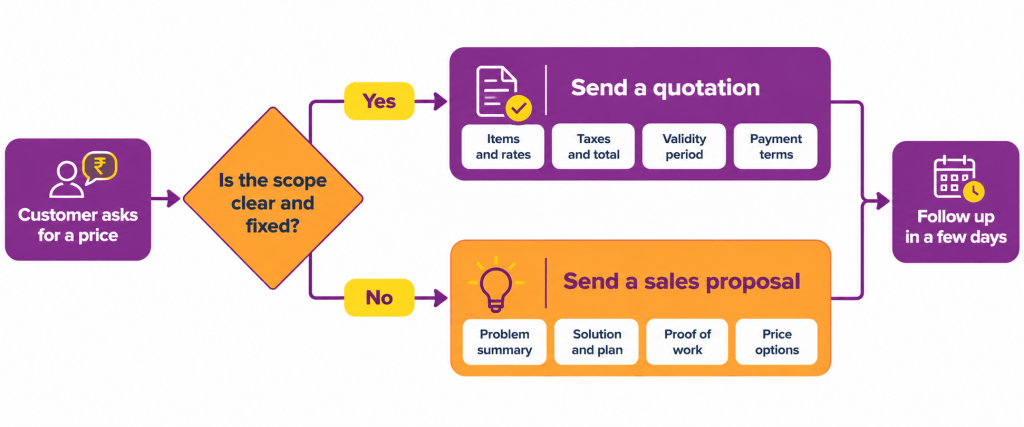
- Send a quotation when the scope is clear, and a proposal when the customer needs convincing.
- A clear quotation format lists items, quantities, rates, taxes, validity, and terms.
- A strong sales proposal starts with the customer’s problem, not your company history.
- Both documents work best when they are short, sent quickly, and followed up.

Quotation vs proposal: what is the difference?
A quotation is a formal offer of a fixed price for clearly defined goods or services. It answers one question: how much will this cost? After the customer accepts, it becomes the basis for an order and, later, an invoice.
A sales proposal answers a wider question: why should the customer choose you? It describes the problem, your solution, the plan, and the price. Businesses often call this document a business proposal.
The table below compares the two.
|
Feature |
Quotation |
Sales proposal |
| Purpose | States the price for a defined job | Persuades the customer to choose your solution |
| Length | One or two pages | Several pages |
| Best used when | The scope is clear, such as a product order | The scope needs explaining, such as a service project |
| Main content | Items, quantities, rates, taxes, terms | Problem, solution, plan, price, proof |
| Customer’s question | How much will it cost? | Why should I choose you? |
| Speed | Often sent the same day | Sent after a conversation with the customer |
Some jobs need both. You may send a proposal first, and then issue a final quotation once the customer agrees to the scope.
What goes into a quotation format?
A good quotation format is simple, so the customer can check it in a minute. It should include the following fields.
- Your business name, address, and contact details, plus your GST number if you are registered.
- The customer’s name and address.
- A quotation number and the date of issue.
- A short description of each item or service.
- Quantity, unit rate, and line amount for every item.
- The subtotal, the taxes, and the final total.
- A validity period, so the customer knows when the price expires.
- Payment terms, delivery time, and any conditions.
- A contact name and a clear way to accept the quotation.
Note that a quotation is an offer, not a bill. You issue an invoice when the sale actually takes place.
How to write a quotation: step by step
Follow these six steps to write a price quotation that is clear and easy to accept.
Step 1: Confirm what the customer needs. Ask about quantity, quality, deadline, and delivery location before you write a number. A quotation based on guesswork often leads to disputes later.
Step 2: Work out your costs and your price. Add up material, labour, and delivery costs, and then add your margin. The pricing strategy guide explains how to do this. Check that the price still leaves a profit after any discount.
Step 3: List each item separately. Show every item with a quantity and a rate. Itemised lines build trust, because the customer can see what they are paying for. They also let you change one line without redoing the whole document.
Step 4: Add taxes and the total. Show tax as a separate line. Rates depend on the product or service, so confirm the correct GST rate for your sale. As of 2026, please check the current rate with your accountant or the official GST sources before you quote. If you are not yet registered, read this GST registration guide.
Step 5: Set a validity period and terms. Costs change, so state how long the price holds, for example 15 days. Then add payment terms, delivery time, and what happens if the scope changes.
Step 6: Send it quickly and follow up. Send the quotation the same day if you can. Customers often compare several quotes, so a short follow-up within a few days keeps you in the running.
Sample quotation layout
The example below is for a print shop quoting 200 branded tote bags. All figures are illustrative and the GST rate is an assumption for the example.
| No. | Description | Quantity | Rate (Rs.) | Amount (Rs.) |
| 1 | Cotton tote bags, one-colour print | 200 | 120 | 24,000 |
| 2 | Artwork and print setup | 1 | 1,500 | 1,500 |
| 3 | Delivery to the customer’s office | 1 | 1,000 | 1,000 |
| Subtotal | 26,500 | |||
| GST at 18% (illustrative) | 4,770 | |||
| Total | 31,270 |
Below the table, add the terms. For example: valid for 15 days from the date of issue, 50% advance with the balance before delivery, and delivery within 10 working days of artwork approval.
Disclaimer: This guide is general information and is not tax or legal advice. GST rates and rules change, so confirm the details with a qualified professional before you issue a quotation.
How to write a sales proposal: step by step
A sales proposal needs more thought than a quotation. It must show the customer that you understand their problem. Follow these six steps.
Step 1: Understand the customer first. Hold a short discovery conversation. Ask what the problem is, what has been tried, and what success would look like. The notes from your sales pitch preparation will help here.
Step 2: Open with a short summary. Begin with half a page that states the problem and your proposed solution. Busy decision makers often read only this part, so make it count.
Step 3: Describe your solution and plan. Explain what you will do, in what order, and by when. Use plain language, and link each activity to a result the customer wants.
Step 4: Show why you are the right choice. Add a brief introduction to your business, relevant past work, and one or two customer results. Your unique selling proposition belongs here.
Step 5: Present the price clearly. Show the total cost with a short breakdown. Where possible, offer two or three options, so the customer compares options instead of deciding between yes and no.
Step 6: State the next step. End with a clear call to action, such as a date for a decision call. Add the validity period and terms, and then follow up.
A simple sales proposal template
Most proposals work well in this order. Cut any section that the customer does not need.
- Cover page with the customer’s name and the date.
- Summary of the problem and your solution.
- Proposed solution and approach.
- Timeline and key milestones.
- Pricing and options.
- About your business, with proof of past work.
- Next steps, validity, and terms.
What should you do after you send it?
Send a short message to confirm that the document arrived. Then follow up within a few days, and ask if the customer has any questions.
Follow-up often brings objections about price or timing. The guide to handling objections in sales shows how to respond. If the customer is still early in their decision, the sales funnel guide explains how to keep the relationship warm.
What mistakes should you avoid?
- Writing a long proposal when the customer only needs a price.
- Sending only a price when the customer needs convincing.
- Leaving out the validity date and the terms.
- Hiding extra charges until the invoice stage.
- Forgetting to follow up after sending.
Conclusion
A quotation and a sales proposal do different jobs. The quotation fixes the price for a defined job. The proposal builds the case for your solution before the price is discussed.
Use the simple quotation format in this guide for clear jobs, and the six-step proposal for bigger ones. Keep both documents short, itemised, and easy to accept. Most importantly, follow up.
Write the quotation for your next job using the six steps above. If the customer needs convincing, draft a one-page proposal before you quote.
Your next step

Frequently asked questions
What is a quotation format?
It is the standard layout of a quotation. It lists your details, the customer’s details, a quotation number, items with quantities and rates, taxes, the total, the validity period, and the terms.
How to write a quotation?
Confirm the customer’s needs and work out your price. Then list each item separately, add taxes and the total, and set a validity period and terms. Send it quickly and follow up.
What is the difference between a quotation and a proposal?
A quotation states a fixed price for a defined job. A proposal explains the problem, your solution, the plan, and the price, so that the customer can decide whether to choose you.
How to write a sales proposal?
Understand the customer’s problem first, and open with a short summary. Then describe your solution and plan, show why you are the right choice, and present the price clearly. End with a clear next step.
How long should a quotation stay valid?
There is no fixed legal period for every case. Choose one that matches how quickly your costs change, and state it clearly on the document.