
Employee Retention: How to Reduce Turnover in Your Small Business in India
Employee retention is the ability of a business to keep its employees over time, rather than losing them to resignation. For a small business, retention matters more directly than it does for a large one: every employee who leaves takes product knowledge, customer relationships, and training investment with them, and a small team has fewer people to absorb the gap while a replacement is found and trained.
However, many small businesses only think about retention after a valued employee has already resigned. By then, the options are limited to a counter-offer or a scramble to backfill the role. This guide covers why employees leave small businesses in India, and the practical, low-cost habits that reduce turnover before it becomes a crisis.
Key Takeaways
- Employee retention is the ability to keep employees over time. For a small business, losing even one trained employee has a proportionally larger impact than it does for a large organisation.
- Employees commonly leave small businesses due to delayed or unclear pay, limited growth opportunities, and a lack of recognition or feedback, not just because of salary alone.
- A retention strategy for a small business does not require a large budget. Paying on time, communicating clearly, and recognising contributions cost little but affect retention directly.
- Statutory compliance, such as timely PF contributions where applicable, is not only a legal requirement but also a trust signal that affects whether employees stay.
- Retention efforts should be measured through turnover rate and exit conversations, not assumed to be working without a way to check.

What Is Employee Retention?
Employee retention is the ability of a business to keep its employees over a sustained period, rather than losing them through resignation. It is distinct from hiring, which is about bringing people in, and from onboarding, which is about getting a new hire productive. Retention is what happens after that, over months and years.
For a small business, retention is closely tied to continuity. A business with five employees that loses one experienced person loses a fifth of its institutional knowledge at once, along with the time it takes to hire and train a replacement. This is different from a large company, where the same departure barely registers.
Why Do Employees Leave Small Businesses in India?
Employees leave small businesses in India for a mix of reasons that go beyond salary alone. Understanding these reasons is the starting point for any retention effort, since a strategy built on the wrong assumption will not address what is actually driving people to leave.
Common reasons include delayed or inconsistent pay, which is a frequent issue in small businesses with irregular cash flow. Employees also leave when they see no clear path for growth, either in responsibility or in compensation, especially when a business has a flat structure with few defined roles above their own. A lack of regular feedback or recognition is another common factor. Employees who do not know whether their work is valued, and who only hear from a manager when something goes wrong, are more likely to look elsewhere.
In addition, statutory non-compliance, such as delayed or missing Provident Fund contributions where the business is required to make them, damages trust even when the employee does not raise it directly. Employees increasingly check whether their employer is meeting these basic obligations, and a business that gets this wrong signals instability beyond the missed compliance itself.
How Do You Build an Employee Retention Strategy for a Small Business?
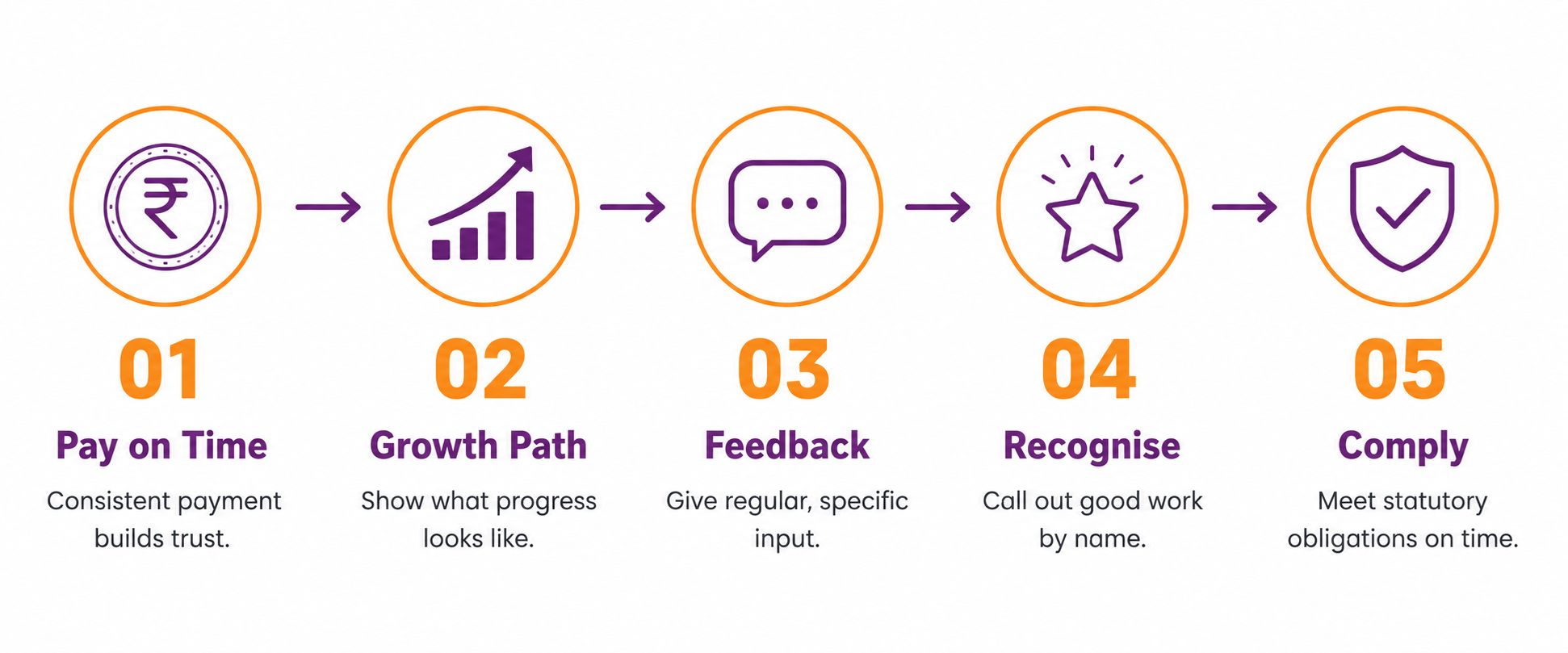
You build an employee retention strategy by addressing the reasons employees actually leave, starting with the habits that cost the least to implement. A small business retention strategy comes together in five steps.
Step 1: Pay on time, every time- Even a modest salary retains employees better than a higher salary paid inconsistently. If cash flow makes payment timing difficult, communicate this to employees in advance rather than letting the date pass silently.
Step 2: Define a growth path, even an informal one- Employees do not need a large organisation to see a future. A conversation about what additional responsibility or compensation looks like after six or twelve months gives employees a reason to stay and invest in the role.
Step 3: Give regular, specific feedback- Feedback does not need to be a formal review process. A short, regular conversation about what is working and what needs improvement keeps employees informed and reduces the surprise factor behind sudden resignations.
Step 4: Recognise contributions specifically- General praise is easy to forget. Recognising a specific action, such as how an employee handled a difficult customer or solved a recurring problem, has a stronger effect on how valued that employee feels.
Step 5: Meet statutory obligations without delay- Where PF, ESI, or other statutory contributions apply to the business, meeting these on schedule is both a legal requirement and a signal to employees that the business is stable and takes its obligations seriously.
What Retention Practices Work Best for Small Businesses in India?
Retention practices vary in cost and effort, and a small business does not need to adopt all of them at once. The table below breaks down common practices by what they require and who they suit best.
|
Practice |
Cost |
Best For |
| On-time salary payment | No added cost, requires cash flow discipline | Every small business, as a baseline requirement |
| Informal growth conversations | Time only | Businesses with flat structures and few formal roles |
| Regular short feedback check-ins | Time only | Teams where feedback currently only happens during problems |
| Specific recognition of good work | Time only | Businesses where praise is currently rare or generic |
| Timely statutory compliance (PF, ESI where applicable) | Ongoing administrative cost | Businesses that have crossed the threshold requiring these contributions |
| Structured training investment | Time and, in some cases, a training budget | Businesses ready to formalise onboarding and skill-building |
Start with the practices in this table that cost time rather than money. These address the most commonly cited reasons employees leave and require no budget to begin.
How Do You Know If Your Retention Efforts Are Working?
You know retention efforts are working by tracking turnover rate over time and by understanding, through direct conversation, why employees who do leave are actually leaving. Assuming retention has improved without checking either of these leaves a business guessing.
Turnover rate is calculated by dividing the number of employees who left in a period by the average number of employees during that period. Tracking this figure quarterly, even in a small business with a handful of employees, shows whether changes to pay timing, feedback habits, or recognition are having an effect.
Exit conversations, held when an employee resigns, are equally important. Employees who are leaving are often more candid than those who are still employed, and the reasons they give point directly to what a retention strategy should address next.
Conclusion
Employee retention in a small business in India depends less on salary alone and more on consistency: paying on time, communicating clearly, recognising good work, and meeting statutory obligations without delay. None of these require a large budget, but all of them require deliberate attention rather than being addressed only after an employee has already decided to leave.
Therefore, start with the lowest-cost habits, such as on-time pay and regular feedback, before investing in structured training or formal growth frameworks. Track turnover rate and hold honest exit conversations so retention efforts can be adjusted based on what is actually happening, not assumed.
However, retention is not a one-time fix. It is an ongoing practice that reflects how a business treats its people day to day, and it shows up directly in how long employees choose to stay.
Your Next Step

Frequently Asked Questions
How do I retain employees in my small business in India?
Start with the habits that cost the least: pay employees on time, give regular and specific feedback, and recognise good work as it happens. Define an informal growth path so employees can see what progress looks like. Where PF, ESI, or other statutory contributions apply, meet them without delay, since this affects employee trust directly. Track turnover rate over time to see whether these changes are working.
Why do employees leave small businesses in India?
Common reasons include delayed or inconsistent pay, a lack of visible growth opportunities, infrequent or only negative feedback, and statutory non-compliance such as missed Provident Fund contributions. Salary alone is rarely the only factor. Employees often leave businesses where they do not feel informed, valued, or secure, even if the pay itself is reasonable.
What are some low-cost employee retention ideas for a small business?
On-time salary payment, regular short feedback conversations, and specific recognition of good work are the lowest-cost retention practices, since they require time rather than budget. Meeting statutory obligations on schedule also costs little relative to the trust it builds. Structured training and formal growth frameworks can be added later as the business scales.
How do I measure employee retention in my business?
Calculate turnover rate by dividing the number of employees who left during a period by the average number of employees during that period. Track this figure quarterly. Combine it with honest exit conversations with departing employees, since the reasons they give are often more direct than feedback from employees who are still with the business.
Does paying a higher salary guarantee employee retention?
No. A higher salary alone does not guarantee retention if pay is inconsistent, if employees see no growth path, or if they receive little recognition or feedback. Consistency in how a business treats its employees day to day generally has a stronger effect on retention than salary level alone.