10 Common Branding Mistakes Small Business Owners Make in India
Business branding is one of the most misunderstood areas for Indian small business owners, not because they do not care about it, but because they often start with the wrong definition of what branding actually is. Many small businesses lose customers, undercharge for their products, and struggle to grow not because of poor quality, but because of avoidable branding errors. This guide covers 10 of the most common mistakes and what to do instead.
Key Takeaways
- Branding is not just a logo — it includes your visual identity, brand voice, customer experience, and the promise your business makes every time someone interacts with it
- Most small business branding mistakes come from starting too late, being inconsistent, or defining the brand too broadly with no clear target customer
- Competing on price instead of building brand value is one of the costliest branding mistakes a small business can make
- Inconsistency — across platforms, touchpoints, and customer interactions — is the single most common branding error seen across Indian small businesses
- Personal branding as a founder is one of the most underused tools available to small business owners in India

What Do Most Small Businesses Get Wrong About Branding?
Most small businesses in India equate branding with having a logo. A logo is one visible element of a brand — it is not the brand itself. Business branding is the complete set of signals your business sends to customers: what it looks like, what it sounds like, how it treats people, and what it stands for. When these signals are inconsistent, unclear, or absent, customers have no reason to choose one business over another except price.
The 10 mistakes below are the most common patterns in small business branding across India. Each one is fixable — and fixing even three or four of them can meaningfully change how customers perceive and value a business.
Mistakes Related to Brand Identity
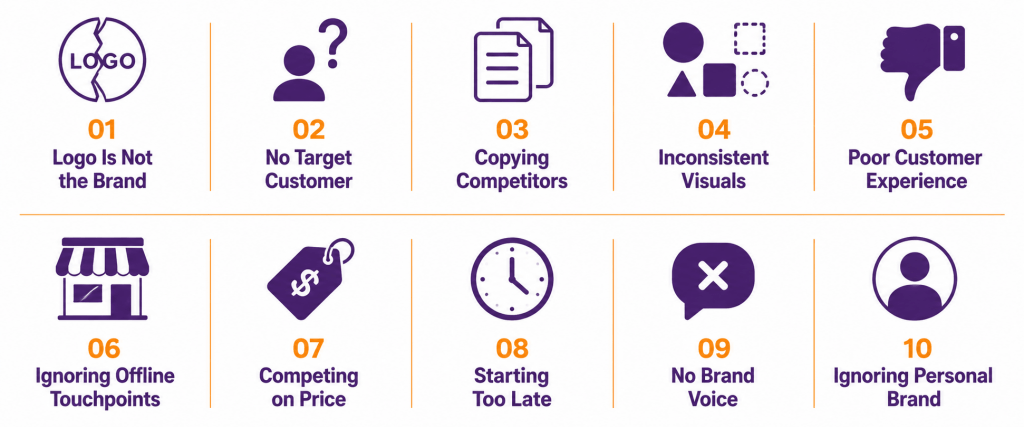
Mistake 1: Treating the Logo as the Entire Brand
Many small business owners spend time and money getting a logo designed and consider their branding done. A logo is a recognition tool — it is not a brand. Business branding also includes your colour palette, typography, packaging, the tone of your WhatsApp messages, how your staff speaks to customers, and the experience someone has when they receive your product. A polished logo with an inconsistent everything-else still produces a weak brand.
What to do instead: Define your brand beyond the logo. Write down your brand colours, the fonts you use, the tone of your communication, and how you want customers to feel after every interaction.
Mistake 2: No Clear Target Customer
Trying to appeal to everyone is the fastest way to resonate with no one. A home bakery that markets itself as “cakes for all occasions for everyone” competes with every other bakery on price alone. A bakery that positions itself as “custom celebration cakes for families in Pune” has a clear identity, attracts the right customers, and can charge accordingly.
What to do instead: Define your target customer specifically — their age, location, income level, what they value, and what problem your product or service solves for them. Every branding decision should be made with this customer in mind.
Mistake 3: Copying a Competitor’s Visual Identity
Using a similar colour scheme, logo style, or communication tone as a direct competitor does not help you compete — it confuses customers and makes you interchangeable. If two businesses in the same category look and sound alike, the customer will choose the one they heard of first or the one with the lower price.
What to do instead: Study what competitors are doing and deliberately choose a different visual and communication direction. Differentiation — not similarity — is the goal of small business branding.
Mistakes Related to Consistency
Mistake 4: Inconsistent Visuals Across Platforms and Touchpoints
A business that uses one logo version on Instagram, a different one on its visiting card, a third on its packaging, and no logo at all on WhatsApp does not have a brand — it has a collection of disconnected assets. Customers cannot build recognition for a brand that looks different every time they encounter it.
What to do instead: Create a simple brand guideline document — even a one-page PDF — that specifies your logo, colours, and fonts. Use these consistently across every platform, printed material, and digital touchpoint.
Mistake 5: Inconsistent Customer Experience
A business that delivers excellent service one week and average service the next creates uncertainty in the customer’s mind. Business branding is as much about what the customer experiences as what they see. A beautifully designed Instagram page paired with slow responses, unclear pricing, and inconsistent product quality produces a brand that looks good but does not build trust.
What to do instead: Define what a consistent customer experience looks like for your business — from first inquiry to final delivery. Create simple checklists or processes that ensure the quality of the experience does not depend on how busy or tired you are that day.
Mistake 6: Ignoring Offline Brand Touchpoints
Many small businesses invest in their Instagram presence but ignore what happens in person. Packaging that looks generic, a shop or stall with no signage, receipts with no logo, delivery that arrives in unmarked bags — these are all missed branding opportunities. For Indian small businesses, where a significant portion of sales still happens in person or through WhatsApp, offline touchpoints are part of the brand experience.
What to do instead: Audit every point at which a customer encounters your business — online and offline. Packaging, signage, visiting cards, delivery, follow-up messages — each should carry consistent brand elements.
Mistakes Related to Brand Strategy
Mistake 7: Competing on Price Instead of Brand Value
Reducing your price to match or undercut a competitor is a branding decision. And it is one that positions your business as a commodity rather than a brand. Once a business is known for being cheap, it is difficult to charge more, even if the quality improves. Competing on price also leaves no margin for investing in growth, quality improvement, or marketing.
What to do instead: Build brand value by communicating what makes your product or service worth paying for. Shift the customer’s attention from price to the problem you solve, the quality you deliver, or the experience you provide. Customers pay more for brands they trust.
Mistake 8: Starting Branding Too Late
A common belief among Indian small business owners is that branding is something to think about once the business is bigger. In practice, every customer interaction from day one is forming a brand perception — with or without your input. Businesses that delay branding end up with an accidental brand built from inconsistency and missed opportunities.
What to do instead: Start with the basics from day one — a consistent logo, two or three brand colours, a defined tone of communication, and a clear statement of what your business offers and for whom. Branding does not require a large budget to begin.
Mistake 9: No Defined Brand Voice
Many small businesses have a visual identity but no consistent communication style. The Instagram captions are formal, the WhatsApp messages are casual, the packaging copy is generic, and the in-person experience is entirely different again. A customer encountering these different voices does not feel they are dealing with one coherent business.
What to do instead: Decide how your brand communicates — warm and conversational, professional and precise, friendly and informal — and apply that voice consistently across every channel. Your brand voice should feel the same whether someone reads your Instagram bio or receives a message from you on WhatsApp.
A Mistake Many Founders Overlook
Mistake 10: Ignoring Personal Branding as a Business Owner
For small businesses, especially in the early stages, the founder’s identity and the business brand are closely connected. Customers often buy from people they trust before they buy from a brand they recognise. A small business owner who is visible — sharing their story, their expertise, and the thinking behind their business — builds trust faster than a business that only shows products.
What to do instead: Consider your personal presence as part of your business branding. Share your journey, your process, and your perspective on social media. Customers who trust the person behind a business are more loyal and more likely to recommend it to others.
Conclusion
The 10 branding mistakes covered in this guide share a common thread: they all result from treating branding as an afterthought rather than a foundation. Business branding is not a one-time exercise — it is an ongoing discipline of showing up consistently, communicating clearly, and delivering an experience that matches the promise the brand makes.
The good news is that none of these mistakes require a large budget to fix. Defining a target customer, creating a simple brand guideline, choosing a consistent voice, and treating every customer touchpoint as part of the brand experience are decisions, not expenses. For Indian small businesses competing in crowded local and online markets, these decisions are often the difference between a business that customers remember and one they forget.
Your Next Step

deAsra’s Branding for Business Growth resource page brings together practical tools, expert insights from branding professionals, and a downloadable checklist to help Indian small business owners build a brand that is consistent, credible, and positioned for growth. It is free and built specifically for entrepreneurs who are ready to take their branding seriously.
FAQs
What are the most common branding mistakes small businesses make in India?
The most common branding mistakes include treating the logo as the entire brand, having no defined target customer, inconsistent visuals across platforms, competing on price instead of brand value, and ignoring offline touchpoints like packaging and signage. Most of these mistakes come from starting branding too late or defining it too narrowly.
Why is business branding important for small businesses in India?
Business branding determines how customers perceive and remember a business. A consistent, clearly defined brand builds trust, allows a business to charge more than unbranded competitors, and reduces the need to compete on price. For small businesses in India where word-of-mouth and repeat customers drive a significant share of revenue, a strong brand directly supports growth.
How do I build a consistent brand for my small business without a big budget?
Start with a one-page brand guideline that defines your logo, two or three brand colours, and your brand voice. Apply these consistently across your Instagram, WhatsApp, packaging, and visiting cards. Consistency does not cost money — it requires decisions. Use free tools like Canva to create branded templates for social media posts and promotional materials.
When should a small business start thinking about branding?
From day one. Every customer interaction from the first sale onward is forming a brand perception. Small businesses that delay branding end up with an accidental brand built from inconsistency. Starting with basic brand elements early — a consistent logo, defined colours, a clear communication tone — makes every subsequent marketing effort more effective.
What is the difference between a logo and a brand for a small business?
A logo is a visual symbol that represents a business. A brand is the complete set of signals a business sends — its visual identity, communication style, customer experience, and the promise it makes. A well-designed logo with inconsistent communication, poor packaging, and variable customer experience produces a weak brand. Branding encompasses every touchpoint a customer has with a business.