
From Idea to Action: How to Validate Your Business Idea Before You Start
In India’s thriving entrepreneurial landscape of 2026—with over 2 lakh DPIIT-recognised (Department for Promotion of Industry and Internal Trade ) startups and unprecedented access to digital tools, government schemes, and global connectivity—many industry leaders spot promising business ideas every day. Yet far too many launch without confirming real demand, only to face costly pivots or failure. The smartest path forward lies in rigorous validation: turning assumptions into evidence through structured steps like validating business idea processes, deep market research, precise target audience identification, and direct demand testing. This approach minimises risk and builds confidence before committing significant time or capital.
deAsra supports and engages aspiring founders through practical resources, including checklists and assessments that simplify early validation and compliance. For deeper guidance on formal planning, explore their essential guide on how to write a business plan. Start with the foundational steps outlined here, and discover more structured support at deAsra’s Start a Business page.

Why Validation Matters More Than Ever in 2026
Validation acts as the critical filter between inspiration and sustainable success. Industry leaders from sectors like tech, retail, services, and manufacturing often generate dozens of business ideas but succeed only when they confirm customers will pay for the solution. Skipping this stage leads to common traps: building features nobody needs, misjudging market timing, or draining resources on unproven concepts.
Mr. Vikrant Bhujbalrao, a respected business coach and first-generation entrepreneur featured on the deAsra and dreamBIG podcast, emphasises this clearly: “Build something customers are willing to pay for.” His insight, drawn from evaluating over 10,000 business ideas and mentoring more than 100 founders, highlights that true viability comes from evidence of demand, not internal excitement alone.
In today’s environment, validation has become faster and more accessible. AI tools deliver instant competitive scans and market sizing, while low-cost digital experiments allow quick tests without heavy investment. Industry leaders benefit from this shift: they can de-risk decisions, align offerings with persistent needs (such as food, health, shelter, or emerging areas like sustainability and AI integration), and position ventures for scalable growth.
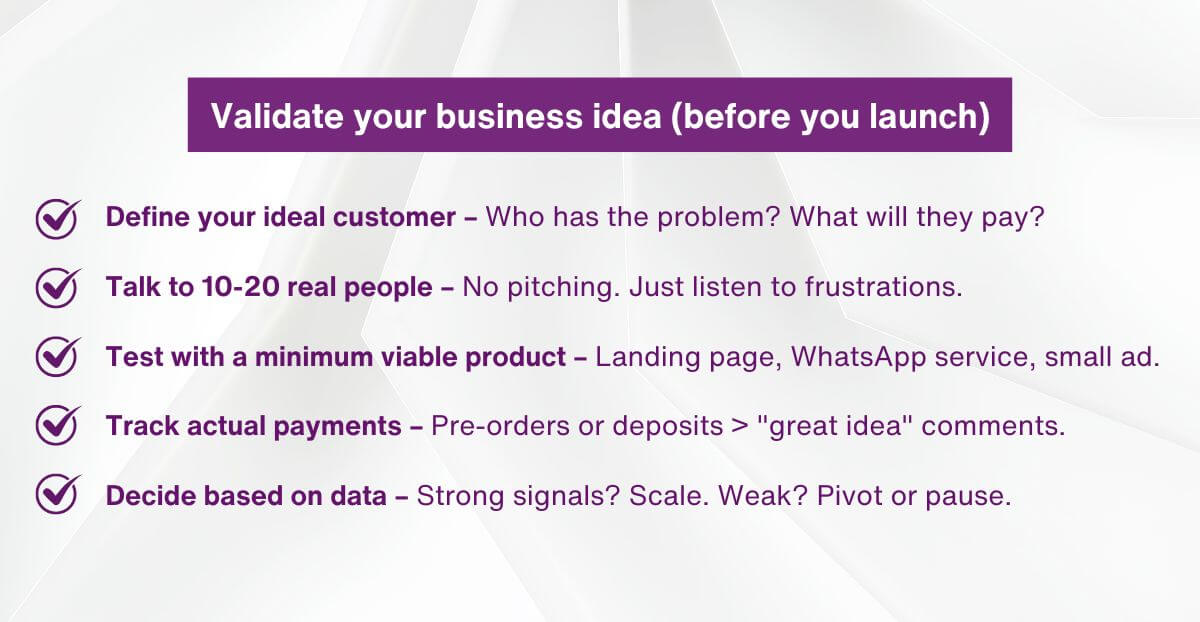
Step 1: Define Your Ideal Customer Profile and Conduct Deep Market Research
Begin by sharpening focus on who truly faces the problem your business idea solves. Create a detailed Ideal Customer Profile (ICP) based on 15–25 real individuals or segments, not vague groups or personal circles. Include demographics, pain points, current workarounds, and budget realities.
Conduct thorough market research to map the landscape. Study industry trends, competitor offerings, and gaps using free resources like Google Trends or public data. In India, pay attention to regional dynamics—urban price sensitivity, rural opportunities, or Bharat-centric models. Surveys, public reports, and conversations reveal whether the need persists and evolves.
This research phase directly supports validating business idea efforts by grounding assumptions in facts. Leaders who invest time here avoid the error of assuming personal challenges reflect widespread demand. Tools like AI-powered platforms (such as IdeaProof) provide rapid TAM/SAM/SOM estimates and competitor insights in minutes, accelerating the process while maintaining rigour.
Step 2: Engage in Customer Discovery Interviews
Talk directly to potential customers without pitching your solution. Ask open questions: When did this problem last arise? How do they handle it now (perhaps via WhatsApp, spreadsheets, or local vendors)? What frustrates them? How much would they spend to fix it?
Aim for 10–20 candid interviews through networks, LinkedIn, community groups, or local meetups. Listen actively to uncover budget constraints and genuine willingness to pay. These conversations often expose surprises—such as hidden preferences or stronger alternatives—that reshape the business idea.
Mr. Vikrant Bhujbalrao advises focusing on enduring human needs to ensure longevity. This principle guides effective discovery: prioritise problems tied to basics or high-value outcomes, then confirm severity through honest feedback. Industry leaders find this step transformative, as it replaces guesswork with real insights and builds early relationships.
Step 3: Build and Test a Minimum Viable Product or Service
Create the simplest version possible to test demand overall. For many Indian ventures, this means a manual service—perhaps coordinating via WhatsApp—rather than a full app or product line. The goal remains the same: prove people engage and commit.
Launch a “fake door” test with a basic landing page (using tools like Carrd) describing the offering and including a pre-order or waitlist button. Run targeted, small-budget ads on Facebook or Google to measure clicks, sign-ups, and interest. Track metrics such as click-through rates above 2–3% or sign-up rates over 5–10% as positive signals.
The decisive proof arrives when prospects take financial action like pre-orders, small deposits via UPI, or letters of intent. This step in validate business idea confirms the pain point justifies payment, separating viable concepts from speculative ones.
Step 4: Measure, Iterate, and Decide Next Moves
Track clear indicators of progress: validation of demand, initial sign-ups, feedback loops, and early revenue signals. Set specific deadlines—such as completing interviews in one week or launching a test page in two—to combat overthinking.
If results show strong interest and willingness to pay, move confidently toward formalisation, team building, and scaling. If signals remain weak, pivot quickly or abandon the business idea to preserve resources. This iterative mindset, embraced by successful founders, turns validation into a continuous strength.
Throughout, maintain discipline: document findings, refine the customer profile, and adjust based on evidence. Industry leaders who follow this path report higher confidence when seeking funding, partners, or loans, as validation data demonstrates professionalism and market fit.
Conclusion
Validating a business idea transforms uncertainty into clarity and positions ventures for lasting impact. By defining precise audiences, conducting honest research and interviews, building lightweight tests, and proving payment intent, leaders across sectors create ventures rooted in reality rather than hope. This disciplined approach—supported by accessible tools, AI acceleration, and expert guidance—reduces failure risks and unlocks scalable potential in India’s dynamic economy.
deAsra supports and engages entrepreneurs at every stage with resources designed for practical progress. Embrace validation as your first action, and turn promising business ideas into thriving realities. The journey rewards those who test rigorously before they leap.

FAQs
1. How long does it typically take to validate a business idea?
Validation can take 4–8 weeks if approached systematically. Begin with customer interviews and market research in the first two weeks, followed by MVP tests and demand checks in the next phase. Set firm deadlines to maintain momentum and avoid delays.
2. What if my interviews show no strong interest?
Low interest signals a need to pivot or refine the business idea. Revisit the problem, adjust the ICP, or explore related needs. Early detection saves resources and allows exploration of stronger opportunities before significant investment.
3. Do I need money to start validation?
Minimal funds suffice for most steps. Use free tools for research, conduct interviews via existing networks, and run low-budget ads (₹1,000–5,000). Focus on organic methods first to prove demand without heavy spending.
4. How does validation differ for service versus product businesses?
Service businesses emphasise high-value clients and willingness to pay through packages or consultations. Product businesses focus on volume potential and scalability. Both require proving demand via pre-orders or commitments, tailored to customer priorities.
5. Can AI tools replace human interviews?
AI accelerates analysis with quick market scans and competitor insights, but human interviews remain essential for a nuanced understanding of pain points and budgets. Combine both for the strongest validation of business idea outcomes.