
12 Common Business Tax Deductions You Might Be Missing
For most entrepreneurs in India, saving on business income tax feels confusing—but it doesn’t have to be. The truth is, many business owners end up paying more business tax simply because they don’t claim the deductions that the law already allows.
During a recent dreamBIG podcast by deAsra Foundation, CA Amit Lomte and CA Anoop Tabe shared a powerful insight: “The real profit of a business is seen only after you claim every eligible deduction.”
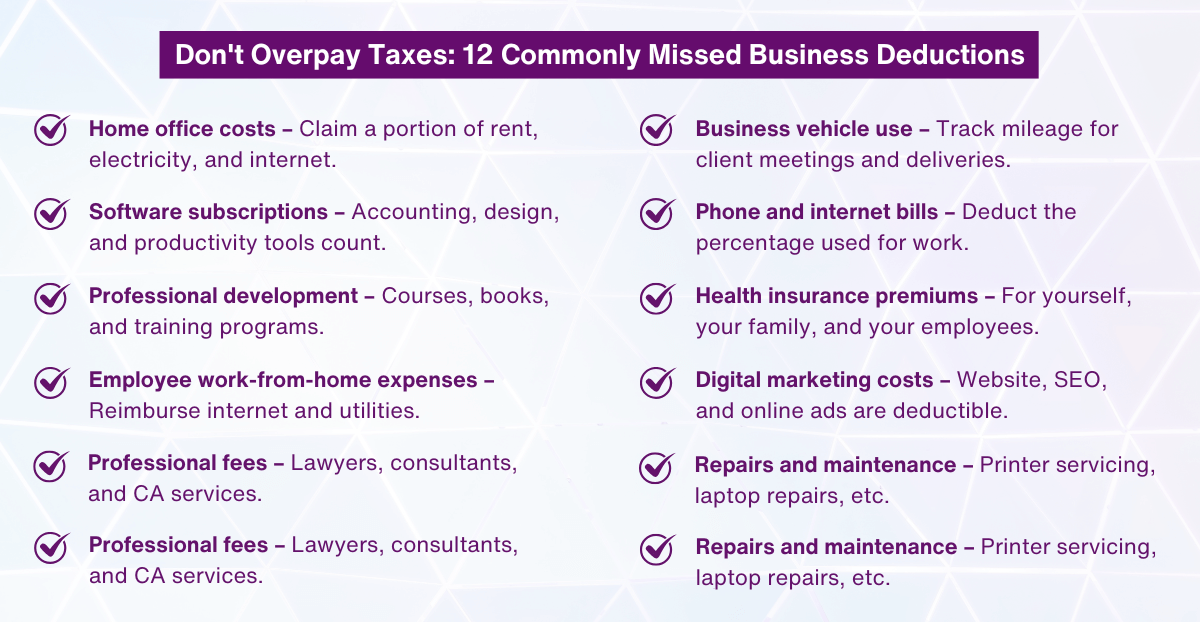
To help you make the most of 2026, here are the 12 simplest deductions that business owners often miss—explained in an easy, practical way.
1. Home Office Expenses – A Simple Everyday Saving
If you work from a part of your home, you can claim a share of rent, electricity, Wi-Fi and repairs. This could be a corner of your living room or a separate room. You can calculate this using a per sq ft rate or by measuring the actual proportion used for work. This is one of the most common savings founders miss.
2. Vehicle and Mileage Expenses
When you use your personal vehicle for client visits, deliveries or market visits, those expenses count as business expenses. You can claim fuel, servicing, repairs or a simple per-kilometre rate. A basic notebook or app to track kilometres is enough—no complex system needed.
3. Software and Online Tools You Use Every Day
Accounting tools, design software, CRM systems, cloud storage and even subscriptions like Zoom Pro or Grammarly are fully deductible. If the tool helps you run your business, the cost can be claimed as an expense.
4. Mobile Phone and Internet Bills
If you use your phone mostly for work, you can claim the work-related portion of your bill. For example, if 60% of your usage is business-related, you can claim 60% of the bill. Many freelancers forget this simple deduction.
5. Courses, Books, and Training Programmes
Any online course, workshop, seminar or book that helps you or your team improve business skills can be claimed. This covers platforms like Udemy, Coursera, industry training programmes and paid webinars.
6. Health Insurance for Yourself and Family
Proprietors and partners can reduce their business income tax by claiming health insurance premiums for themselves and their families. Depending on age, this deduction can range from ₹25,000 to ₹1,00,000.

7. Work-from-Home Allowances for Employees
If you reimburse employees for electricity or internet while they work from home, the entire amount is deductible for the business. These reimbursements are also tax-free for employees when recorded properly.
8. Website, Digital Marketing & Online Presence Costs
Domain renewal, hosting, SEO tools, ads on Google or Facebook, influencer marketing—everything you spend to build your online presence is deductible. Many businesses also use guides like this article on how to calculate your business income tax to correctly record digital expenses.
9. Professional Fees (Not Just CA Bills)
Payments made to lawyers, consultants, designers, virtual CFOs, digital marketers or trademark experts are all valid deductions. Any expert service that supports your business operations reduces your business income tax.
10. Repairs and Maintenance
Small repair bills—printer servicing, laptop repairs, AC service—can be claimed immediately. As long as the amount is within reasonable limits, you don’t need to treat it as a capital purchase.
11. Food Expenses During Business Travel or Meetings
Meals during official travel or client meetings can be claimed up to 50%. Many business owners skip this because they pay for food personally, but even simple bills can reduce your business tax.
12. Pre-Launch or Start-up Costs
Before officially starting your business, you may spend on logo design, domain, branding, or research. These costs can be claimed over five years under Section 35D. Many new founders discover this through expert conversations like the dreamBIG episode on accounting & taxation for small businesses
Key Reminder
CA Amit Lomte said it best: “Your bank balance shows money. Your real profit shows only after deductions.”
How to Start Claiming These in 2026
- Use a separate bank account for business spending.
- Keep simple records—Excel or basic cloud tools are enough.
- Review expenses every month instead of waiting for the year-end.
- Speak to your CA regularly to avoid missing deductions.
Conclusion
Deductions are not loopholes—they are your legal rights as a business owner. Every unclaimed deduction increases your business tax and reduces your working capital. By tracking everyday expenses and claiming what you are entitled to, you can reduce your business income tax by 15–30% this year.
Saving properly is just as important as earning more.

FAQs
1. Can I claim rent even if I work from my own home?
Yes. You can assign a reasonable “notional rent” to the portion of your home used for work and claim it as an expense. With proper records, this reduces your business income tax legally.
2. Can I claim fuel if my personal vehicle is used for business work?
Yes. If you use your personal vehicle for meetings or travel related to work, you can claim the business portion of fuel and maintenance. Keep a simple kilometre log as proof.
3. Are employee training or online courses deductible?
Yes. Any training, course, or workshop that improves business skills—whether for you or your employees—is fully deductible under Section 37.
4. Can I claim CA fees or other professional charges paid in cash?
No. Any payment above ₹10,000 made in cash to a professional cannot be claimed. Always use bank transfer, UPI, or cheque to ensure the deduction is applied correctly.
5. Can freelancers claim co-working space expenses?
Yes. If you use a co-working space or shared office, the full fees can be claimed. This directly reduces your business income tax, provided you keep receipts and proof of payment.