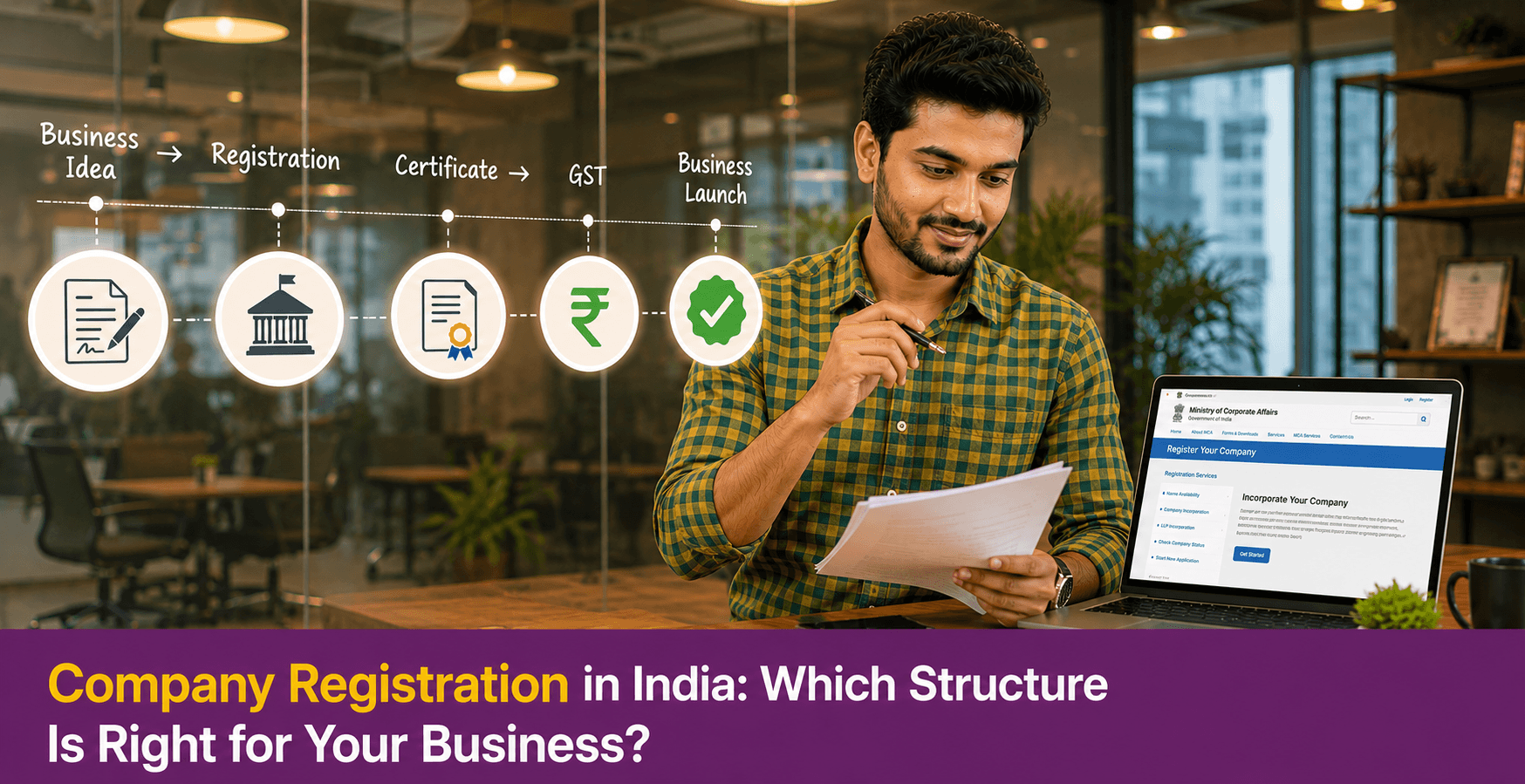
Company Registration in India: Which Structure Is Right for Your Business?
Registering a business in India means choosing a legal structure first. The four main options for small business owners are sole proprietorship, partnership firm, Limited Liability Partnership (LLP), and private limited company. Each has different costs, compliance requirements, liability rules, and tax implications. This guide covers what each structure involves, how to register under each, and which suits different business types — with updated 2026 requirements throughout.
Key Takeaways
- A sole proprietorship is the simplest structure but carries unlimited personal liability. It does not require MCA registration — GST registration, Udyam registration, and a Shop & Establishment Act licence together give it legal recognition
- An LLP gives partners limited liability and a separate legal identity, with lower compliance requirements than a private limited company. Minimum two designated partners are required, at least one of whom must be a resident of India
- A private limited company is the right structure for businesses planning to raise external funding. It requires minimum two directors and two shareholders, and is registered through the SPICe+ form on the MCA portal
- Udyam Registration (MSME registration) is free, fully online, and permanent. It unlocks collateral-free loans, delayed payment protection, and government scheme access. Old UAM registrations must migrate to Udyam by 31 December 2026
- GST registration is required when annual turnover crosses ₹40 lakh for goods or ₹20 lakh for services. Voluntary registration is possible before crossing these thresholds

What Are the Main Business Structures Available in India?
India offers four primary business structures for small business owners. Each balances simplicity, legal protection, tax treatment, and compliance differently.
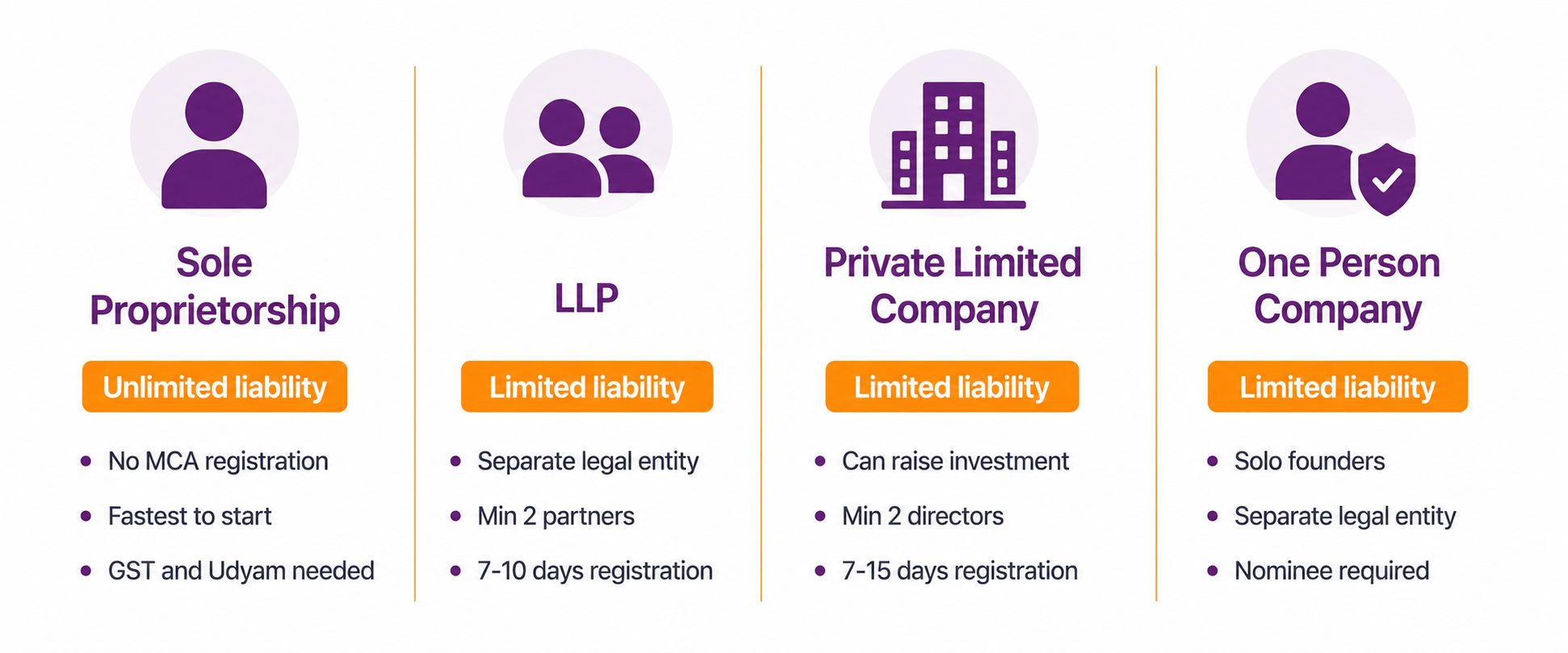
| Structure | Separate Legal Entity | Personal Liability | Minimum Persons | Best For |
| Sole Proprietorship | No | Unlimited | 1 | Micro businesses, home-based, first-time entrepreneurs |
| Partnership Firm | No | Unlimited | 2 | Family businesses, small traders with multiple partners |
| LLP | Yes | Limited | 2 | Professional services, small and medium businesses |
| Private Limited Company | Yes | Limited | 2 directors, 2 shareholders |
Businesses planning to raise investment or scale significantly |
| One Person Company (OPC) | Yes | Limited | 1 | Solo entrepreneurs wanting limited liability |
The most common starting point for Indian small business owners is sole proprietorship. It requires no formal incorporation and you can establish it quickly. LLP and private limited company suit businesses that want legal separation between personal and business assets, or plan to grow significantly.
How Is a Sole Proprietorship Registered in India?
A sole proprietorship does not have a formal registration process with the Ministry of Corporate Affairs (MCA). The government does not maintain a central registry for proprietorship firms. A sole proprietorship gets its legal recognition through a combination of registrations that together establish the business as a legitimate entity.
Step 1: Get a PAN card in the business name (or use personal PAN) For a sole proprietorship, the proprietor’s personal PAN serves as the business PAN. A separate business PAN is not required.
Step 2: Register for GST (if applicable or voluntarily) GST registration gives a sole proprietorship a GSTIN, which banks and clients use to verify the business. GST registration is mandatory when turnover crosses ₹40 lakh for goods or ₹20 lakh for services. You can also register voluntarily before crossing these limits for credibility and input tax credit eligibility. Register at gst.gov.in.
Step 3: Get Udyam Registration Udyam Registration from the Ministry of MSME gives your business official MSME recognition and a permanent Udyam Registration Number (URN). It unlocks government schemes, priority lending, and payment protection. It is free and takes under 15 minutes at udyamregistration.gov.in.
Step 4: Get a Shop & Establishment Act licence Your local municipal authority or state labour department issues this licence for businesses operating from commercial premises. Requirements vary by state. In Maharashtra, for example, this falls under the Maharashtra Shops and Establishments (Regulation of Employment and Conditions of Service) Act.
Step 5: Open a current bank account Banks require at least two of the above registrations to open a current account in the business name. A current account separates personal and business finances, simplifying GST filing, income tax, and client payments.
A sole proprietorship carries unlimited personal liability. If the business owes money to creditors, the owner’s personal assets are at risk. This is the key limitation of this structure compared to an LLP or private limited company.
When Should You Choose an LLP Over a Sole Proprietorship?
Choose an LLP when you want limited liability protection, a separate legal identity, or when you are starting with a partner. LLPs work well for professional services firms: consultants, architects, designers, and chartered accountants. They also suit businesses with two or more founders who want to protect personal assets.
Key LLP facts (2026):
- Governed by the Limited Liability Partnership Act, 2008
- Requires minimum two designated partners
- At least one designated partner must be a resident of India with a minimum 120-day stay in the preceding financial year, under the LLP Amendment Act, 2021
- No minimum capital contribution required
- Separate legal entity — the LLP can own property, enter contracts, and be sued in its own name
- Taxed at a flat rate of 30% on profits
- LLP agreement must be filed with MCA within 30 days of registration
How to register an LLP: Register through the MCA portal using the FiLLiP (Form for Incorporation of LLP) form. Each designated partner needs a Digital Signature Certificate (DSC) and a Designated Partner Identification Number (DPIN) before filing. Registration typically takes 7 to 10 working days.
An LLP has fewer compliance requirements than a private limited company but more than a sole proprietorship. Annual filing of Form 8 (accounts and solvency) and Form 11 (annual return) with MCA is mandatory. Late filings attract penalties.
What Does Private Limited Company Registration Require in India?
A private limited company suits businesses that plan to raise external funding. Only a private limited company can issue equity shares to investors, making them shareholders. An LLP cannot accommodate this structure.
Key private limited company facts (2026):
- Governed by the Companies Act, 2013
- Minimum two directors and two shareholders (can be the same persons)
- Directors need a Director Identification Number (DIN) and Digital Signature Certificate (DSC)
- No minimum paid-up capital requirement since the Companies (Amendment) Act, 2015
- Founders register through the SPICe+ (Simplified Proforma for Incorporating Company Electronically Plus) form on the MCA portal
- Registration timeline: 7 to 15 working days
- A registered office address is mandatory — residential addresses are accepted
Post-registration compliance:
- File Form INC-20A (declaration of commencement of business) within 180 days of incorporation
- Hold at least two board meetings in the first year
- File annual returns with MCA and income tax returns every year
A private limited company has higher compliance requirements and costs than an LLP or sole proprietorship. It is the correct choice when investor funding is on the roadmap. For most small business owners in the early stages, it adds unnecessary compliance overhead.
What Is Udyam Registration and Why Does Every Small Business Need It?
Udyam Registration is the government’s official MSME recognition system, managed by the Ministry of Micro, Small and Medium Enterprises. Every small business in India should register on the Udyam portal if it qualifies as a micro, small, or medium enterprise. This applies to sole proprietorships, partnerships, LLPs, and private limited companies.
Why Udyam Registration matters:
- Access to collateral-free loans under the Credit Guarantee Trust Fund for Micro and Small Enterprises (CGTMSE) scheme
- Legal protection against delayed payments — buyers must pay within 45 days or face compound interest liability under the MSMED Act
- 50% subsidy on patent and trademark registration fees
- Eligibility for government tenders and procurement programmes exclusive to MSMEs
- Priority access to government schemes including PMEGP and sector-specific subsidies
How to register for Udyam (2026): Go to udyamregistration.gov.in. The process is fully online, free, paperless, and takes under 15 minutes. You need your Aadhaar number, PAN card, and GSTIN (if registered for GST). You need not upload any documents. The portal validates your details against PAN and GST databases automatically.
Your Udyam certificate is permanent and does not require renewal. Update your financial data (turnover and investment figures) once a year to keep your MSME classification accurate.
Important: If your business holds an old Udyog Aadhaar Memorandum (UAM) registration, migrate it to Udyam by 31 December 2026. Banks and government portals will reject old UAM registrations after this date for loan applications, government schemes, and tender participation.
Visit udyamregistration.gov.in for current MSME classification thresholds, since the government revises these periodically.
What Other Registrations Does a New Business Need?
Beyond the structure-specific registration and Udyam, most small businesses in India need the following:
| Registration | When Required | Portal |
| GST Registration | Turnover above ₹40 lakh (goods) or ₹20 lakh (services); or voluntary | gst.gov.in |
| PAN (Business) | All registered companies and LLPs — issued automatically via SPICe+ | incometax.gov.in |
| TAN | Required if you deduct TDS on payments above threshold | tin.tin.nsdl.com |
| Shop & Establishment Act Licence | All businesses operating from commercial premises | State-specific portal |
| FSSAI Registration or Licence | All food businesses — mandatory before starting | foscos.fssai.gov.in |
| Trade Licence | Some business types require a trade licence from local municipality | Municipal corporation portal |
Not every registration applies to every business. A home-based tiffin service needs FSSAI registration and GST registration. A consulting firm needs GST registration and TAN if it pays professional fees. A retail shop needs a Shop & Establishment Act licence, GST registration, and Udyam registration. Start with the registrations specific to your business type and sector.
Conclusion
Choosing the right business structure is the first decision in any company registration in India. For most first-time small business owners, a sole proprietorship is the fastest and simplest starting point. It costs almost nothing, requires no MCA registration, and gives you legal recognition through GST and Udyam registration. The trade-off is unlimited personal liability.
An LLP makes sense when you have a co-founder, want limited liability protection, or are building a professional services firm. A private limited company makes sense when raising external investment is on the plan. Both require MCA registration and carry annual compliance costs.
Regardless of which structure you choose, Udyam Registration should follow immediately. It is free, takes under 15 minutes, and unlocks government scheme access, priority lending, and legal payment protection.

Your Next Step
Two registrations every new small business in India should complete first: GST registration and Udyam registration. deAsra’s GST Registration Service covers the full application process, document preparation, and submission. deAsra’s Udyam Registration Service helps you get your MSME certificate and access the government benefits it unlocks.
FAQs
What is the easiest way to register a small business in India?
The simplest path is sole proprietorship registration through GST registration, Udyam registration, and a Shop & Establishment Act licence. There is no MCA registration required. A sole proprietorship can be legally operational within a few days. The main limitation is unlimited personal liability — the owner’s personal assets are not protected from business debts.
What is the difference between an LLP and a private limited company in India?
An LLP has limited liability for partners and fewer compliance requirements than a private limited company. An LLP cannot issue shares to investors. This makes it unsuitable for businesses planning to raise venture capital or angel funding. A private limited company can issue equity shares, which is why investor-backed businesses use this structure. Both require MCA registration and carry separate legal identity.
Is Udyam Registration mandatory for small businesses in India?
Udyam Registration is not legally mandatory to operate a business, but it is essential for accessing MSME benefits. Without Udyam Registration, a business loses access to CGTMSE collateral-free loans, delayed payment protection, MSME-exclusive government tenders, and patent and trademark subsidies. Registration is free, takes under 15 minutes, and has permanent validity.
What is the GST registration threshold for a new small business in India?
GST registration is mandatory when annual turnover crosses ₹40 lakh for businesses selling goods, or ₹20 lakh for service-based businesses. Special category states have lower thresholds. Voluntary registration is possible before crossing these limits. It gives the business a GSTIN, which improves credibility with clients and enables input tax credit claims.
How long does company registration take in India?
An LLP registration through the MCA portal typically takes 7 to 10 working days. A private limited company registered through the SPICe+ form typically takes 7 to 15 working days. A sole proprietorship can be operational within a few days once GST and Udyam registrations are complete. No MCA filing is required.