
6 Common Team Management Challenges and How to Overcome Them
Entrepreneurs building small teams face team management hurdles that can stall progress if left unaddressed. From delegation struggles to low engagement and interpersonal friction, these challenges of managing a team demand practical approaches that fit real operations. deAsra supports and engages entrepreneurs through its dreamBIG podcast, where experts share grounded strategies for sustainable growth. This discussion draws insights from such conversations, including the episode featuring Mr. Adwait Kurlekar, while offering clear steps to strengthen teams across sectors.

1. Understanding Core Team Management Challenges
Small business owners often juggle multiple roles while trying to expand their workforce. Team management becomes complex when the founder remains central to daily decisions. Owners hesitate to release control, fearing tasks will suffer or standards will drop. This reluctance creates bottlenecks and prevents the business from scaling efficiently.
Many leaders also encounter difficulties in matching people to roles effectively. New hires may bring skills yet struggle to adapt to the informal environment typical in smaller setups. Without clear structures, overlap in responsibilities leads to confusion and reduced productivity. These challenges of managing a team appear frequently as businesses move beyond the solo stage.
2. Delegation Issues and the Path to Effective Handover
Delegation stands out as one of the toughest challenges of managing a team. Founders often view it as giving up control rather than building capability. They worry that work will slow down or fail to meet exact expectations. Such doubts keep them involved in routine tasks, leaving little time for strategic thinking.
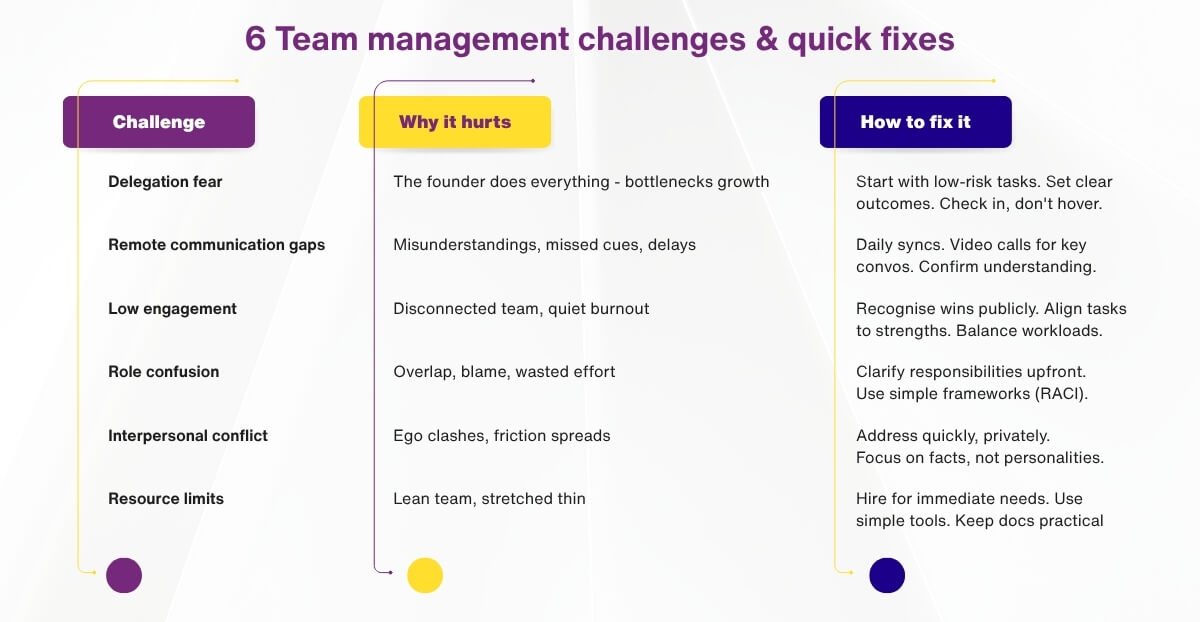
A practical way forward involves starting with low-risk activities. Identify repetitive or administrative duties that drain energy from higher-value work. Assign these to capable team members while setting clear outcomes and timelines. Regular but non-intrusive check-ins maintain accountability without constant oversight.
Mr. Adwait Kurlekar emphasised the human side in the dreamBIG podcast: “Communication isn’t just about words; body language is equally important.” This reminder highlights why face-to-face or video interactions remain valuable even in hybrid settings. Clear dialogue builds mutual understanding and reduces errors during delegation.
Owners who master this aspect of team management free themselves to focus on growth. They also develop team confidence, as members gain ownership over their contributions. Over time, this creates a more resilient operation capable of handling increased demands.
3. Remote Team Dynamics and Modern Communication Barriers
Hybrid and remote arrangements add fresh layers to the challenges of managing a team. Distance reduces spontaneous interactions, making it harder to read reactions or maintain a connection. Misunderstandings arise more easily when non-verbal cues disappear, leading to delays or frustration.
Leaders can counter this by establishing consistent communication rhythms. Schedule short daily or weekly syncs using simple platforms that suit team size. Combine digital tools with occasional video calls to preserve personal elements. Encourage questions and confirm understanding to avoid assumptions.
The deAsra blog on communication offers further guidance. Explore practical tips here: The Role of Communication in Successful Team Management. It stresses adapting styles—direct for deadlines or supportive in personal discussions—to match situations and personalities.
Another valuable resource comes from deAsra’s dedicated page on strategies: Team Management Strategies. These materials help entrepreneurs address remote dynamics while keeping operations lean and effective.
4. Tackling Low Engagement and Motivation Gaps
Low engagement ranks high among the persistent challenges of managing a team. When employees feel disconnected from purpose or unrecognised for their efforts, motivation dips. In smaller businesses, limited formal reward systems can make appreciation seem scarce.
Solutions begin with genuine recognition of contributions. Highlight achievements in team settings or through personal notes. Align tasks with individual strengths to create a sense of progress and value. Involve members in relevant decisions to foster ownership.
Team management improves when workloads stay balanced. Avoid overloading strong performers, as this breeds resentment. Distribute responsibilities fairly and watch for signs of burnout. Open conversations allow early adjustments before issues escalate. Simple gestures during tough times, such as supportive help with personal challenges, create lasting loyalty.
5. Resolving Conflicts and Building Healthy Dynamics
Interpersonal tensions form another common set of challenges of managing a team. Ego clashes, competition for influence, or unclear roles can spark blame and reduce collaboration. In close-knit groups, such friction spreads quickly through informal channels.
Prevention starts with upfront clarity on responsibilities. Frameworks that define who handles what reduce ambiguity and finger-pointing. Address concerns promptly through private, respectful discussions focused on facts rather than personalities.
When conflicts surface, explore root causes instead of surface complaints. Transparent handling preserves fairness and reinforces trust. In small teams, swift yet equitable decisions help maintain momentum without prolonged disruption.
6. Optimising Resources and Leveraging Simple Tools
Resource constraints amplify the challenges of managing a team in smaller operations. Owners naturally run lean, yet stretching people too thin risks quality and morale. Hiring decisions must target immediate needs while allowing room for adaptation.
Technology helps without adding complexity. Front-end tools that improve customer experience deliver clear value. For internal coordination, basic messaging groups or shared trackers often suffice for teams of eight to twelve. Choose solutions that solve specific pain points rather than introducing new ones.
Documentation should stay straightforward and usable. Simple outlines of roles prevent confusion without creating heavy manuals. This keeps team management practical and accessible for everyone involved.
Continuous learning through peer networks or mentors supports better handling of the challenges of managing a team. Connecting with other entrepreneurs provides fresh perspectives tailored to real conditions.
Conclusion
Mastering team management equips entrepreneurs to build resilient businesses that grow beyond the founder’s daily involvement. By addressing delegation fears, communication gaps, low engagement, remote dynamics, and conflicts with practical steps, leaders create environments where teams thrive. deAsra supports and engages entrepreneurs through resources like the dreamBIG podcast and targeted guidance, helping turn these challenges of managing a team into opportunities for stronger performance and satisfaction.

FAQs
1. What are the main challenges of managing a team in small businesses?
Common issues include reluctance to delegate, unclear roles, low engagement, and handling conflicts in informal settings. These challenges of managing a team arise because owners often stay deeply involved while lacking formal structures. Practical solutions involve setting clear expectations, using simple role definitions, and maintaining open dialogue to prevent bottlenecks and frustration.
2. How can entrepreneurs improve delegation to overcome team management challenges?
Begin by identifying tasks that drain time from strategic work and assign them with specific outcomes in mind. Regular check-ins without micromanaging build confidence on both sides. This approach reduces challenges of managing a team by freeing leaders for higher-value activities while developing team capability and accountability.
3. Why does low engagement appear as a frequent challenge of managing a team?
Employees may feel disconnected when contributions go unrecognised or when workloads seem unbalanced. In smaller setups, formal systems are limited, so genuine appreciation and fair distribution of responsibilities become essential. Addressing this through transparent updates and strength-based task assignment lifts motivation and strengthens overall team management.
4. How should leaders handle conflicts within remote or hybrid teams?
Prompt, private conversations focused on root causes work best. Use video where possible to capture non-verbal signals and establish regular syncs for alignment. Clear responsibility frameworks minimise overlap. These steps ease the challenges of managing a team by turning potential friction into collaborative problem-solving.
5. What role does communication play in solving team management challenges?
Open and adaptive communication aligns goals, reduces misunderstandings, and builds trust across distances or generations. Combining digital tools with personal interactions and active listening prevents isolation and supports timely conflict resolution. Strong communication directly tackles many challenges of managing a team and fosters a supportive culture.