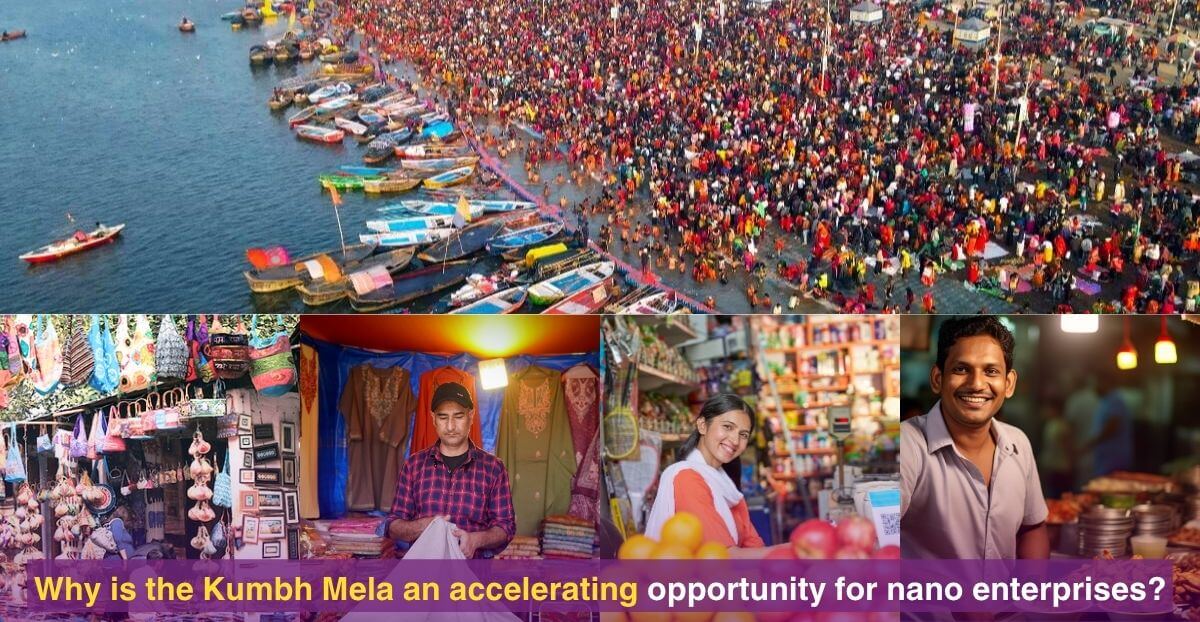
Why is the Kumbh Mela an accelerating opportunity for nano enterprises?
The Kumbh Mela is not only one of the world’s largest spiritual gatherings, but it is also a powerful driver of economic activity. The Prayagraj Maha Kumbh 2025 saw an estimated 400–450 million visits over its 45-day run, considering its massive scale and spiritual significance. With 50–70 million visitors expected in Nashik for the 2027 Kumbh and an average per-visitor spending of ₹4,500–₹5,000 (based on Prayagraj 2019 estimates), the projected economic revenue ranges from ₹22,500 to ₹35,000 crores. This scale presents an unprecedented opportunity for nano and local entrepreneurs.
Religious tourism creates what Heitzman (1991) calls a “transactional network” – an intricate web where every player, from the humblest flower vendor to the largest hotel chain, finds their niche. Historically, the Kumbh has scaled small-scale commerce during its highly concentrated weeks of activity. Scholarly research shows that traditional fairs (or melas) in India, especially the Kumbh, have long served as economic hubs where local craftsmen, food vendors, and travelling merchants earned the bulk of their annual income during the festival season (Shristy Agrawal, 2025). Therefore, the Kumbh happens to be an opportune occasion for nano/tiny businesses that function on quick demand and low working capital.
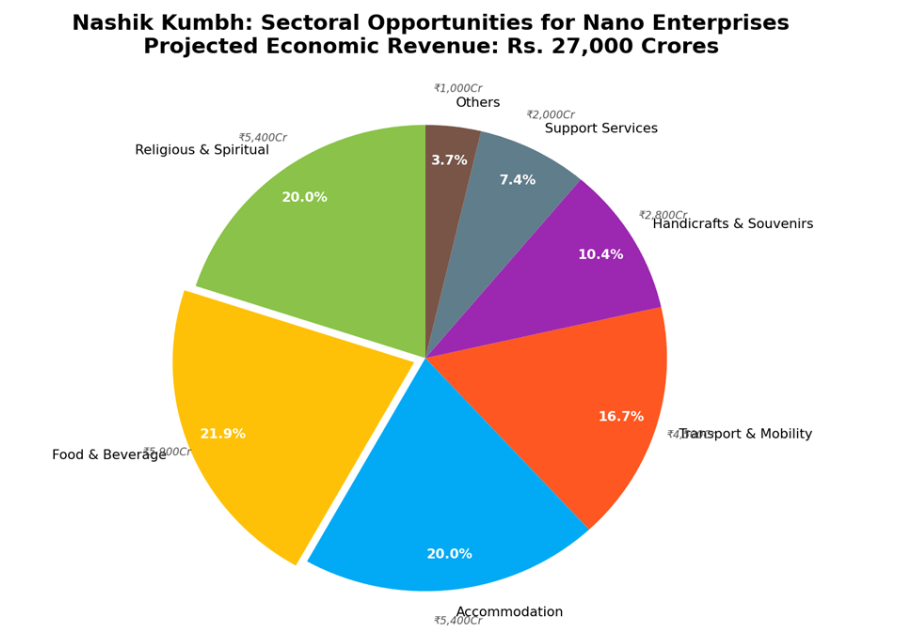
Figure 1: Nashik Kumbh: Sectoral Opportunities for Nano Enterprises
Data sources: District Economic Survey, Nashik (for baseline economy); previous Kumbh visitor spending patterns (2015 Nashik and 2019 Prayagraj).
Figure 1 projects a picture of the sectoral opportunities available for nano enterprises. The market size distribution shows that nearly two-thirds of the entire projected ₹27,000 crore market lies in Food & Beverage (21.9%), Religious & Spiritual Retail (20%), and Accommodation (20%). To further break down the subsectors mapped into these broad sectors: vendors dealing in puja materials and items, flowers and garlands, religious books and literature, street food vendors, tea and snack stalls, traditional sweet shops, prasad distribution centres, lodging and boarding centres, etc.
With the Kumbh creating an inherent market for local and nano entrepreneurs to thrive, some of the potential business opportunities can be transformed into viable ones, and existing nano enterprises can find the acceleration that puts them on a growth path. During the Kumbh, visitors rely heavily on quick, hygienic, and affordable food services, creating steady demand for tea stalls, snack vendors, prasad boxes, and simple home-style meals. This demand allows many to try their entrepreneurial ideas and also allows existing food businesses – through branding and online marketing – a chance to taste growth.
Another untapped area is souvenir localisation. Studies from pilgrimage towns like Jejuri and Tuljapur show that most souvenirs sold during religious festivals are mass-produced, not locally (Shinde, 2025). Nashik has a chance to change this pattern by promoting local craftsmanship. Artisans can offer bamboo crafts, Paithani-inspired textiles, locally crafted idols, traditional décor, and locally packaged prasad or dry snacks.
Given all this, the presence of larger market players overshadowing the local and nano players cannot be ignored. A collaborative approach proves to be useful, as seen in the Prayagraj 2019 model. Successful nano-enterprises became suppliers to larger firms: local sweet-makers provided hotels with authentic prasad, home cooks supplied corporate kitchens with regional specialities, and local households partnered with larger hospitality firms. Homestays can be another business type that can flourish during the Kumbh.
The Kumbh creates an acceleration opportunity where small vendors can earn in months what they usually make in a year. However, challenges like information asymmetry, lack of working capital, limited digital readiness, and weak linkages to formal systems are equally prominent. Targeted and structured interventions such as designated nano-enterprise zones, simplified registration (even adopting basic digital tools like enabling QR codes), subsidised credit, and skill building can prepare these enterprises to harness the opportunity effectively.
The path ahead is clear: prepare early, build capacity, and empower nano enterprises not only to serve the market but also to grow with it. The Kumbh leaves a lasting impact on devotees, giving them an experience to cherish for life. It can play a similar role for thousands of enterprises in the vicinity if society, the market, and the government create the required conditions for it.
References:
- Shristy Agrawal, D. A. (2025). Economic Impact of Kumbh Mela on Local Communities and Spiritual Tourism. International Journal of Scientific Research in Engineering and Management (IJSREM).
- Shinde, K. (2025). Entrepreneurship Opportunities in the Religious Tourism Economy.