Upskilling Employees and Reskilling: A Strategic Approach to Future-Proof Your Workforce
In an era of rapid technological shifts and evolving market demands, industry leaders recognise that upskilling employees stands as a cornerstone of sustainable growth. Upskilling employees equips teams with enhanced capabilities to meet current challenges while building resilience against future disruptions. This strategic focus on upskilling employees not only bridges skill gaps but also fosters adaptability, productivity, and loyalty.
As Mr. Sajiri from Anand HR Solutions insightfully notes in the deAsra dreamBIG podcast, “Training is the same—an investment… What’s worse is not training someone who stays. That’s a bigger problem.” By prioritising upskilling employees, organisations turn potential vulnerabilities into competitive strengths.

Understanding Upskilling and Reskilling
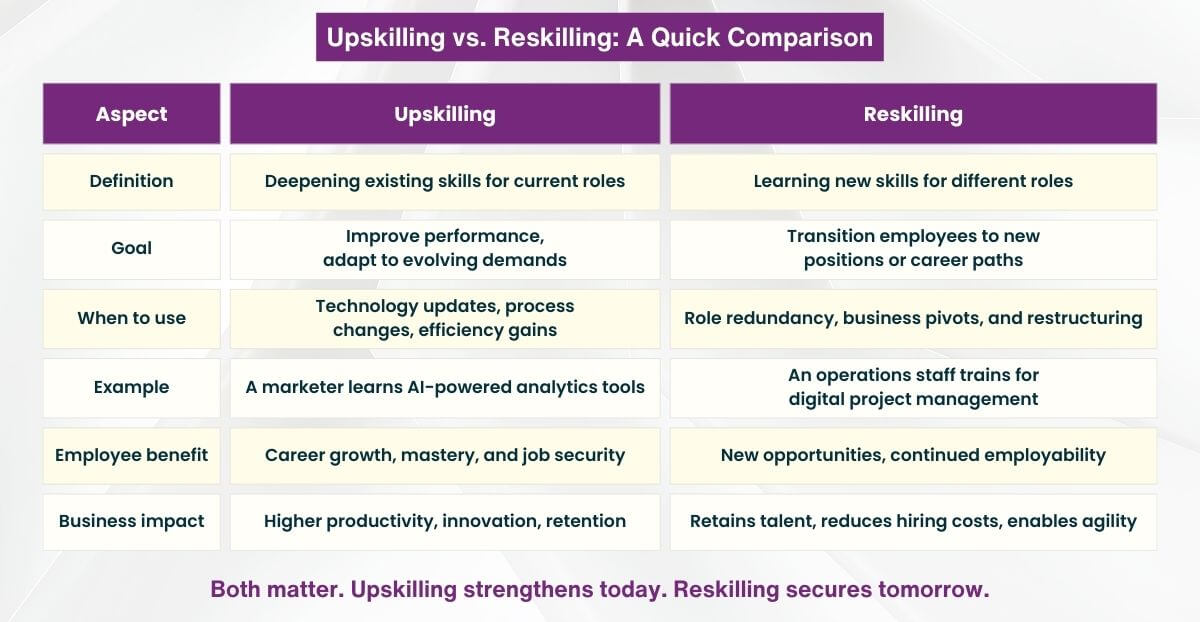
Upskilling employees involves deepening existing skills to improve performance in current roles. For instance, a sales professional might advance their expertise in digital tools or data analysis to handle complex client interactions more effectively. This approach keeps talent sharp and aligned with emerging trends like AI integration or automation. Upskilling employees proves cost-effective, as it leverages internal resources rather than relying solely on external hires.
Reskilling, by contrast, prepares individuals for entirely new responsibilities or career paths within the organisation. It addresses role redundancy or business pivots, such as shifting a team member from traditional operations to digital project management. While upskilling employees refines what people already know, reskilling opens doors to fresh opportunities. Together, these efforts create a versatile workforce ready for Industry 4.0 demands, including sustainability practices and remote collaboration tools.
The Strategic Imperative for Upskilling Employees
Leaders across sectors face mounting pressure to adapt. Reports highlight that proactive upskilling employees closes critical gaps in digital and soft skills. Organisations that invest here gain agility, enabling quicker responses to market changes. Upskilling employees boosts individual confidence and organisational innovation, as teams experiment with new ideas without fear of obsolescence.
Practical implementation starts with assessing current capabilities against future needs. Conduct skill audits to identify priorities, then design targeted programmes. On-the-job training, mentorship, and short online modules suit busy teams, especially in small and medium enterprises. Upskilling employees through hands-on methods ensures immediate application and measurable progress.
Benefits of Investing in Upskilling Employees
The advantages extend far beyond individual development. Upskilling employees enhances retention by signalling commitment to growth—employees stay longer when they see clear career paths. Productivity rises as skilled workers deliver higher-quality output with fewer errors. Financially, upskilling employees often costs less than recruitment, with studies showing significant savings and ROI through improved performance.
A culture of continuous learning emerges, where curiosity drives engagement. Teams become more collaborative, sharing knowledge freely. For industry leaders, upskilling employees translates to stronger bottom-line results, including revenue growth and cost efficiencies.
Measuring the Impact of Upskilling Employees
To ensure programmes deliver value, evaluation remains essential. The Kirkpatrick Model offers a proven framework with four levels: reaction (feedback on satisfaction), learning (knowledge gains via tests), behaviour (on-the-job application observed over months), and results (business outcomes like productivity or reduced turnover). Start with simple tools—surveys for immediate reactions and performance metrics for long-term impact.
Regular reviews help refine approaches. For practical guidance, explore this deAsra blog on measuring training effectiveness, which details actionable steps tailored for resource-conscious organisations. Tracking these elements confirms that upskilling employees yields tangible returns.
Overcoming Common Challenges in Upskilling Employees
Resistance can arise when employees feel overwhelmed or question relevance. Address this through clear communication—explain how upskilling employees benefits their roles and the business. Start small with pilot programmes to build momentum and gather feedback.
Budget constraints pose another hurdle, particularly for smaller operations. Focus on low-cost options like peer mentoring or free online resources. Upskilling employees internally taps existing expertise, reducing external spend while strengthening team bonds.
Time limitations demand flexible formats. Blend short sessions with self-paced learning to minimise disruption. Leadership buy-in proves crucial—when leaders model commitment to upskilling employees, the entire organisation follows suit.
Retention Through Strategic Upskilling of Employees
Upskilling employees directly supports retention efforts. Transparent growth discussions and personalised development plans foster loyalty. In small teams, emotional connections amplify this effect, but structured approaches prevent over-reliance on individuals.
Mr. Sajiri emphasises treating training as essential insurance against stagnation. deAsra supports and engages entrepreneurs through resources like the dreamBIG podcast, including this episode on training and retention, offering practical insights for building engaged teams.
Building a Future-Proof Culture
Sustain momentum by embedding learning into daily operations. Recognise achievements to reinforce value. Align upskilling employees with organisational vision, showing how individual progress contributes to collective success.
This strategic approach positions businesses to thrive amid uncertainty. Upskilling employees creates resilient, innovative workforces capable of navigating change with confidence.
Conclusion
Embracing upskilling employees and reskilling transforms challenges into opportunities. Industry leaders who act decisively secure a competitive edge, higher engagement, and lasting growth. Start today—assess needs, invest wisely, and measure results. The future belongs to organisations that prioritise their people’s development.

FAQs
1. What is the main difference between upskilling and reskilling?
Upskilling focuses on enhancing existing skills to improve performance in current roles, while reskilling teaches entirely new abilities for different positions or career shifts. Both support adaptability, but upskilling builds depth and reskilling enables breadth.
2. Why should businesses prioritise upskilling employees?
Upskilling employees bridges skill gaps, boosts productivity, and improves retention. It proves more cost-effective than frequent hiring and equips teams to handle technological and market changes effectively.
3. How can small businesses implement upskilling employees without big budgets?
Use on-the-job training, peer mentoring, and free online resources. Document simple processes and allocate short daily sessions. Focus on internal expertise to keep costs low while delivering real value.
4. How do you measure the success of upskilling employees programmes?
Apply the Kirkpatrick Model: gather feedback, test knowledge gains, observe behaviour changes, and track business results like output or turnover. Use surveys, performance reviews, and KPIs for evidence-based insights.
5. Does upskilling employees really improve retention?
Yes—upskilling employees shows investment in growth, creating clear career paths and job satisfaction. Employees feel valued and motivated to stay, reducing costly turnover.