
The Role of Communication in Successful Team Management
In the demanding landscape of modern leadership, team management stands as a cornerstone for sustainable growth and performance. Effective communication serves as the vital thread that weaves alignment, trust, and productivity into every interaction. For industry leaders across sectors, mastering this skill transforms challenges into opportunities, ensuring teams remain cohesive and driven.
As Mr. Adwait Kurlekar, a seasoned expert featured in deAsra Foundation’s dreamBIG podcast, notes, “Communication isn’t just about words; body language is equally important.” This insight underscores why clear, intentional exchanges form the foundation of effective team management. Explore more in deAsra’s practical guide on team management strategies. Understanding team management begins with recognising its core elements, as outlined in deAsra’s resources, like their blog on what team management is, which highlights building structures that support people and processes.

Why Communication Drives Effective Team Management
Strong communication ensures every team member grasps goals, roles, and expectations without ambiguity. In team management, this clarity prevents costly misunderstandings and keeps efforts directed towards shared objectives. Leaders who prioritise open channels foster an environment where ideas flow freely, boosting innovation and problem-solving. When conflicts emerge, prompt and transparent dialogue resolves them before they disrupt harmony. Effective team management relies on this dynamic to maintain momentum, especially in fast-paced settings where decisions must happen swiftly.
Beyond alignment, communication builds lasting trust. Team members feel valued when their input receives genuine attention, leading to higher engagement and loyalty. Regular exchanges, whether through meetings or casual check-ins, reinforce a sense of belonging. In team management, this relational strength proves essential during periods of change or pressure, helping teams adapt while preserving morale. Leaders who communicate consistently inspire confidence, turning potential setbacks into collective triumphs.
Exploring Different Communication Styles in Team Management
Leaders adapt their style to suit diverse personalities and situations, a key aspect of effective team management. Direct styles suit urgent tasks, delivering precise instructions that leave no room for confusion. Supportive approaches emphasise empathy, ideal for addressing concerns or motivating during challenges. Analytical styles focus on data and details, perfect for complex projects requiring thorough discussion. Visionary communication inspires with big-picture thinking, rallying teams around ambitious targets.
Blending these styles enhances flexibility in team management. For instance, a leader might use direct language for deadlines while shifting to supportive tones in one-on-one conversations. Awareness of cultural and generational differences further refines this approach, ensuring messages resonate across the group. By varying styles thoughtfully, leaders promote inclusivity and maximise each member’s contribution.
Essential Tools and Techniques for Clarity and Alignment
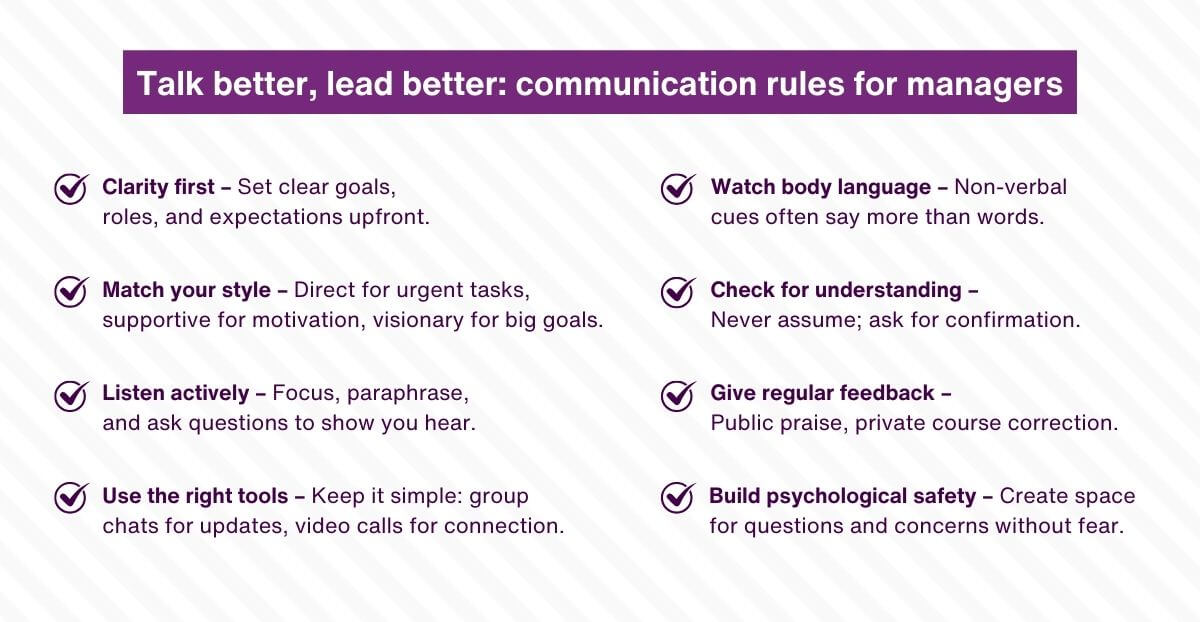
Technology plays a supporting role in modern team management, with tools like messaging platforms, project trackers, and video conferencing enabling seamless exchanges. Simple group chats handle quick updates, while shared documents maintain transparency on progress. Video calls capture non-verbal cues, vital for building rapport in distributed teams. The key lies in selecting tools that fit the team’s size and needs, avoiding unnecessary complexity.
Techniques such as active listening deepen understanding. Leaders demonstrate this by maintaining focus, paraphrasing responses, and asking clarifying questions. Regular feedback loops, including constructive praise and suggestions, keep performance on track. One-on-one sessions allow personalised discussions, uncovering hidden issues early. In effective team management, these practices create a rhythm of continuous improvement.
Setting clear expectations stands out as a fundamental technique. Leaders outline responsibilities using frameworks like RACI to define who handles what. This reduces overlap and accountability gaps. Visual aids, such as charts or diagrams, simplify complex ideas during discussions. Consistent follow-up confirms comprehension and reinforces commitment. These methods ensure alignment remains strong throughout projects.
Overcoming Common Barriers in Team Management
Miscommunication often stems from assumptions or overloaded channels. Leaders counter this by encouraging questions and confirming understanding. In team management, promoting psychological safety lets team members voice concerns without fear. Training in communication skills equips everyone to express ideas effectively.
Over-reliance on digital tools can dilute personal connections. Balancing virtual exchanges with face-to-face interactions preserves the human element. In effective team management, leaders monitor for signs of disengagement, addressing them through open dialogue. Regular team meetings provide structured opportunities to align and celebrate progress.
Fostering a Culture of Open Communication
A positive culture emerges when leaders model transparency and respect. Recognising contributions publicly boosts motivation, while private feedback handles improvements sensitively. In team management, this balance nurtures respect and collaboration. Team-building activities strengthen bonds, encouraging informal exchanges that enhance daily interactions.
Growth opportunities tied to clear communication keep talent engaged. Leaders who share business updates transparently build trust, showing team members their role in success. In effective team management, this approach retains skilled individuals and attracts new ones drawn to supportive environments.
Conclusion
Communication remains the heartbeat of successful team management, enabling leaders to align efforts, resolve issues, and inspire performance. By embracing varied styles, appropriate tools, and proven techniques, industry leaders create teams that thrive under pressure and deliver exceptional results. deAsra supports and engages entrepreneurs through initiatives like the dreamBIG podcast, offering practical insights to elevate team management practices. Commit to refining communication daily, and witness the profound impact on team dynamics and organisational success.

FAQs
1. What makes communication essential in team management?
Communication ensures alignment on goals, builds trust, and resolves conflicts early. It drives productivity by minimising errors and fostering collaboration, forming the foundation of strong team performance across all sectors.
2. How can leaders adapt different communication styles effectively?
Leaders assess situations and personalities to switch between direct, supportive, analytical, or visionary styles. This flexibility ensures messages connect appropriately, enhancing understanding and engagement within diverse teams.
3. Which tools best support team communication today?
Tools like messaging apps, project management software, and video platforms facilitate quick updates and collaboration. Choose simple, value-adding options that match team size to maintain efficiency without overwhelming users.
4. How do leaders handle communication barriers in teams?
Address barriers through active listening, clear expectations, and psychological safety. Regular check-ins and feedback help identify issues early, while balanced use of digital and personal interactions keeps connections genuine.
5. Why does culture matter in team communication?
A supportive culture encourages openness, recognition, and growth. Leaders who model transparency and respect create environments where team members feel valued, leading to higher motivation and sustained performance.