
The First 7 Legal Steps You Must Take to Start Your Business
“Once you’re ready to sell, formalise with a legal entity like a private limited company or LLP, especially if targeting international markets,” advises Mr. Vikrant Bhujbalrao in the deAsra and dreamBIG podcast. In India’s thriving entrepreneurial landscape, with a population exceeding 1.45 billion and technology facilitating global connections as of December 2025, the moment is ideal to start your business.
Drawing from Mr. Bhujbalrao’s expertise—he has mentored over 100 entrepreneurs and evaluated more than 10,000 ideas—the focus remains on validating concepts linked to timeless needs such as food, clothing, or shelter prior to legal formalities. deAsra supports and engages entrepreneurs through starting a business resources, featuring updated 2025 checklists for effortless registration.
Why Legal Steps Matter When You Start Your Business
Legal compliance provides essential protection against penalties, builds investor confidence, and supports scalability in India’s fully digitalised 2025 ecosystem. Recent MCA updates, including extended dematerialisation deadlines to June 2025, emphasise timely adherence. Overlooking these can expose owners to personal liability or hinder expansion.
Mr. Vikrant Bhujbalrao cautions against early oversights in planning and recommends formalisation only after proof of concept. deAsra supports and engages with tools like the Business Compliance Assessment, integrated with SPICe+ for seamless PAN, TAN, GSTIN, EPFO, and ESIC allocations. For leaders, robust compliance attracts premium clients and partnerships. As you explore how to start a business, note that SPICe+ approvals now typically take 7-10 days via the MCA portal.
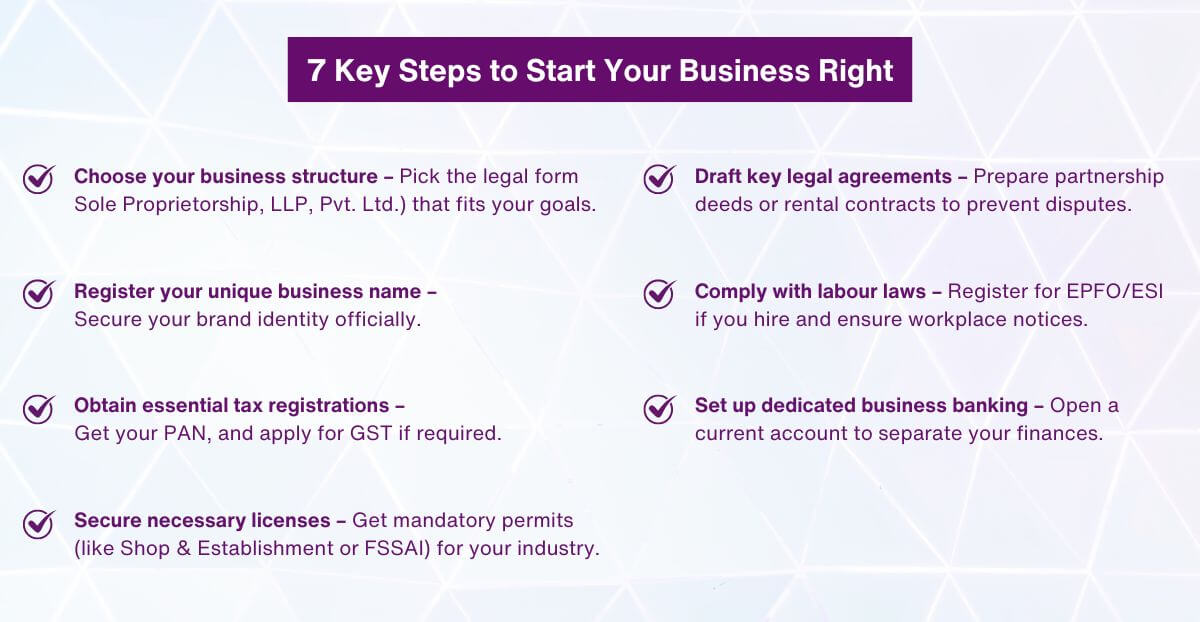
Step 1: Choose the Right Business Structure
Choosing the appropriate structure is the foundational move to start your business legally in India. Options range from Sole Proprietorship—ideal for simplicity with full owner responsibility—to Partnership via a deed, LLP for flexible limited liability, or Private Limited Company for investor appeal and growth potential.
Private Limited and LLP structures best suit scaling ambitions, while Sole Proprietorship works for low-risk individual ventures. In 2025, regulations require Digital Signature Certificates and Director Identification Numbers upfront for companies through the SPICe+ form on the MCA portal.
Mr. Bhujbalrao recommends starting with proprietorship during ideation and upgrading after validation. deAsra engages by providing templates that consider business scale and foreign investment needs. Register Private Limited or LLP entities on MCA to obtain a Company Identification Number; Sole Proprietorships require only local address proof. This choice safeguards assets under evolving company laws.
Step 2: Register Your Business Name
Reserving a distinctive name is key to start your business with strong branding. Use the MCA’s SPICe+ Part A to propose up to two names, or handle locally for Sole Proprietorships. Verify trademarks separately on the IP India portal and avoid generic terms per current guidelines.
Approvals come quickly in days with minimal fees, establishing professional credibility. Names should reflect enduring sectors like shelter, as in examples from the podcast.
deAsra supports with verification tools to prevent conflicts. Industry leaders appreciate this step for fostering trust with stakeholders. It forms a critical part of learning how to start a business effectively.

Step 3: Obtain Necessary Tax Registrations
Tax registrations are vital when you start your business. PAN and TAN are allocated automatically via SPICe+ for companies. GST becomes mandatory if turnover exceeds ₹40 lakh for goods or ₹20 lakh for services (lower in special category states), unchanged in late 2025.
Udyam registration for MSMEs is free and voluntary but unlocks benefits like input tax credits. Apply through the GST portal, typically processed in 3-7 days.
Mr. Bhujbalrao connects this to planning a 6-18 month financial runway. deAsra’s updated tools help meet deadlines and evade penalties, ensuring smooth invoicing and cash flow management.
Step 4: Secure Business Licences and Permits
Certain licences are essential to start your business compliantly. Obtain Shop Act registration via state labour portals within 30 days of operations. For food-related ventures, secure FSSAI; other sectors may need trade or environmental permits.
Many integrate into SPICe+ for efficiency. Prioritise core requirements for low-budget launches, as Mr. Bhujbalrao advises bootstrapping initially.
deAsra supports through shoestring budget blog and specialised checklists. This step aligns operations with regulations from the outset.
Step 5: Draft and Register Key Agreements
Solid agreements protect interests as you start your business. Draft rent agreements and register them if exceeding 11 months using e-stamping. For partnerships or LLPs, prepare deeds outlining roles and exit terms.
deAsra checklists ensure comprehensive clauses on terms and maintenance. State-varying stamp duties apply, but online processes simplify execution. Mr. Bhujbalrao stresses focusing on validation post these protections. This prevents disputes and allows concentration on growth.
Step 6: Comply with Employment and Labour Laws
Labour compliance matters when hiring while you start your business. Register for EPFO if over 20 employees and ESI through SPICe+’s AGILE-PRO. Display Shop Act notices prominently; expanded 2025 labour codes apply broadly.
deAsra guides on prioritising mentors before co-founders for accountability. This fosters a positive culture essential for retention and scaling.
Step 7: Set Up Banking and Financial Systems
Establish dedicated finances to start your business professionally. Open a current account post-Certificate of Incorporation, leveraging MSME perks like Mudra loans. Adopt GST-compliant accounting software.
deAsra assists with scheme access; separation ensures transparency for investors. This supports sustainable operations and funding pursuits.
Actionable Checklist for Legal Setup (First-Time Founders)
- Business Structure: Choose how you want to run your business — Sole Proprietorship, Partnership, LLP, or Private Limited. LLP/Private Limited registrations are done on the MCA portal using SPICe+. You will need DSC and DIN.
- Name Registration: Apply for your business name through SPICe+ Part A. Before applying, quickly check if the name is already trademarked.
- Tax Registrations: Apply for PAN and TAN.
Register for GST if your turnover crosses ₹40 lakh (goods) or ₹20 lakh (services).
Get Udyam Registration to be recognised as an MSME and access benefits. - Licences and Permits: Apply for basic licences based on your business type —
Shop & Establishment, FSSAI (for food businesses), or other sector-specific licences. - Agreements: Prepare and e-stamp important documents like rent agreements or partnership deeds.
- Labour Compliance: If you hire employees, register for EPFO and ESI where applicable and display required notices.
- Banking: Open a current account in your business name and start using simple accounting or billing software.
Building Beyond Legal Foundations
With legalities complete, prioritise customer validation. Mr. Bhujbalrao urges: “Build something customers are willing to pay for.” deAsra engages with mentoring for sales and systems refinement.
Conclusion
These seven steps, aligned with 2025’s stable SPICe+ and GST frameworks, create resilient foundations in India’s dynamic market. Industry leaders, let deAsra equip you to start your business confidently—embrace action over perfection for lasting excellence.

FAQs
1. What is the simplest way to start your business in India?
Sole Proprietorship stands out as the easiest, needing only PAN, Shop Act, and optional Udyam. It requires little paperwork and low costs, suiting low-risk solo operations with a setup in days.
2. How do I choose between LLP and Pvt Ltd when learning how to start a business?
Opt for LLP if seeking flexibility for professionals with reduced filings, or Pvt Ltd for equity fundraising and greater investor credibility. Both provide limited liability protection.
3. Are there mandatory licences for all businesses to start your business?
GST applies above turnover limits, and the Shop Act covers most establishments; sector-specific like FSSAI for food. Requirements differ by activity, but non-compliance risks fines.
4. What funding options align with how to start a business legally?
Post-registration and Udyam, access Mudra loans or angels. Compliant structures enhance eligibility, with bootstrapping recommended initially for control.
5. How long does it take to complete these legal steps to start your business?
Expect 15-45 days total: Sole Proprietorship quickest, Pvt Ltd/LLP via SPICe+ around 7-15 days. Digital portals accelerate with accurate submissions.