Step-by-Step Guide to Copyright Registration in India
Understanding Copyright Registration in India
In today’s digital world, protecting your creative work is essential. Whether you are a writer, artist, musician, or business owner, securing your intellectual property can prevent unauthorised use and ensure you get credit for your work. One of the most effective ways to protect creative assets is through copyright registration.
If you are unsure about how the copyright registration process works, this step-by-step guide will explain everything, including the required documents, fees, and benefits. To understand the basics of copyright protection, check out this blog.
What is Copyright?
Copyright is a legal right that gives the creator of an original work exclusive rights to use and distribute it. This includes literary works, music, films, software, paintings, and more. Copyright registration ensures that your work is legally recognised and protected from unauthorised reproduction or misuse.
Benefits of Copyright Registration
- Legal protection – Prevents others from copying or distributing your work without permission.
- Exclusive rights – Allows the copyright holder to reproduce, distribute, and modify the work.
- Increased credibility – Helps businesses and individuals establish ownership over creative content.
- Monetary benefits – Copyrighted content can be licensed, sold, or transferred for commercial purposes.
- Global protection – India is a member of international copyright agreements, ensuring protection beyond national borders.
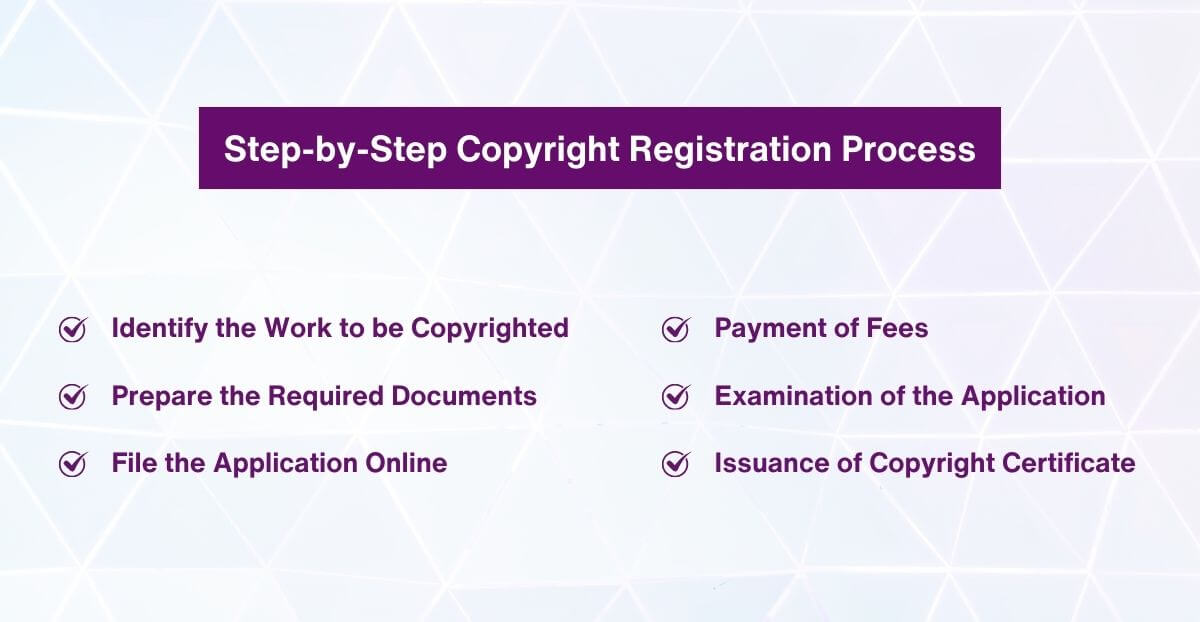
Step-by-Step Copyright Registration Process
1. Identify the Work to be Copyrighted
Before applying for copyright registration, you must identify the type of work you want to protect. This can include:
- Literary works (books, scripts, articles)
- Artistic works (paintings, sculptures, photography)
- Musical compositions
- Cinematographic films
- Sound recordings
- Software programs
- Dramatic works
Each category has specific requirements, so it is important to select the correct classification before proceeding.
2. Prepare the Required Documents
To complete the copyright registration process, you need to gather the following documents:
- Application form (Form XIV) – This must be filled out and signed.
- Copies of the work – At least two copies of the original work.
- No Objection Certificate (NOC) – If the applicant is not the original creator, an NOC from the creator is required.
- Power of Attorney – If an authorised representative is applying.
- Identity and address proof – Aadhaar card, PAN card, or passport.
- Fee payment receipt – Proof of fee payment for the application.
For a complete checklist of documents, refer to this guide.
3. File the Application Online
The next step is to apply on the official e-filing portal of the Copyright Office (www.copyright.gov.in). Follow these steps:
- Visit the portal and create an account.
- Fill in Form XIV with the required details.
- Attach the necessary documents and work samples.
- Pay the required fee through online payment modes.
- Apply and note the acknowledgement number for future reference.
4. Payment of Fees
The fee structure varies based on the type of work. Below are the general charges:
- Literary work – ₹500 per work
- Artistic work – ₹2,000 per work
- Musical compositions – ₹2,000 per work
- Cinematographic films – ₹5,000 per work
- Software and sound recordings – ₹2,000 per work
Fees may change, so it is advisable to check the official Copyright Office website for updated charges.
5. Examination of the Application
Once submitted, the Copyright Office reviews the application. The process involves:
- Waiting period (30 days) – Any third party can raise objections during this time.
- Objection handling – If objections arise, the applicant is required to respond.
- Scrutiny by the examiner – The Copyright Office verifies the application details.
If no objections are raised, the application moves to the final stage.
6. Issuance of Copyright Certificate
If the application passes all checks, the Copyright Office issues the copyright registration certificate. This serves as legal proof of ownership and can be used in court in case of infringement.
4 Common Challenges in the Copyright Registration Process
1. Incorrect Documentation
A missing or incorrect document can delay or reject your application. Ensure all required documents are correctly submitted.
2. Third-Party Objections
Sometimes, objections arise from other businesses or individuals claiming prior rights. Responding with legal proof of ownership can help resolve the issue.
3. Long Processing Time
Although the copyright registration process usually takes 2-3 months, delays can occur due to objections or administrative backlogs. Monitoring your application status is recommended.
4. Lack of Awareness
Many individuals and businesses do not know the importance of copyright registration. Protecting creative work should be a priority to prevent misuse or plagiarism.
Tips for a Smooth Copyright Registration Process
- Double-check all documents – Ensure that all required documents are correct and complete.
- Use legal assistance if needed – A lawyer or consultant can help navigate legal issues.
- Track your application – Regularly check the status online to avoid unnecessary delays.
- Be prepared for objections – Maintain records of creation dates and drafts to establish ownership.
- Update copyright details if necessary – If ownership changes, update the records to reflect new rights holders.
Conclusion
Registering a copyright in India is essential for safeguarding creative works from unauthorised use. The copyright registration process involves several steps, from identifying the type of work and submitting documents to paying fees and handling objections. This step-by-step guide allows individuals and businesses to secure their intellectual property and gain legal protection.
For a detailed checklist of requirements, refer to this guide. If you are looking to protect your business’s creative assets, understanding copyright registration is the first step towards legal security.
FAQs
1. What types of works can be copyrighted in India?
Copyright protection is available for literary, artistic, musical, and dramatic works, along with sound recordings, films, and software. It covers original creations such as books, paintings, songs, films, and even website content. However, copyright does not protect mere ideas, concepts, or procedures—only their tangible expression.
2. How long does copyright protection last in India?
For literary, artistic, musical, and dramatic works, copyright lasts for the lifetime of the creator plus 60 years. For sound recordings, cinematograph films, and photographs, copyright protection extends for 60 years from the date of publication. Once the term expires, the work enters the public domain and can be freely used by anyone.
3. Can software be copyrighted in India?
Yes, software or computer programs can be protected under copyright law as “literary works.” This protection prevents unauthorised copying or distribution. However, copyright does not protect functionality, algorithms, or methods of operation—those aspects fall under patent law. Software owners can also use licensing agreements for added legal protection.
4. Is copyright protection automatic, or is registration required?
Copyright is granted automatically when a work is created and expressed in a tangible form. However, copyright registration provides legal proof of ownership, making it easier to enforce rights in case of disputes. Registered works carry stronger legal standing in courts, helping creators claim damages against infringement.
5. Can I copyright a business name or logo?
No, a business name or logo falls under trademark protection, not copyright. Copyright safeguards creative works such as books, music, or films. If your logo contains an original artistic element, it may be eligible for copyright registration, but for full brand protection, trademark registration is recommended.
DISCLAIMER:
This blog is provided by the deAsra Foundation (“deAsra”) for informational purposes only, offering insights that may be beneficial for micro, small, and medium-sized enterprises (MSMEs).
PLEASE NOTE: This blog is neither written nor endorsed by any governmental organization nor has any affiliation or connection with any government ministry in India. deAsra makes no warranty or representation regarding the information provided through this blog and disclaims its liabilities in respect thereof, including any liability for authenticity, errors, omissions, or inaccuracies in this blog, if any. Any action on the blog readers’ part based on the information provided in this blog is at his/her/its own risk and responsibility. deAsra reserves the right to modify the information contained in this blog at any time at its sole discretion. deAsra agrees that though all efforts have been made to ensure the veracity of the information in this blog, the same should not be construed as an accurate replacement for authorized commentary on the subject matter before it is used for any legal, financial, or business purposes. deAsra accepts no responsibility for the information’s accuracy, completeness, usefulness or otherwise. In no event will deAsra be liable for any loss, damage, liability, or expense incurred or suffered that is claimed to have resulted from the use or misuse of the information in this blog. We advise you to corroborate the information through authenticated sources and professional consultants before relying on the information stated in this blog. All the information in this blog is for educational and reference purposes only, and we do not make or charge any money to provide this information. Links to the relevant websites included in this blog are provided for readers’ convenience only. deAsra is not responsible for the contents or reliability of linked websites and does not necessarily endorse the views expressed therein. deAsra does not always guarantee the availability of such linked pages. If any content has been unintentionally published or copyrighted material in violation of the law, please don’t hesitate to contact us, and we will have it removed immediately