
Start Your Business Right: 5 Common Mistakes New Entrepreneurs Make (And How to Avoid Them)
The thrill of launching a venture often begins with a spark of inspiration, yet many aspiring founders in India stumble before gaining real traction. Starting your own business demands more than enthusiasm; it requires sharp awareness of pitfalls that can drain resources and momentum.
From the insights shared in the deAsra and dreamBIG podcast with Dr. Vikrant Bhujbalrao, a seasoned mentor who has guided over 100 entrepreneurs, clear patterns emerge in early failures. This post highlights five common mistakes new entrepreneurs make when starting their own business and offers practical ways to sidestep them for stronger, scalable growth.

1. Building Without Validating Market Demand
One of the quickest ways to stall progress is pouring time and money into an idea that lacks real customer interest. Many founders rely on personal assumptions rather than evidence, creating products or services nobody truly needs or will pay for. Markets shift rapidly, and what seems brilliant in isolation often misses the mark on timing or audience fit.
To avoid this trap, begin with thorough validation. Speak directly to potential customers, run small tests like surveys or prototypes, and use free tools such as Google Trends to gauge interest. Focus on enduring needs—food, shelter, health, or convenience—that offer lasting potential. Dr. Vikrant Bhujbalrao emphasises this approach: “Many entrepreneurs make the mistake of pursuing ideas that exist only in their minds. My recommendation is to first identify a problem and validate what the market needs.” By confirming demand early, you conserve energy and build confidence in starting your own business.
2. Poor Financial Planning and Underestimating Runway
Cash flow issues sink more ventures than almost any other factor. New entrepreneurs frequently underestimate personal living costs, operational expenses, or the time needed before revenue flows steadily. Without a clear buffer, even promising ideas falter under pressure.
Plan meticulously for at least six to eighteen months of personal “survival money” from savings or family support—never from early investor funds. For the business, assume minimal or zero income in the first year and map out realistic projections. Track every rupee with simple tools initially, then upgrade to reliable software. Explore government schemes or low-interest options only after establishing the basics. Solid financial discipline ensures you stay in the game long enough to see results when starting your own business.
3. Neglecting Systems, Processes, and Early Discipline
Chaos creeps in when founders treat structure as optional in the early days. Without basic systems—from daily routines to customer tracking—scaling becomes painful later, requiring costly overhauls. Discipline starts with the founder; a lack of it spreads throughout the team.
Implement processes from day one, even if flexible. Document workflows, set clear goals, and review progress regularly. Prioritise health and mental calmness through exercise or meditation to sustain focus amid uncertainty. As operations grow, these foundations support efficient hiring and expansion. Starting your own business thrives when structure underpins creativity rather than restricting it.
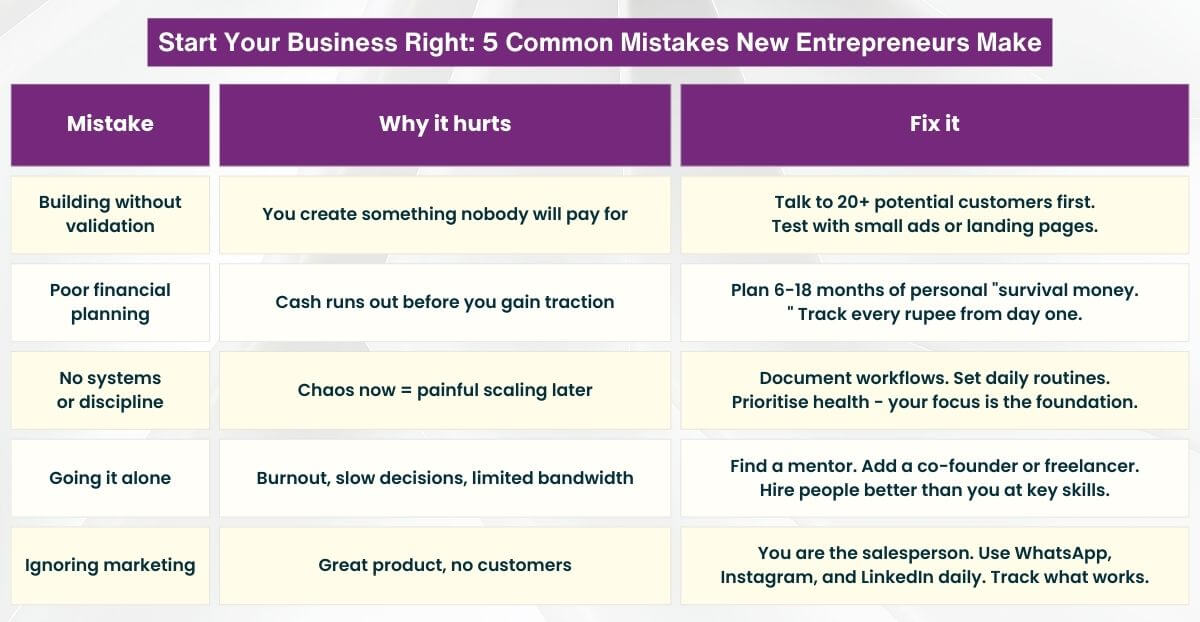
4. Trying to Do Everything Alone
Solo efforts limit bandwidth, increase burnout risk, and slow decision-making. Many entrepreneurs begin isolated, handling sales, operations, marketing, and more, which stretches them thin and delays growth.
Build a support network early. Seek a mentor for objective guidance and accountability. Consider a co-founder with complementary skills, especially in sales or marketing if that’s your weak area. Start with interns or freelancers for cost-effective help, then hire talent that exceeds your own strengths as funds allow. Emotional connections with the right people foster loyalty and shared success. Starting your own business scales far better with a capable team than in isolation.
5. Overlooking Marketing and Customer Acquisition
Even exceptional offerings fail without visibility. New founders often assume great products sell themselves, neglecting consistent outreach and lead generation. Limited budgets make this mistake costlier, as organic reach takes time to build.
Act as your own salesperson initially—engage networks, offer samples, or share content on platforms like WhatsApp, Instagram, or LinkedIn. Track metrics diligently and refine approaches based on feedback. For online ventures, platforms like Shopify or WooCommerce simplify setup, while tools such as Razorpay handle payments seamlessly.
deAsra supports and engages entrepreneurs through practical resources; explore their Start a Business guide for checklists on planning and compliance. For digital-first ideas, their blog on starting your business online offers steps for e-commerce and services. Aggressive, budget-smart marketing keeps cash flowing when starting your own business.
Conclusion
Starting your own business in India holds immense potential, backed by a maturing ecosystem of knowledge, networks, and opportunities. Yet success hinges on avoiding these five pitfalls: unvalidated ideas, weak finances, absent systems, solo overload, and ignored marketing. By validating demand, planning funds wisely, building discipline, assembling support, and prioritising customer reach, you position your venture for sustainable growth. Take calculated steps, learn from setbacks, and move forward decisively. The rewards of creating real value await those who navigate these challenges thoughtfully.

FAQs
1. What is the most critical first step when starting your own business?
Validate your idea by confirming market demand through customer conversations, surveys, or small tests. This prevents wasting resources on unviable concepts and builds a strong foundation for growth.
2. How much money should I save before starting my own business?
Aim for six to eighteen months of personal expenses plus business runway, assuming little to no revenue initially. Rely on savings or family support first to avoid early pressure from loans or investors.
3. Should I register my business immediately when starting my own business?
Delay formal registration until after proof of concept and early sales. Start simple as a proprietorship, then formalise as a private limited company or LLP for compliance and attracting bigger clients.
4. How can I market my business with a limited budget when starting my own business?
Focus on organic methods: leverage personal networks, share content on social platforms, offer samples, and engage directly with prospects. Track results and scale to paid ads once you see traction.
5. Why is having a mentor important when starting your own business?
A mentor provides guidance, accountability, and perspective to avoid common errors. They help refine strategies, navigate challenges, and accelerate progress without learning everything through costly trial and error.