Sales Tax for Small Businesses: When and How to Collect It
Strategic financial oversight begins with a firm command over tax responsibilities that directly influence liquidity and expansion. Small business owners in India must navigate sales tax in India effectively to avoid pitfalls while unlocking opportunities for sustainable growth. The dreamBIG podcast series from deAsra reveals how precise accounting and taxation practices build a strong foundation for success.
For deeper insights from chartered accountants, explore this episode on accounting and taxation. This guide equips leaders with practical steps for navigating nexus rules, registering for a permit, collecting sales tax, and filing returns.

Grasping the Core Principles of Sales Tax Duties
Sales tax serves as a consumption-based levy that businesses collect from customers and remit to authorities. In the Indian framework, it operates primarily through the Goods and Services Tax system, which replaced fragmented earlier regimes. Proper understanding ensures accurate recording of transactions and prevents mismatches during audits. Business leaders who treat these duties as strategic priorities gain clearer visibility into cash flows and operational efficiency.
Accurate records form the bedrock of reliable financial reporting. They support timely decision-making across procurement, sales, and inventory management. Entrepreneurs benefit when they view tax collection as an integral part of daily processes rather than an afterthought. This approach reduces risks and strengthens overall business resilience in competitive markets.
Recognising the Moment to Register for Sales Tax
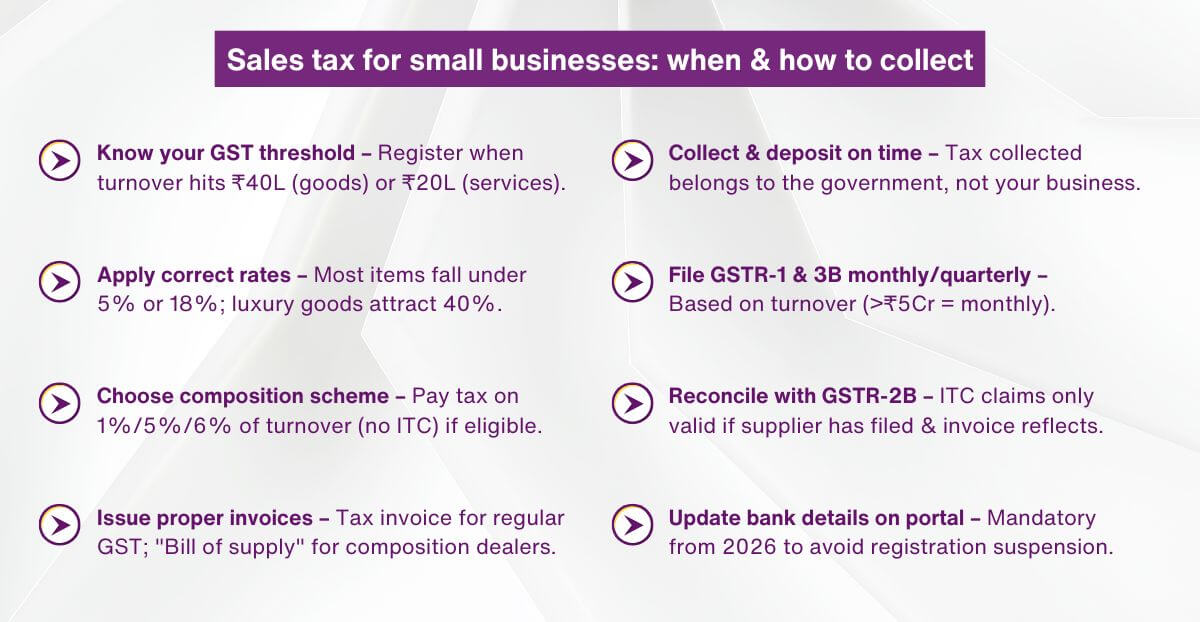
Businesses must monitor their aggregate turnover closely to determine registration requirements. The current threshold stands at ₹40 lakh for goods suppliers in most states and ₹20 lakh for service providers, with lower limits in special category states. Crossing these figures triggers mandatory registration, even for smaller operations engaged in interstate supplies or e-commerce activities.
Sales tax in India demands proactive assessment of supply types and customer locations. Place of supply rules dictate whether a transaction qualifies as intra-state or inter-state, affecting the applicable tax components. Small enterprises that track these elements early avoid last-minute compliance pressures and maintain smooth vendor relationships.
Establishing Proper Registration and Permit Procedures
Registration involves submitting details through the GST portal, including business PAN, bank account information, and proof of address. Once approved, authorities issue a unique GSTIN that serves as the official permit for lawful tax collection. This identifier appears on all invoices and enables input tax credit claims for eligible purchases.
Voluntary registration remains an option below the threshold for businesses seeking credibility with larger clients. The process typically takes a few days when documents are organised in advance. Leaders who complete registration promptly position their ventures for seamless scaling and access to government schemes tied to formal compliance.
Implementing Effective Collection Mechanisms
GST collection begins at the invoicing stage, where businesses must apply the correct tax rate to the taxable value and use the appropriate HSN or SAC codes for accurate classification. As per the GST 2.0 reforms effective from 22 September 2025, the GST Council rationalised the rate structure by removing the earlier 12 % and 28 % slabs and moving to two primary rates — 5 % and 18 % for most goods and services. A higher 40 % rate applies only to notified luxury and de-merit goods, while special rates such as 0 % (nil/exempt), 3 % and 0.25 % continue for specific categories
Accurate segregation of tax amounts in accounting records remains essential for GST compliance and transparency. Most businesses now rely on digital billing and accounting systems that automatically calculate GST based on item classification and transaction details, helping reduce manual errors, minimise mismatches in returns, and improve cash-flow visibility under the revised GST framework
Handling Return Filing with Precision
Returns such as GSTR-1 for outward supplies and GSTR-3B for summary payments follow monthly or quarterly schedules depending on turnover. Reconciliation with purchase data from GSTR-2A or 2B ensures accurate input tax credits. Timely filing prevents late fees and interest charges that erode profits.
A well-maintained compliance calendar helps track due dates and cash requirements in advance. Sales tax in India filings benefit from automated data pulls from bank statements and supplier portals. Consistent adherence signals reliability to bankers and investors reviewing the business for funding or partnerships.
Integrating Technology for Seamless Compliance
Modern accounting software connects directly with government portals to import transaction data and auto-populate returns. Optical character recognition features convert bill images into entries, while pattern recognition handles repetitive categorisations. These advancements free up valuable time for core business activities.
Sales tax in India processes become more reliable when standard operating procedures govern data entry and verification. Cloud-based platforms support multi-location operations and generate real-time reports for management review. Businesses that adopt such solutions report higher accuracy and reduced administrative burden.
Securing Expert Guidance for Sustained Success
Virtual CFO services offer cost-effective access to specialised knowledge without the expense of a full-time hire. These professionals manage budgeting, tax planning, and regulatory updates while aligning financial strategies with growth objectives. deAsra supports and engages entrepreneurs by facilitating connections to such expertise through targeted initiatives.
Sales tax in India compliance improves dramatically with expert oversight. Leaders can focus on innovation and market expansion when routine tasks are handled systematically. This division of responsibilities creates a robust framework for long-term viability.
Conclusion
Mastering sales tax responsibilities transforms a potential regulatory challenge into a competitive advantage for small businesses. By understanding registration triggers, maintaining meticulous records, and leveraging available technology, owners safeguard liquidity and build stakeholder confidence. The principles shared in the dreamBIG podcast underscore the value of systematic processes over ad-hoc efforts.
For further exploration of customer segmentation that influences tax handling, refer to this resource on B2B vs B2C digital marketing strategy. Consistent application of these practices supports steady growth while minimising risks. Small enterprises that prioritise disciplined financial management often discover new pathways to profitability and resilience.

FAQs
1. When does a small business need to start collecting sales tax in India?
Registration becomes mandatory once annual turnover exceeds the prescribed threshold, currently ₹40 lakh for goods in normal states or ₹20 lakh for services. Certain activities, like interstate sales, require registration regardless of turnover. Early monitoring of sales volume prevents sudden obligations and supports orderly compliance.
2. What are nexus rules in the context of sales tax in India?
Nexus refers to the connection that triggers tax obligations, primarily based on turnover thresholds and the nature of supplies. Place of supply rules determine tax jurisdiction for inter-state transactions. Businesses must evaluate both physical presence and economic activity to identify applicable requirements accurately.
3. How can small businesses register for a sales tax permit?
The process involves applying online via the GST portal with essential documents such as PAN, address proof, and bank details. Approval leads to the issuance of a GSTIN. Voluntary registration is possible for those below the thresholds who wish to claim input credits or enhance credibility with clients.
4. What is the simplest way to collect and track sales tax?
Use accounting software integrated with the GST portal to generate invoices with correct tax components and reconcile data automatically. Maintain separate records for taxable value and tax amounts. Regular reviews of outstanding collections help maintain healthy cash flows.
5. Why is professional support valuable for sales tax compliance?
Experts provide guidance on complex areas like classification, credits, and updates in regulations. They help establish standard procedures that reduce errors and penalties. deAsra supports and engages businesses by connecting them with virtual CFO services tailored to small-scale operations.