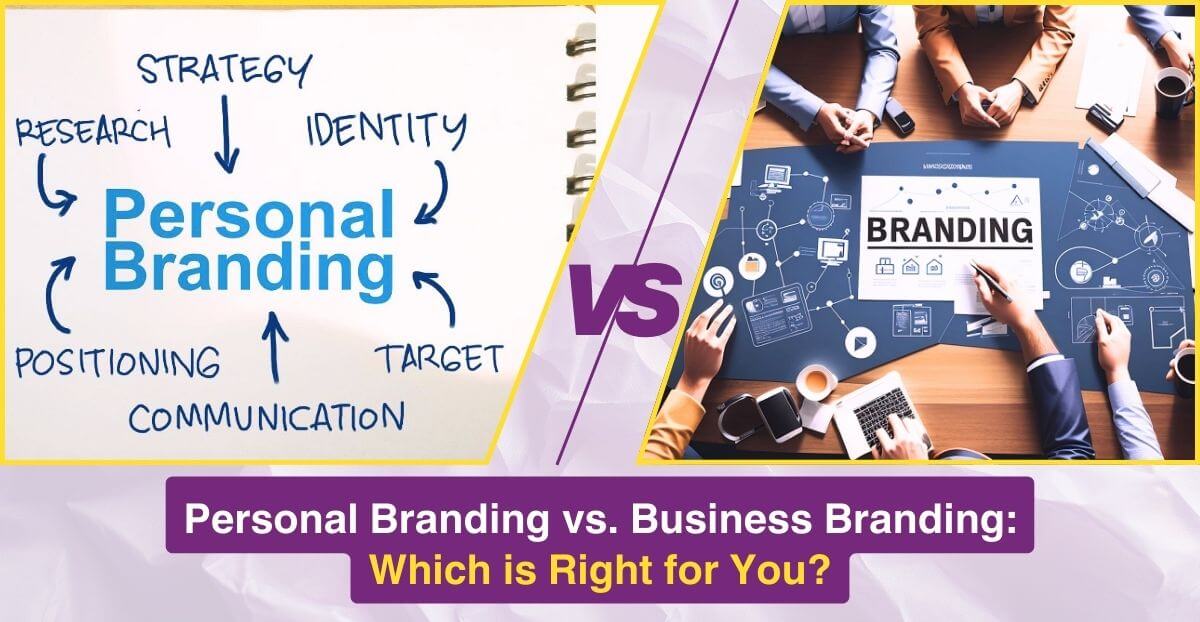
Personal Branding vs. Business Branding: Which is Right for You?
Every strategic choice in entrepreneurship shapes perception, trust, and trajectory. For consultants, founders, and solopreneurs, the decision between personal branding and business branding stands out as particularly decisive. This choice determines client connections, growth potential, and market positioning across industries.
Personal branding centres on your individual story, expertise, and values to create authentic relationships, whereas business branding establishes a distinct entity focused on mission, consistency, and scalability. Insights from deAsra’s dreamBIG podcast reveal that effective branding evolves from understanding the soul of your venture, helping leaders decide where to invest effort for lasting impact.

Understanding Personal Branding
Personal branding positions you as the central figure of your professional identity. It builds around your experiences, voice, and principles, turning your narrative into the primary draw for clients and collaborators. This method excels when human connection drives decisions, allowing consultants and solopreneurs to differentiate through genuine storytelling on platforms such as LinkedIn, Instagram, or podcasts. Sharing your professional journey, challenges overcome, and unique perspective fosters immediate rapport and transforms followers into committed supporters.
In sectors like coaching, advisory services, or creative freelancing, personal branding highlights empathy alongside authority. Clients often select based on perceived alignment with your character rather than purely technical deliverables.
Exploring Business Branding
Business branding constructs an independent identity for the enterprise, emphasising shared mission, values, and customer promises over any single person’s story. This path suits founders who envision structured expansion, team involvement, or market diversification. Core components include logos, colour schemes, typography, and unified messaging that convey reliability and professionalism. Small businesses in tech, e-commerce, or professional services frequently adopt business branding to project stability and attract partners or investors.
This method supports scalability by enabling delegation and standardised processes. Once established, the brand can function without constant founder input, allowing operations to continue during absences or pivots. It also strengthens perceived legitimacy in B2B contexts, where formal presentation often influences contract awards.
Key Differences Between Personal and Business Branding
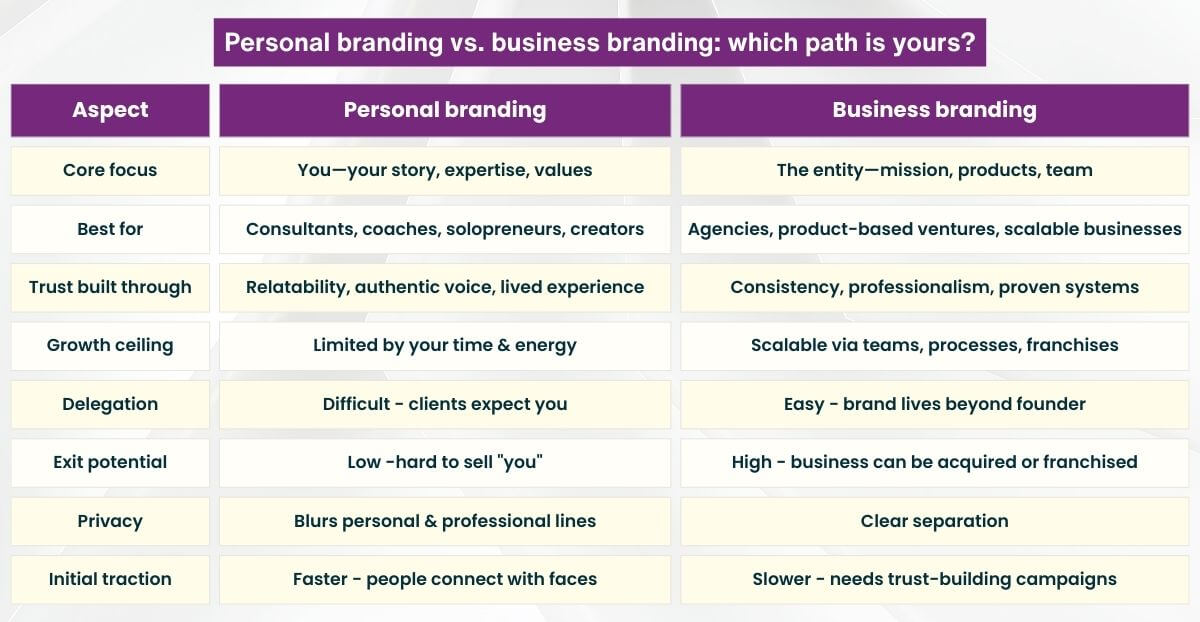
The fundamental contrast lies in orientation: personal branding links success directly to your reputation and narrative, cultivating emotional loyalty through relatability. Consultants and solopreneurs often favour this route because clients respond to personality and lived experience. Business branding, by comparison, highlights the collective strengths of the organisation—product quality, service consistency, or innovation—making it more suitable for ventures that plan to hire or productise offerings.
Operational implications differ sharply. Personal branding requires ongoing visibility and content rooted in your authentic voice, while business branding depends on documented guidelines to ensure uniformity across channels and team members. Exit planning also diverges: personal routes can complicate transferability, whereas business structures offer clearer paths to sale, franchising, or succession. Despite these distinctions, both approaches pursue trust and differentiation. deAsra’s guide on personal branding for entrepreneurs illustrates how aligning individual identity with broader goals strengthens overall strategy without forcing an either-or choice.
Overlaps and Synergies in Branding Approaches
Personal branding and business branding frequently intersect, particularly during entrepreneurial evolution. Founders can infuse personal authenticity into a business entity, adding warmth and approachability to structured messaging. This combination proves powerful for consultants who differentiate services through their story while building scalable delivery systems. In the dreamBIG podcast, Mr Dhruva Pakhnikar observes, “Personal branding is a huge thing. And not just these days, it was there way back.” Such integration allows solopreneurs to gain rapid trust and then layer professional frameworks for sustained operations.
These synergies create versatile paths. Personal branding often drives early audience engagement, while business branding manages expansion and consistency. Founders might publish thought leadership under their name to attract leads, then direct those prospects to branded services or products.
Pros and Cons of Personal Branding
Personal branding delivers swift trust through a genuine human connection. Solopreneurs and consultants benefit from showcasing expertise and personality, which often leads to stronger client loyalty and organic referrals. Social algorithms tend to favour personal content, boosting reach without heavy advertising spend. The approach grants flexibility, enabling quick adaptation to market changes or new interests without rebranding the entire venture.
Challenges include growth constraints tied to individual capacity and energy. Privacy boundaries blur when professional identity merges with personal life, increasing burnout risk. Delegation becomes difficult because clients expect direct involvement from the named person. Despite these drawbacks, many leaders value the emotional depth personal branding provides, using deAsra resources to manage visibility sustainably.
Pros and Cons of Business Branding
Business branding excels at enabling scale. It permits team building, process standardisation, and independent operation, critical for ventures targeting broader markets or multiple locations. The structured presentation enhances credibility in competitive sectors such as finance, technology, or consulting agencies. It also maintains separation between work and personal spheres, allowing founders to step back without jeopardising momentum.
Drawbacks involve slower initial trust-building, as logos and guidelines lack the immediate warmth of a human face. Upfront costs for professional design, copywriting, and strategy can strain early-stage budgets. Audience growth may lag compared with personal storytelling unless supported by substantial marketing. deAsra supports and engages businesses in addressing these hurdles through expert guidance and community discussions.
The Hybrid Model: Blending Personal and Business Branding
Hybrid branding combines personal branding with business branding to capture advantages from both. Consultants often use their name for content and thought leadership, funnelling engagement toward a branded firm for service delivery. This model leverages personal relatability to build audience loyalty while establishing scalable infrastructure. Mr. Dhruva Pakhnikar notes in the dreamBIG podcast, “If you create an aspirational brand, and if you are delivering to it, that will happen.” Such delivery-focused integration sustains momentum across growth phases.
Implementation begins with personal branding for traction, then introduces business branding elements as volume increases. Tools like content calendars and brand voice guides maintain alignment. deAsra’s platforms encourage this strategy, offering insights on consistency, audience psychology, and long-term vision. Hybrids minimise risks, allowing ventures to remain adaptable while preserving authenticity.
Deciding the Right Path for Your Venture
Evaluate goals and personal comfort to select between personal branding and business branding. Founders seeking rapid scaling or team structures lean toward business branding. Those in niche advisory or creative roles often prefer personal branding for direct rapport. Hybrid options suit most ambitious leaders who want flexibility without limits.
Test small experiments—publish under your name or draft preliminary guidelines—to assess resonance. Engage networks deAsra supports for candid feedback. This deliberate process ensures branding choices fuel sustainable progress rather than constrain it.
Conclusion
The choice between personal branding and business branding reflects your vision for connection, scale, and legacy. Personal branding offers emotional depth and swift trust; business branding provides structure and endurance; hybrids deliver balance for evolving ambitions. Consistency and alignment remain essential regardless of path. deAsra supports and engages industry leaders through the dreamBIG podcast and targeted resources, equipping consultants, founders, and solopreneurs to build identities that drive meaningful, lasting growth.

FAQs
1. What is the main difference between personal branding and business branding?
Personal branding centres on your individual story and expertise to forge emotional connections, suiting consultants and solopreneurs who thrive on direct client rapport. Business branding creates a separate entity focused on mission and consistency, ideal for scalable ventures with teams or products. The distinction guides leaders toward approaches that match their operational and growth objectives.
2. How can personal branding benefit a solopreneur?
Personal branding helps solopreneurs establish trust quickly through authentic sharing of experiences and insights, leading to loyal clients and organic referrals. It boosts visibility on social channels and allows flexible pivots as interests evolve.
3. When should a founder consider business branding over personal branding?
Founders should choose business branding when planning team expansion, market diversification, or eventual exit, as it builds an independent, transferable entity. This method suits product-led or agency models requiring professional presentation and standardised processes to attract partners and investors reliably.
4. Is a hybrid branding model suitable for consultants?
Hybrid branding fits consultants well by merging personal branding’s relatability with business branding’s scalability. Personal stories attract and engage clients, while branded systems handle delivery and growth. This combination reduces burnout and supports the transition from solo to collaborative work effectively.
5. How does deAsra support entrepreneurs in branding decisions?
deAsra supports and engages entrepreneurs via the dreamBIG podcast, blogs, and workshops that deliver expert perspectives on personal branding and business branding. These resources cover strategy, consistency, and audience psychology, helping leaders craft intentional identities aligned with their sector and long-term goals.