
How to Write a Business Plan: The Essential Blueprint for Starting Your Own Business in 2026
India has crossed the milestone of over 2 lakh DPIIT-recognised startups as of December 2025, according to Commerce and Industry Minister Piyush Goyal. This surge reflects a dynamic ecosystem ripe for new ventures. Many ideas, however, never take off without a structured approach. Mastering how to write a business plan provides that crucial framework, turning concepts into viable enterprises ready for funding and growth.
Experts like Mr. Vikrant Bhujbalrao, featured on the deAsra and dreamBIG podcast, highlight the advantages of today’s mature support systems, from digital connectivity to government schemes. deAsra supports and engages aspiring founders with essential tools, such as the Business Compliance Assessment Tool, to navigate regulations smoothly. As 2026 brings focus on AI integration, sustainability, and Bharat-centric models, a solid business plan ensures your idea aligns with these evolving trends.
Why a Strong Business Plan Matters When Starting Your Own Business
A business plan functions as more than documentation—it acts as a strategic tool that sharpens focus in a crowded market. It prompts examination of market fit, potential pitfalls, and sustainable revenue streams, particularly vital in 2026’s landscape shaped by technological shifts and economic prudence.
Mr. Vikrant Bhujbalrao underscores the importance of demand: “Build something customers are willing to pay for.” This principle guards against investing in unviable concepts. Grasping how to write a business plan enables the connection of innovations to persistent needs, like health, education, or eco-conscious solutions. For leaders across sectors guiding new initiatives, this process encourages rigorous, fact-based planning. Emerging fields such as deeptech and quick commerce reward those with clear foresight. deAsra supports and engages entrepreneurs through practical checklists that simplify early stages.
Furthermore, a well-prepared business plan signals professionalism to banks, investors, or schemes. In an era of selective capital, detailed insights into operations and finances demonstrate commitment and realism.
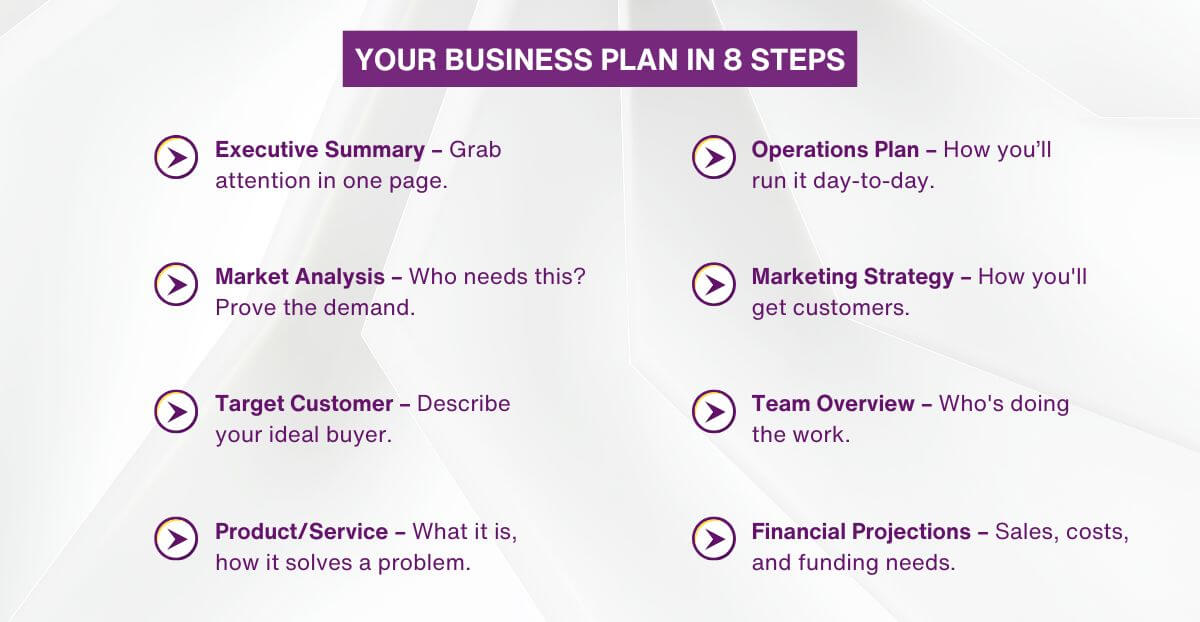
Core Sections of an Effective Business Plan Template
Adopt a straightforward template to organise your business plan. Target 15-25 pages for readability. Emphasise evidence from research to strengthen each part.
1. Executive Summary and Company Overview
Position the executive summary prominently—compose it after completing other sections. Condense your mission, target audience, competitive advantage, and capital requirements into 1-2 pages.
Elaborate on company fundamentals: legal form, core problem addressed, and long-term objectives. Incorporate 2026-relevant ideas, including sustainable practices or rural-focused services drawn from deAsra’s 10 best business ideas to start your business in 2026. This overview captivates potential readers from the outset.
Specify ownership, location strategy, and initial setup. If beginning alone, detail intentions for mentors or collaborators.
2. Market Analysis and Customer Insights
Conduct an in-depth evaluation of industry scope, emerging patterns, rivals, and customer groups. Employ free resources for initial validation.
Mr. Bhujbalrao recommends: “Focus on businesses tied to basic human needs like food, clothing, and shelter.” Extend this to current opportunities in affordable wellness or local sourcing. Substantiate demand with surveys or public data, pinpointing gaps in areas like AI-assisted education or green logistics. Create detailed customer profiles covering demographics, challenges, and preferences. This validation step confirms scalability when starting your own business.

3. Organisation, Products, and Operations
Illustrate team composition, responsibilities, and qualifications. Highlight advisors to enhance trustworthiness. Outline offerings thoroughly: key attributes, customer advantages, pricing models, and current status. Transform services into standardised packages to facilitate expansion.
Discuss operational aspects: supply chains, daily workflows, technology integration, and legal adherence. Establish routines early—consistent founder practices lay the groundwork for larger teams. Transition to formal entities once initial traction emerges.
4. Marketing, Sales, and Financial Projections
Map out customer reach strategies: online platforms, personal connections, or collaborations. Favour affordable methods like content creation or community engagement at the start.
Define sales pathways, targets, and conversion tactics. Capitalise on 2026’s emphasis on digital tools for broader access.
Present prudent financial estimates: income forecasts, cash movement, and balance overviews spanning 3-5 years. Secure personal funds for at least 12-18 months. Articulate any external capital needs clearly. Ground all figures in verifiable assumptions. Transparency here fosters confidence in enduring success.
Refining and Applying Your Business Plan for Ongoing Success
Regard your business plan as evolving—revise regularly with fresh insights or market changes. Impose firm timelines to maintain momentum. When starting your own business, circulate drafts among trusted advisors for constructive input. Adapt to developments such as regulatory updates or consumer shifts toward sustainability. Use it to gauge advancement via milestones: idea confirmation, initial revenue, or operational efficiency. This living document aids in pursuing incentives, partnerships, or credit facilities.
In conclusion, excelling at how to write a business plan instils clarity and resilience amid 2026’s promising yet competitive environment. With over 2 lakh recognised startups fueling innovation, deliberate preparation distinguishes lasting achievements. Centre efforts on genuine customer value, accept informed risks, and nurture adaptability. deAsra supports and engages through dedicated resources, smoothing the transition from vision to vibrant operation. Begin drafting your business plan today—opportunity rewards those who prepare thoroughly.

FAQs
1. Does bootstrapping in 2026 still require a business plan?
Indeed, a business plan proves invaluable even without investors when starting your own business. It highlights vulnerabilities, optimises limited resources, and monitors key indicators in sectors like sustainability or digital services.
2. What level of detail suits financial sections in how to write a business plan?
Supply balanced 3-5 year projections rooted in cautious scenarios. Account for initial outlays, recurring costs, and equilibrium points. Leverage compliant software for precision in local contexts.
3. Are templates useful for starting your own business?
Templates accelerate how to write a business plan by offering reliable frameworks. Personalise them to reflect regional dynamics, such as community-driven commerce or renewable initiatives.
4. How frequently should one review a business plan?
Conduct reviews every quarter or following notable events, including policy changes or feedback cycles. Rapid advancements in AI or eco-friendly practices may necessitate timely tweaks.
5. In what way does a business plan support access to support programmes?
Programmes prioritise demonstrable potential. A thorough business plan illustrates feasibility, enhancing prospects for grants or benefits when starting your own business.