
How to Measure the Effectiveness of Your Employee Training Programs
Imagine investing weeks in training your team—hands-on sessions, role-playing, skill-building—only to wonder: Did it actually make a difference? Are people performing better, making fewer mistakes, or driving more revenue? Or did the effort fade away once everyone returned to daily work? These questions keep leaders up at night, especially when budgets are tight and results must be proven. Simply running employee training programs is no longer enough; you need clear evidence that they deliver value.
The deAsra Foundation’s dreamBIG podcast episode on training and retention highlights how even small businesses can see real gains from thoughtful employee training. But how do you measure it reliably? Enter one of the most trusted tools in the field: the Kirkpatrick Model—a framework born in the 1950s that has guided organisations worldwide for over 70 years.
The Need for Structured Measurement in Employee Training
Without proper evaluation, employee training programs often feel like a leap of faith. Leaders see initial enthusiasm, but struggle to connect it to bottom-line outcomes like productivity, quality, or retention. Random feedback or gut feelings fall short when justifying costs or scaling efforts. A systematic approach changes that—it reveals what works, spots weaknesses early, and builds a strong case for ongoing investment.
This is where proven frameworks shine. They provide a clear roadmap, moving beyond surface-level opinions to deeper insights on knowledge gained, behaviour changed, and business impact achieved. For businesses of any size, starting with a reliable model ensures measurement is practical, consistent, and credible.
One such model has stood the test of time since its creation in the mid-20th century. Developed by Donald L. Kirkpatrick during his PhD research at the University of Wisconsin, it began as a way to evaluate supervisory training programmes. Kirkpatrick first shared the ideas in articles published in 1959–1960 in what is now the Training & Development Journal, and later expanded them in his influential 1994 book, Evaluating Training Programs: The Four Levels. What started as a doctoral dissertation grew into the global standard for assessing employee training—simple, logical, and adaptable even today.

Exploring the Kirkpatrick Model Step by Step
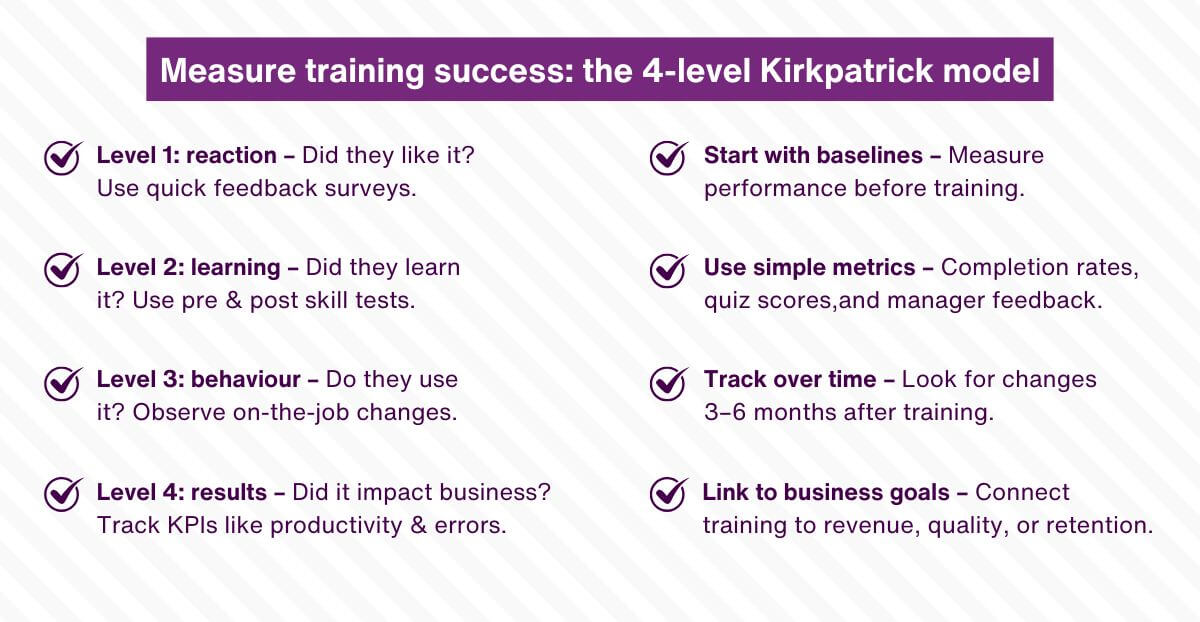
The Kirkpatrick Model organises evaluation into four progressive levels, each building on the last to show how employee training programs create value from start to finish.
Level 1: Reaction focuses on participants’ immediate impressions. Did they find the session engaging, relevant, and well-delivered? Quick post-training surveys or smile sheets capture this feedback. High satisfaction scores indicate the programme held attention and met expectations—essential for buy-in in future sessions.
In smaller teams, simple questions like “Was this useful for your daily role?” provide fast, honest input to refine delivery.
Level 2: Learning measures actual gains in knowledge, skills, or attitudes. Pre- and post-training tests, quizzes, or skill demonstrations quantify improvement. This level confirms the content was absorbed and understood.
Practical approaches, such as those in deAsra’s blog on on-the-job training, use quick checks during real tasks to track progress without formal exams.
Level 3: Behaviour examines whether new learning shows up in daily work. Do employees apply skills consistently? Manager observations, performance logs, or colleague feedback reveal changes over time—often 3 to 6 months after training.
This level bridges the gap between classroom (or hands-on) learning and real application, proving that employee training influences actions.
Level 4: Results link everything to organisational outcomes. Track metrics such as increased output, reduced errors, higher sales, better customer satisfaction, or lower turnover. By comparing data before and after employee training programs, you demonstrate ca lear return on investment.
Layering in Practical Metrics for Stronger Insights
The Kirkpatrick levels provide the backbone, but adding targeted metrics strengthens the picture. Completion rates highlight programme accessibility—if most finish, the format suits busy schedules. Low rates signal the need for adjustments in timing or delivery.
Follow-up knowledge checks weeks or months later test retention beyond initial learning. For behaviour, regular performance reviews or 360-degree input spot lasting shifts.
Business KPIs make the strongest case: productivity per person, cost savings from fewer mistakes, revenue growth in trained teams, or improved engagement scores. These tie employee training directly to growth. In resource-limited settings, rely on free tools—survey platforms, existing dashboards, simple spreadsheets—and review data quarterly for trends.
Addressing Common Hurdles in Evaluation
Measurement challenges include delayed results and potential bias in feedback. Set baselines early, schedule timed follow-ups, and blend subjective input with objective data like performance records.
Start small—focus on one or two levels plus key KPIs—then expand as confidence grows. Encourage open dialogue so teams share honest views, turning evaluation into a tool for continuous improvement.
Mr. Sajiri from Anand HR Solutions, with more than 16 years of HR experience, captures the core mindset: “Training is the same—an investment. Like we invest in products, services, or marketing, training is just as crucial.”
He reinforces the risk of skipping it: “What’s worse is not training someone who stays. That’s a bigger problem.” These views highlight why measuring employee training programs turns potential into proven impact.
Conclusion
Evaluating employee training programs effectively means moving from assumptions to evidence. The Kirkpatrick Model, with its four levels—Reaction, Learning, Behaviour, and Results—offers a clear, credible path that has guided leaders since the 1950s. Combine it with practical metrics, stay consistent, and adapt based on data to maximise returns. deAsra Foundation supports and engages businesses through accessible resources like the dreamBIG podcast series, helping turn employee training into a strategic advantage. Measure purposefully, invest with confidence, and watch your organisation grow stronger.

FAQs
1. Why is the Kirkpatrick Model still relevant for employee training programs today?
Created in the 1950s by Donald Kirkpatrick as part of his PhD research and first shared publicly in 1959 articles, it remains the most recognised framework because of its logical progression from immediate feedback to business results—simple to apply yet powerful for proving value in employee training.
2. How do I practically measure Level 1 Reaction in employee training?
Distribute short surveys immediately after sessions, asking about enjoyment, relevance, and clarity. Anonymous tools like Google Forms make it easy to gather responses and identify quick wins for better engagement.
3. What are strong Level 4 Results metrics for employee training?
Look at tangible outcomes: sales increases, productivity gains, error reductions, customer satisfaction improvements, or cost savings. Use before-and-after comparisons to show direct links to training efforts.
4. Is the Kirkpatrick Model suitable for on-the-job employee training?
Yes—it works well with hands-on formats. Use observations and checklists for behaviour changes, quick skill checks for learning, and performance data for results, making evaluation straightforward and relevant.
5. How often should I review the effectiveness of employee training programs?
Assess Reaction and Learning right away, Behaviour after 3–6 months, and Results on an ongoing or quarterly basis. Regular cycles help catch issues early and keep training aligned with business priorities.