FSSAI Licence vs. Registration: Key Differences and Which One You Need
Starting a food business in India? Whether you run a home-based tiffin service or a large restaurant, obtaining an FSSAI licence is a crucial legal requirement. The Food Safety and Standards Authority of India (FSSAI) ensures food safety and hygiene across the country. But do all food businesses require an FSSAI licence? Some may only need FSSAI registration. Understanding the difference is essential to comply with regulations and avoid penalties.
Before we explore the key differences, check out this FSSAI registration procedure checklist for a detailed guide on how to apply.
What is an FSSAI Licence?
An FSSAI licence is mandatory for medium to large-scale food businesses that exceed a specific annual turnover or operate in multiple states. It is issued under the Food Safety and Standards Act, 2006, ensuring businesses follow food safety norms.
There are two types of FSSAI licences:
- State Licence: Required for businesses with an annual turnover of ₹12 lakh to ₹20 crore.
- Central Licence: Required for businesses with a turnover above ₹20 crore or those involved in import/export, large-scale manufacturing, or inter-state operations.
What is FSSAI Registration?
FSSAI registration is for small food businesses with a turnover of up to ₹12 lakh per year. This includes home-based food vendors, petty manufacturers, and small food stalls. Registration ensures basic compliance with food safety standards but has fewer regulations compared to a licence.
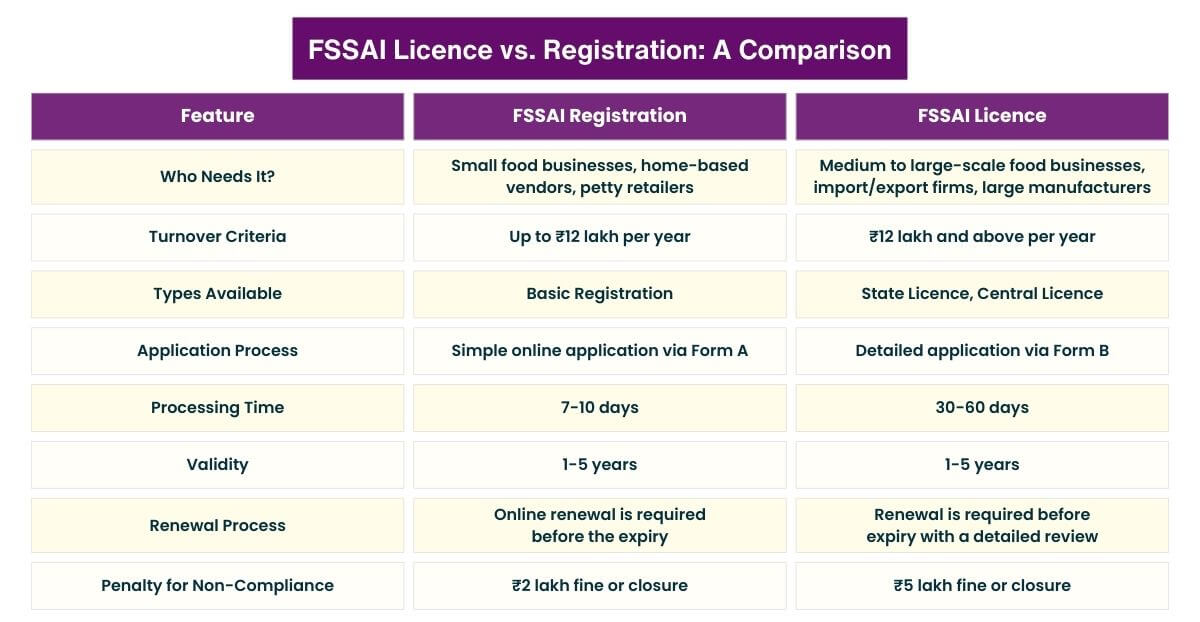
FSSAI Licence vs. Registration: A Comparison
Here’s a breakdown of the differences:
Which One Do You Need?
- If your annual turnover is up to ₹12 lakh, you need FSSAI registration.
- If your annual turnover is above ₹12 lakh, you need an FSSAI licence.
- If you are a food manufacturer, importer, exporter, or operating in multiple states, you must apply for a Central FSSAI licence.
- If you run a restaurant, dairy, catering business, or food processing unit, you need a State FSSAI licence.
How to Get an FSSAI Licence?
Wondering how to get an FSSAI licence? Follow these steps:
Step 1: Determine Eligibility
First, check whether you need FSSAI registration or an FSSAI license based on your business type and turnover.
Step 2: Prepare Documents
For an FSSAI licence, the required documents include:
- PAN Card and Aadhaar Card of the business owner
- Business registration certificate
- Food safety management plan
- Premises layout and equipment details
- List of food products manufactured or sold
For FSSAI registration, only basic documents like identity and address proof are required.
Step 3: Apply Online
- Visit the FSSAI’s official website.
- Fill out Form A for registration or Form B for a licence.
- Upload the required documents and pay the applicable fees.
Step 4: Inspection & Approval
The authorities may inspect an FSSAI licence before approval. The processing time varies from 7 days for registration to 60 days for a central licence.
Step 5: Get Your FSSAI Licence
Once approved, you will receive your FSSAI licence, which must be displayed at your business premises.
For a more detailed step-by-step guide on setting up a food business, refer to this blog on starting a food business.
Why is an FSSAI Licence Important?
- Legal Requirement: Avoid hefty fines and legal troubles.
- Consumer Trust: Builds credibility among customers.
- Business Growth: Allows expansion into larger markets.
- Quality Assurance: Ensures food safety compliance.
- Avoid Penalties: Businesses operating without an FSSAI licence may face fines up to ₹5 lakh or closure.
Conclusion
Whether you need FSSAI registration or an FSSAI licence depends on the size and nature of your food business. Small vendors require registration, while larger businesses need a State or Central FSSAI license. Understanding this distinction is crucial for compliance and business success.
If you plan to start or expand your food business, follow the correct procedures. Now that you know how to get an FSSAI licence, take the next step towards making your business legally compliant and trusted by consumers.
FAQ
1. Who needs an FSSAI registration, and who needs an FSSAI licence?
If you own a small food business with an annual turnover of less than ₹12 lakh, such as a home-based tiffin service, small food stall, petty retailer, or cottage industry, you need an FSSAI registration. However, if your business earns more than ₹12 lakh per year, you must apply for an FSSAI licence. Large businesses like restaurants, food manufacturers, cloud kitchens, import/export businesses, wholesalers, and retailers handling large volumes of food require an FSSAI licence based on their scale of operation.
2. How long does it take to get an FSSAI licence?
The time required for FSSAI registration or licence depends on the type. Basic FSSAI registration typically takes 7 working days after submitting the application. However, if you apply for a State or Central FSSAI licence, the process is more detailed and can take between 30 to 60 days. Authorities conduct inspections, verify documents, and assess compliance before granting the licence. It is advisable to apply well in advance to avoid operational delays.
3. Is the FSSAI licence mandatory for selling food online?
Yes, an FSSAI licence is compulsory for selling food online, whether through your own website, food delivery platforms (Swiggy, Zomato, Dunzo), or e-commerce marketplaces like Amazon and Flipkart. Food aggregators also require their partners to have a valid FSSAI licence number before listing products. Even home-based food businesses selling through WhatsApp, Instagram, or Facebook need at least FSSAI registration. Having an FSSAI licence ensures compliance with food safety laws and builds customer trust.
4. What happens if I don’t have an FSSAI licence?
Running a food business without an FSSAI licence is illegal and can result in heavy fines and legal action. If a business operates without the required FSSAI registration or licence, it can face penalties of up to ₹5 lakh, and in extreme cases, the authorities may shut down the business. Additionally, customers may lose trust in the brand, affecting sales. To avoid penalties and ensure smooth operations, all food businesses should apply for an FSSAI licence based on their scale of operation.
5. How do I check if my FSSAI licence is valid?
You can check your FSSAI licence validity online by visiting the FSSAI Food Licensing website. Simply enter your 14-digit FSSAI licence number to verify details like validity period, business name, and registration status. If the licence is about to expire, it is essential to renew it at least 30 days before the expiry date to avoid penalties or cancellation. Keeping your FSSAI licence updated ensures smooth business operations without legal issues.
DISCLAIMER:
This blog is provided by the deAsra Foundation (“deAsra”) for informational purposes only, offering insights that may be beneficial for micro, small, and medium-sized enterprises (MSMEs).
PLEASE NOTE: This blog is neither written nor endorsed by any governmental organization nor has any affiliation or connection with any government ministry in India. deAsra makes no warranty or representation regarding the information provided through this blog and disclaims its liabilities in respect thereof, including any liability for authenticity, errors, omissions, or inaccuracies in this blog, if any. Any action on the blog readers’ part based on the information provided in this blog is at his/her/its own risk and responsibility. deAsra reserves the right to modify the information contained in this blog at any time at its sole discretion. deAsra agrees that though all efforts have been made to ensure the veracity of the information in this blog, the same should not be construed as an accurate replacement for authorized commentary on the subject matter before it is used for any legal, financial, or business purposes. deAsra accepts no responsibility for the information’s accuracy, completeness, usefulness or otherwise. In no event will deAsra be liable for any loss, damage, liability, or expense incurred or suffered that is claimed to have resulted from the use or misuse of the information in this blog. We advise you to corroborate the information through authenticated sources and professional consultants before relying on the information stated in this blog. All the information in this blog is for educational and reference purposes only, and we do not make or charge any money to provide this information. Links to the relevant websites included in this blog are provided for readers’ convenience only. deAsra is not responsible for the contents or reliability of linked websites and does not necessarily endorse the views expressed therein. deAsra does not always guarantee the availability of such linked pages. If any content has been unintentionally published or copyrighted material in violation of the law, please don’t hesitate to contact us, and we will have it removed immediately