Franchise Business vs. Startup: Which Path is Right for You?
In India’s dynamic entrepreneurial landscape, franchise business models deliver structured expansion with proven systems, while startups chase innovation through uncharted territory. Industry leaders across sectors increasingly weigh these paths, drawn to franchise business opportunities in India that promise lower entry barriers and faster stability.
A franchise business leverages established brand power and operational blueprints, contrasting sharply with the independent journey of launching a startup. This comparative analysis explores the entrepreneurial journey, risks, and potential rewards of each model, equipping you to decide which aligns best with your vision and resources.

Understanding the Core Differences
A franchise business grants you the right to operate under a recognised brand, following its guidelines, products, and processes. You invest an upfront fee, pay ongoing royalties, and benefit from the franchisor’s expertise. This model suits entrepreneurs seeking predictability and support. In contrast, a startup involves building everything independently—from concept to customer base—offering complete autonomy but demanding original ideas and resilience.
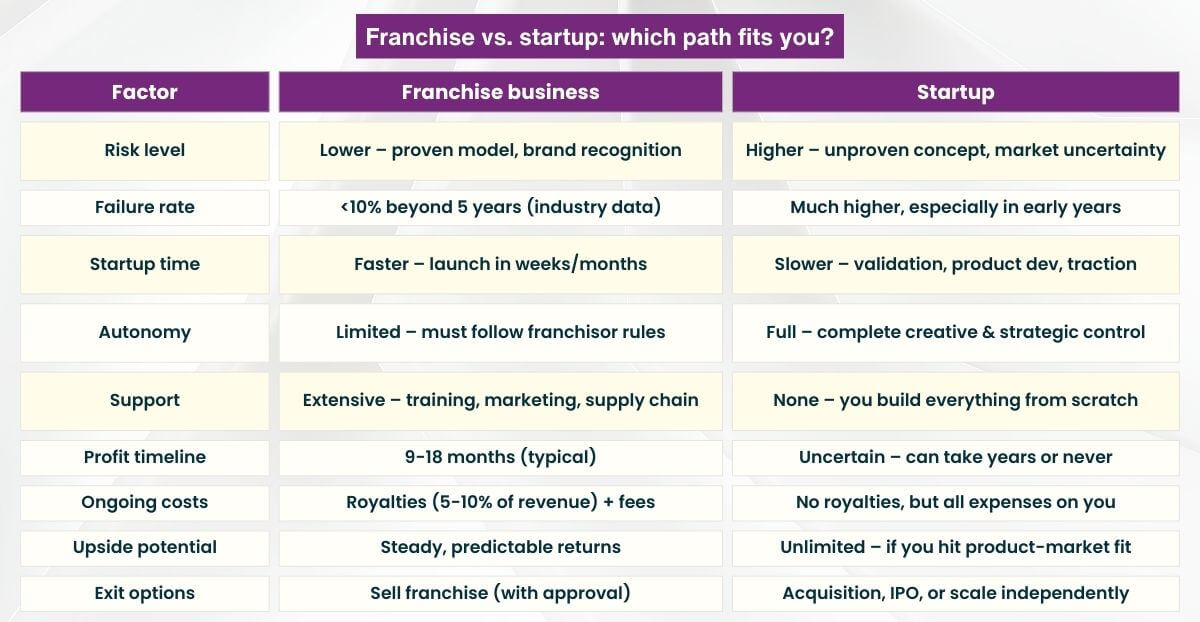
The entrepreneurial journey in a franchise business begins with thorough research into established brands, followed by due diligence on the Franchise Disclosure Document, location selection, training, and launch. Support from the franchisor accelerates progress, often leading to breakeven within 9–18 months in popular sectors like food, education, or retail. Startups demand longer timelines for validation, product development, and market traction, with founders handling every aspect, from funding pitches to team building.
Both paths demand commitment, yet they differ in structure. Franchise business emphasises compliance and replication of success, fostering steady growth through network effects. Startups prioritise experimentation and pivots, which can yield breakthroughs but require navigating uncertainty.
Risk Assessment: Balancing Caution and Ambition
Risk stands as a defining factor. Startups carry higher failure rates, with many ventures struggling to survive the initial years due to untested models, funding challenges, and market competition. Founders face the full burden of trial and error, where missteps in product-market fit or cash flow can prove costly.
Franchise business reduces this exposure through validated systems and brand recognition. Established operations, supplier networks, and marketing support minimise guesswork. Industry data indicates franchises achieve stronger survival rates, often exceeding 90% beyond five years, compared to independent businesses. In India, where consumer trust builds slowly, joining a franchise business provides immediate credibility.
That said, franchise business introduces ongoing commitments like royalties (typically 5–10% of revenue) and adherence to rules, limiting flexibility. Startups avoid such fees but risk prolonged losses without external backing. Your risk tolerance determines the fit—cautious leaders may favour the safeguards of franchise business opportunities, while bold innovators embrace startup volatility for greater control.
Potential Rewards: Stability Versus Scale
Rewards vary by model. A franchise business delivers predictable returns through proven demand and operational efficiency. Many franchisees achieve profitability sooner, supported by training, marketing campaigns, and peer networks. In growing sectors, franchise business opportunities in India enable multi-unit expansion with lower personal capital outlay in FOFO models.
Startups hold unlimited upside. Successful ventures can disrupt markets, attract venture funding, and command high valuations upon exit. Founders retain full equity and decision-making power, potentially building generational wealth through innovation. However, such outcomes remain rare amid intense competition.
In practice, franchise business offers reliable income streams and work-life balance once established, appealing to leaders prioritising sustainability. Startups reward those who thrive on challenges, with potential for exponential growth if the idea resonates.
Mr. Aniket More, a respected business growth strategist, notes: “Franchising allows you to expand rapidly with lower capital investment and operational risk.”
He adds: “When franchisees succeed, your brand becomes a trusted name, and growth follows naturally.”
These insights highlight how a franchise business creates mutual prosperity through structured support.
Franchise Business Opportunities in India: A Growing Landscape
India’s franchise sector expands vigorously, driven by urbanisation, rising incomes, and demand in Tier 2 and Tier 3 cities. Sectors like food and beverage, education, wellness, and retail lead the charge, with low-investment options starting from ₹5–10 lakh attracting nano-entrepreneurs. The market’s momentum makes franchise business opportunities increasingly accessible.
For those exploring entry, resources prove invaluable. deAsra supports and engages aspiring entrepreneurs through its dreamBIG initiative, including expert podcasts and practical tools. Visit the dedicated page for franchise growth strategies and guidance: Franchise for Business Growth.
If buying appeals more, a step-by-step guide clarifies the process: How to Buy a Franchise Business.
These platforms empower informed choices in franchise business opportunities in India.
Making the Decision: Align with Your Strengths
Evaluate your goals, skills, and resources. Do you value guidance, quicker stability, and brand leverage? A franchise business may suit you perfectly. Prefer full creative control and high-reward potential despite risks? A startup aligns better.
Many leaders combine approaches—starting with a franchise business for experience before venturing independently. The key lies in self-awareness: assess risk appetite, financial readiness, and long-term vision.
Franchise business provides a safer entry into ownership, especially in India’s evolving economy, while startups fuel disruption. Whichever path you select, thorough preparation and persistence drive success.
Conclusion
Entrepreneurship in India offers diverse routes, with franchise businesses and startups presenting compelling yet distinct propositions. Franchise business excels in risk mitigation, support, and efficiency, ideal for leaders seeking predictable progress. Startups inspire through freedom and innovation, rewarding those ready for uncertainty.
Reflect on your priorities—stability or disruption, structure or autonomy. With India’s franchise sector thriving and startup ecosystem vibrant, the right choice positions you for meaningful achievement. Explore options, consult experts, and step forward confidently.

FAQs
1. What is the main advantage of choosing a franchise business over a startup?
A franchise business offers a proven model, brand recognition, training, and ongoing support, which significantly lowers risk and accelerates profitability compared to building a startup from scratch, where you must create systems and gain customer trust independently.
2. How much investment is typically required for franchise business opportunities in India?
Investments vary by sector, but many accessible franchise business opportunities start from ₹5–20 lakh, covering fees, setup, and working capital, with higher-end options reaching ₹50 lakh or more for premium brands.
3. Are franchise businesses more successful than startups in India?
Yes, franchises generally show higher success rates due to established systems and support, with lower failure risks than startups, which face greater uncertainty in market validation and operations.
4. Can I innovate within a franchise business model?
Innovation remains limited in a franchise business, as you must follow the franchisor’s guidelines and SOPs for consistency, unlike startups, where full creative freedom allows experimentation and pivots.
5. Which model suits first-time entrepreneurs better in India?
Franchise business opportunities in India often suit beginners best, providing structure, training, and reduced risk, while startups demand more experience, diverse skills, and tolerance for potential setbacks.