Copyright Registration for Businesses: Protecting Your Brand’s Creative Assets
Imagine a situation where your company creates a powerful advertising campaign with striking visuals and catchy music. Without copyright protection, a competitor could easily copy these materials, damaging your brand’s reputation and cutting your profits. Copyright registration prevents such scenarios by providing legal ownership of your creative assets.
For businesses in India, safeguarding intellectual property is not just about protection—it’s about building credibility. Customers are more likely to trust brands that take their work seriously and ensure it’s legally secured. If you’re starting or expanding a business, following a step-by-step guide can help set the foundation, while registering your copyrights should be a key part of your growth strategy.
Copyright registration provides the exclusive rights to your original work, enabling you to prevent others from reproducing, distributing, or modifying it without your permission. This article will explain the importance of copyright registration, highlight the types of business assets you can protect, and walk you through the copyright registration process in India.
Why Is Copyright Registration Important?
Imagine a situation where your company creates a powerful advertising campaign, complete with striking visuals and catchy music. Without copyright protection, a competitor could easily copy these materials, damaging your brand’s reputation and cutting into your profits. Copyright registration prevents such scenarios by providing legal ownership of your creative assets.
One of the key benefits of copyright registration is that it serves as undeniable proof of ownership. This is invaluable in cases of disputes, as the copyright certificate acts as evidence in court. For businesses, it also adds a layer of professionalism, showing clients and competitors that your work is legally protected. This can improve customer trust and brand perception. Additionally, registering your creative assets can open up opportunities for licensing, enabling you to monetise your work further.
What Types of Business Assets Can Be Copyrighted?
Not all assets qualify for copyright protection, but many creative works commonly used by businesses do. Some examples of copyrightable assets include:
- Logos and Branding Elements: While trademarks are often used for logos, the artistic design of a logo can also be copyrighted.
- Written Content: This includes blog posts, product descriptions, advertisements, and manuals.
- Photographs and Videos: Any original visual content created for marketing, branding, or operational purposes.
- Music and Jingles: Audio compositions used in advertisements or as part of the brand identity.
- Software and Mobile Applications: The code and interface design of software or apps developed by your company.
By securing these assets through copyright registration, you ensure that they remain exclusively yours, preventing unauthorised use and protecting your competitive advantage.
Understanding the Copyright Registration Process in India
The copyright registration process in India is relatively simple and can be completed online. Below are the key steps involved:
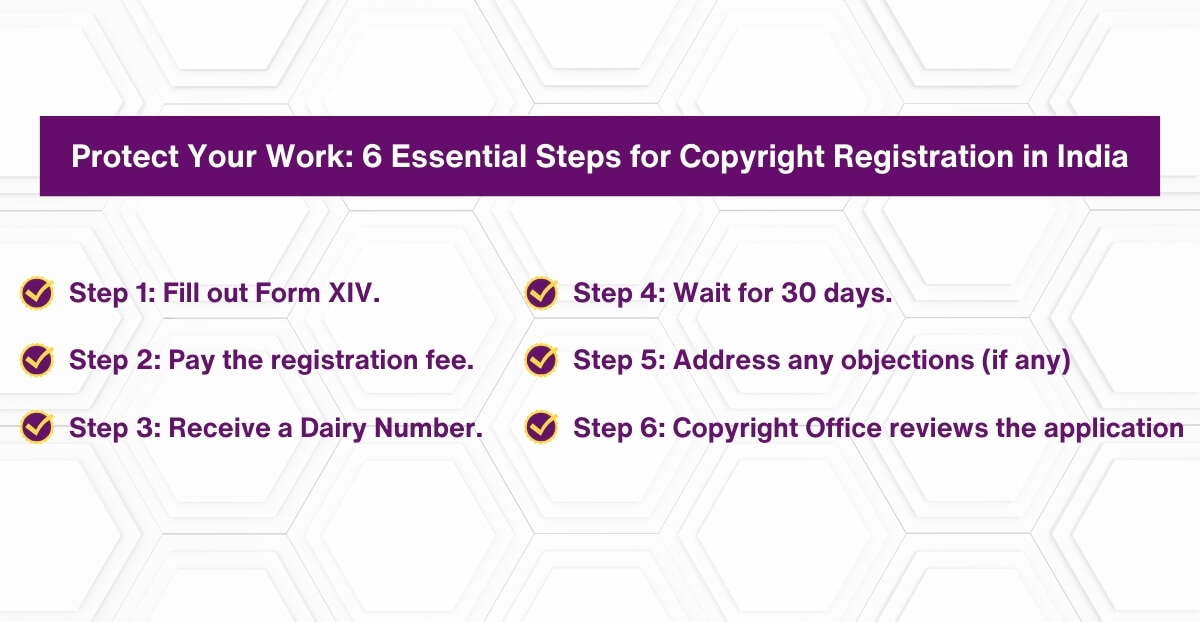
First, you need to apply to Form XIV on the official website of the Copyright Office. This form requires details about the work you’re registering, the creator, and the ownership. Ensure that you upload supporting documents to prove originality. For instance, if you are registering a software application, you can include screenshots or snippets of the source code.
Once the form is filled, you must pay the registration fee. The amount depends on the type of work being registered. Upon successful submission, you will receive a Dairy Number, which is a reference for tracking your application.
Next, there is a 30-day waiting period to allow for any objections. If someone raises an objection, a formal hearing is conducted to resolve the issue. If no objections arise, the Copyright Office reviews your application and issues the copyright certificate, officially recognising your ownership. This process usually takes two to three months to complete.
For a detailed guide on the copyright registration process, check this helpful copyright registration checklist.
Benefits of Copyright Registration for Businesses
The benefits of copyright registration extend beyond mere protection. Firstly, it provides exclusive rights, ensuring that you alone can reproduce, distribute, or adapt your work. This is particularly useful in industries like media, software, and design, where originality is key.
Secondly, having a copyright certificate adds legal protection. If someone infringes on your work, you can take swift legal action using the certificate as proof of ownership. Additionally, registration can create monetisation opportunities by allowing you to license your work. This is a common practice in industries like software development, where licensing agreements generate significant revenue.
Lastly, copyright registration enhances your brand’s credibility. It shows clients, partners, and competitors that you value your creative work and take the necessary steps to protect it. Displaying the © symbol alongside your registered assets also acts as a deterrent, reducing the likelihood of infringement.
Real-Life Example: Protecting Your Assets
Consider a boutique owner who creates a series of unique fashion designs for their new collection. Without copyright registration, competitors could copy these designs and sell them under their brand. However, by registering the designs, the boutique owner ensures exclusive rights to reproduce and sell them, safeguarding their creative efforts and brand identity.
Similarly, a food delivery app that develops a unique user interface can register its software to prevent others from replicating its functionality, ensuring a competitive edge in the market.
Copyright vs Other Types of Protection
It’s essential to understand how copyright differs from other forms of intellectual property protection. Copyright protects creative works such as designs, software, and written content. Trademarks, on the other hand, safeguard brand identifiers like names, slogans, and logos. Patents are used to protect inventions or industrial processes.
For instance, a bakery could copyright its menu designs, trademark its name and logo, and patent a new method for baking bread. Together, these protections create a comprehensive shield for the business.
Common Questions About Copyright Registration
Many business owners have questions about copyright registration. Is it mandatory? While it is not legally required, it is highly recommended. Registration strengthens your legal position, particularly in cases of infringement disputes.
What happens if someone objects to the registration process? Objections are addressed through formal hearings, where additional evidence may be submitted to support your claim.
How much does it cost? The fees for copyright registration are reasonable, especially considering the potential costs of dealing with copyright infringement without proper protection.
Conclusion
Securing your intellectual property is essential in an era where creativity drives business success. Copyright registration protects your creative assets, ensuring that they cannot be copied or misused by others. Whether you’re a designer, developer, or content creator, registering your work gives you exclusive rights and peace of mind.
The copyright registration process in India is straightforward and offers significant benefits, from legal protection to brand credibility. By taking this step, you not only protect your assets but also set your business apart in a competitive marketplace. Don’t leave your hard work vulnerable—start the process of registering your copyrights today.
FAQs
1. What is copyright registration, and why is it important for businesses?
Copyright registration provides legal ownership of original creative works such as designs, software, and written content. It protects businesses by preventing unauthorised use, ensuring exclusive rights, and strengthening their ability to take legal action in case of infringement.
2. What types of works can be copyrighted in India?
Original creative works such as logos, written content, photographs, videos, music, software, and artistic designs can be copyrighted. These assets must be original and created by the applicant or their organisation.
3. How long does copyright protection last?
In India, copyright protection typically lasts for the creator’s lifetime plus 60 years after their death. For works owned by businesses, the duration is 60 years from the date of publication.
4. Is copyright registration mandatory for businesses?
No, it is not mandatory, but it is highly recommended. Registering copyrights provides legal proof of ownership and strengthens your position in case of disputes or infringement issues.
5. Can I register multiple works under a single application?
No, each creative work must be registered separately with the Copyright Office in India. This ensures individual protection and clarity in ownership rights for each asset.
DISCLAIMER:
This blog is provided by the deAsra Foundation (“deAsra”) for informational purposes only, offering insights that may be beneficial for micro, small, and medium-sized enterprises (MSMEs).
PLEASE NOTE: This blog is neither written nor endorsed by any governmental organization nor has any affiliation or connection with any government ministry in India. deAsra makes no warranty or representation regarding the information provided through this blog and disclaims its liabilities in respect thereof, including any liability for authenticity, errors, omissions, or inaccuracies in this blog, if any. Any action on the blog readers’ part based on the information provided in this blog is at his/her/its own risk and responsibility. deAsra reserves the right to modify the information contained in this blog at any time at its sole discretion. deAsra agrees that though all efforts have been made to ensure the veracity of the information in this blog, the same should not be construed as an accurate replacement for authorized commentary on the subject matter before it is used for any legal, financial, or business purposes. deAsra accepts no responsibility for the information’s accuracy, completeness, usefulness or otherwise. In no event will deAsra be liable for any loss, damage, liability, or expense incurred or suffered that is claimed to have resulted from the use or misuse of the information in this blog. We advise you to corroborate the information through authenticated sources and professional consultants before relying on the information stated in this blog. All the information in this blog is for educational and reference purposes only, and we do not make or charge any money to provide this information. Links to the relevant websites included in this blog are provided for readers’ convenience only. deAsra is not responsible for the contents or reliability of linked websites and does not necessarily endorse the views expressed therein. deAsra does not always guarantee the availability of such linked pages. If any content has been unintentionally published or copyrighted material in violation of the law, please don’t hesitate to contact us, and we will have it removed immediately.