
How to Read and Understand a Franchise Disclosure Document (FDD)
The franchise disclosure document (FDD) remains the most critical tool for anyone seriously evaluating a franchise business opportunity. In India’s rapidly expanding franchise business in India, where sectors from food service to education attract ambitious investors, this document delivers unmatched transparency on costs, risks, and commitments. Reputable franchisors provide it voluntarily to build trust, often following international standards with 23 structured sections. Mastering how to read and interpret the franchise disclosure document (FDD) allows industry leaders to spot strong opportunities and avoid costly pitfalls with confidence.
Mr. Aniket More, a prominent expert in franchise strategies from the deAsra dreamBIG podcast, stresses the importance of this step: “Study the Franchise Disclosure Document (FDD): Mandatory in India, provided 15-30 days before payment. Includes franchisor background, investment details, fees, territory protection, and exit terms.”

Franchisor Background and Litigation History
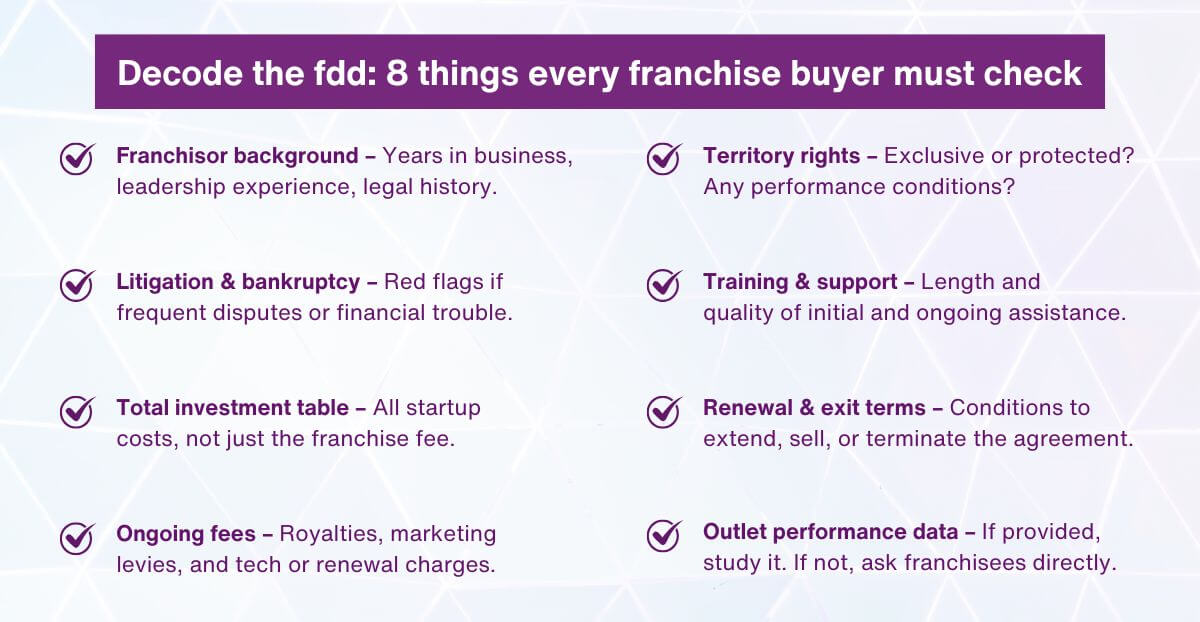
The initial sections of the franchise disclosure document (FDD) establish the franchisor’s identity, including its legal name, principal address, ownership details, and corporate history. These pages reveal how long the brand has operated, any parent companies, predecessors, or affiliates involved, and the professional experience of key executives. This foundation helps assess the stability and credibility of the opportunity in the franchise business.
Litigation and bankruptcy disclosures come next, detailing any past or current legal actions against the franchisor or its principals over the previous decade, along with outcomes or settlements. Bankruptcy filings receive explicit mention if applicable. Industry leaders should flag frequent disputes or financial troubles here, as they may indicate operational weaknesses that could impact future support or brand strength.
Initial and Ongoing Fees
These core financial sections outline all upfront and recurring payments required in the franchise business. The initial franchise fee appears clearly, often alongside a detailed table of estimated total investment that covers equipment, leasehold improvements, signage, inventory, training expenses, and working capital for the opening phase. Readers gain a realistic view of startup capital needs.
Ongoing fees receive equal attention, including royalties (usually a percentage of gross sales), advertising or marketing contributions, technology fees, and any renewal or transfer charges. Restrictions on sourcing products or services from approved suppliers also feature, which can influence profit margins. Prospective franchisees should calculate these against projected revenues to ensure long-term viability.
Estimated Initial Investment and Financial Obligations
Building on fees, this section provides a comprehensive breakdown of the full estimated initial investment, typically presented in a tabular format with low-to-high ranges for various expense categories. It includes everything from real estate costs (if applicable) to grand opening promotions and initial inventory, offering a clear picture of cash required before operations begin in a franchise business in India.
Additional obligations, such as mandatory purchases, insurance requirements, or local compliance costs, appear here too. Industry leaders benefit from cross-referencing these figures with personal financial planning or banker discussions to identify any underestimation or hidden burdens that could strain early performance.
Franchisee Obligations and Franchisor Support
The franchise disclosure document (FDD) spells out what the franchisee must commit to, from following operational standards and reporting sales data to maintaining premises and participating in required marketing. This section ensures expectations align with day-to-day responsibilities and brand compliance.
In exchange, the franchisor details its promised assistance, including initial and ongoing training (often 15-30 days of hands-on sessions), site selection guidance, marketing materials, supply chain support, and field operations help. Strong support systems prove vital for success in the franchise business, so evaluate the depth and duration of training carefully against your experience level.
Territory Rights and Intellectual Property
Territory provisions clarify the geographic area granted, whether exclusive or protected, and any conditions, like performance targets, that could affect rights. This protects against internal competition and supports market potential assessment in the franchise business in India.
Trademarks, patents, copyrights, and proprietary information sections confirm legal protections for the brand’s name, logos, systems, and confidential know-how. Usage rules and any restrictions on modifications receive explanation, safeguarding the value of the intellectual assets you invest in.
Renewal, Termination, and Exit Terms
Long-term relationship aspects receive dedicated coverage, detailing renewal conditions, notice periods, and any changes required for extension. Termination clauses outline grounds for ending the agreement by either party, cure periods for breaches, and post-termination obligations such as non-compete restrictions or de-branding requirements.
Transfer or sale provisions explain processes and approvals needed if you wish to exit, including any right of first refusal by the franchisor. These elements reveal the flexibility and security of the partnership over time.
Financial Performance Representations and Outlets Data
If the franchisor chooses to provide earnings claims, this section (often Item 19) presents substantiated data on average or median revenues, profits, or other metrics from existing outlets, backed by methodology and disclaimers. Absence of such representations is common but prompts direct questions to current operators.
Information on current and former outlets, including numbers opened, closed, or transferred, offers insights into system health, growth trends, and turnover rates. Contacting listed franchisees for validation remains essential after reviewing the franchise disclosure document (FDD).
Conclusion
Decoding the franchise disclosure document (FDD) turns a complex investment into a strategic, well-informed move within the thriving franchise business in India. By methodically examining each section—from background and finances to obligations, support, territory, and exit options—leaders uncover the true nature of the opportunity and align it with their goals and resources. Engage a franchise-specialised lawyer for expert interpretation, and supplement with conversations from existing franchisees. deAsra Foundation supports and engages nano-entrepreneurs and industry professionals through valuable resources in the dreamBIG series.
Explore their dedicated franchise growth page at deAsra Franchise for Business Growth or practical buying guidance at How to Buy a Franchise Business. With disciplined review, franchising delivers scalable growth rooted in proven frameworks.

FAQs
1. What is a Franchise Disclosure Document (FDD)?
The franchise disclosure document (FDD) is a detailed legal disclosure that franchisors provide to prospective franchisees. It covers the brand’s history, financial requirements, obligations, support offered, risks, and other essential details. In India, while not legally required nationwide, ethical franchisors supply it 15-30 days before any payment to promote transparency and enable confident decisions in the franchise business.
2. How many sections are in a typical Franchise Disclosure Document (FDD)?
A standard franchise disclosure document (FDD) includes 23 specific sections or items, following formats like the FTC model adapted for use in India. These cover everything from franchisor background and fees to territory rights, training, financial statements, and termination terms, ensuring comprehensive information for evaluation.
3. Why hire a lawyer to review the Franchise Disclosure Document (FDD)?
A franchise-experienced lawyer spots unfavourable terms, potential risks, ambiguities, or non-standard clauses in the franchise disclosure document (FDD) that non-experts might miss. Their analysis protects your investment, clarifies long-term implications, and aids negotiation, making it a key step for secure entry into the franchise business in India.
4. Does the Franchise Disclosure Document (FDD) always include earnings projections?
Not necessarily; financial performance representations appear only if the franchisor opts to include them, and they must be based on actual data with clear explanations. Many franchise disclosure documents (FDD) omit this to avoid liability, so validate potential returns by speaking directly with current and former franchisees.
5. How much time do I get to review the Franchise Disclosure Document (FDD)?
Reliable franchisors deliver the franchise disclosure document (FDD) at least 15-30 days before requiring any payment or signature, providing sufficient opportunity for careful reading, legal consultation, and franchisee discussions. This period supports thorough due diligence in the franchise business.