
Hiring Employees vs. Contractors: Key Legal and Financial Differences
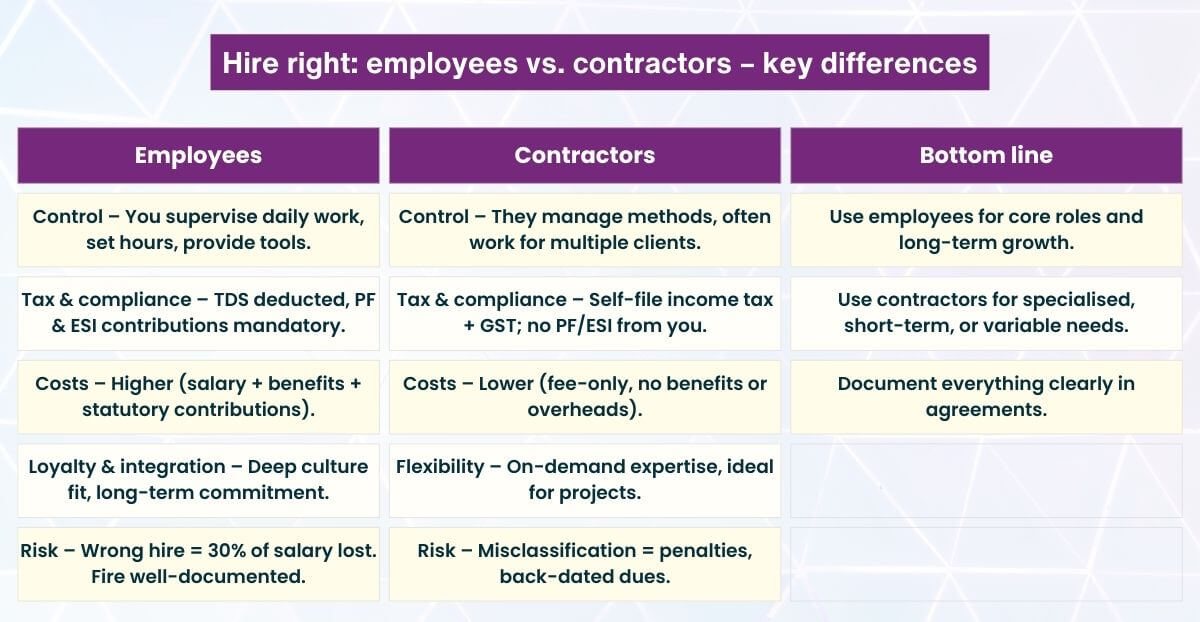
Navigating the complexities of team expansion demands sharp decisions that safeguard growth and compliance. In India, hiring employees brings statutory protections under labour laws such as Provident Fund, Employee State Insurance, gratuity, and mandatory leaves, while independent contractors manage their own insurance and retirement without these benefits. Employers handle tax deductions and contributions for hiring employees, but contractors self-manage income tax and GST, especially with international clients under RBI rules. Control differs sharply—hiring employees means direct supervision and exclusivity, whereas contractors maintain independence across multiple clients.
For entrepreneurs scaling operations, deAsra supports and engages through its dreamBIG podcast, offering insights like those in this episode on hiring for growth, where experts discuss building resilient teams.

Understanding Classification Rules
Classification hinges on the nature of the relationship, guided by tests such as control and integration under Indian laws. For hiring employees, courts examine supervision levels, fixed hours, and exclusivity—if the business dictates methods and provides tools, the individual qualifies as an employee entitled to protections. Contractors, by contrast, operate autonomously, using their expertise without daily oversight, often invoicing for specific outcomes. This distinction prevents sham arrangements where contractors are treated as employees in practice, leading to reclassification risks.
Recent codes like the Code on Social Security 2020 reinforce these rules, extending some benefits to gig workers but excluding true independent contractors. Businesses must document agreements clearly to avoid disputes; for instance, employee contracts specify roles and benefits, while contractor agreements outline deliverables and independence. Hiring for a small business requires vigilance here, as small enterprises in sectors like food or fashion may blur lines during rapid scaling.
Tax Implications Explored
Tax responsibilities vary significantly between the two models. When hiring employees, organisations deduct TDS on salaries and contribute to PF and ESI, ensuring compliance with payroll taxes that support employee welfare. This structured approach simplifies reporting but increases administrative burdens, with employers filing returns quarterly.
Contractors handle their own taxes, filing income tax returns independently and charging GST if applicable, which shifts the compliance load away from the hiring entity. For cross-border engagements, RBI regulations apply without local deductions, demanding careful invoicing. Hiring employees thus involves predictable but higher costs, while contractors offer tax efficiency, though businesses must verify contractor status to dodge liabilities.
Control and Exclusivity Factors
Control defines the core difference, with hiring employees implying full direction over tasks, schedules, and performance. Employees integrate into the company culture, working exclusively and aligning with organisational goals, which builds loyalty but limits flexibility. Mr. Girish Tilak, in deAsra’s dreamBIG podcast, notes, “Attitude comes first,” underscoring the need for adaptable mindsets in such roles.
Contractors retain control over their methods, often serving multiple clients without exclusivity, allowing businesses to tap specialised skills on demand. This setup suits project-based needs in hiring for a small business, yet it reduces oversight, potentially affecting consistency. Leaders must balance this by setting clear expectations in contracts to maintain quality.
Financial Impact Breakdown
Hiring employees escalates costs through benefits and insurances, base salaries, including PF contributions and gratuity provisions. These expenses support long-term stability but strain budgets in early growth phases, where every rupee counts for reinvestment.
Contractors minimise overheads, as payments cover only agreed work without additional perks, making them cost-effective for short bursts of expertise. Hiring for a small business benefits from this model during trials or peaks, though hidden costs like coordination time can arise. Overall, employees yield returns through sustained productivity, while contractors deliver immediate value without commitments.
Liability and Compliance Risks
Misclassification poses major threats, with penalties for unpaid taxes, PF, and ESI if a contractor is deemed an employee. Supreme Court clarifications emphasise that genuine third-party contractors lack employee rights, but sham setups invite back payments and fines, disrupting operations.
To mitigate, businesses should use robust contracts and audits, especially in hiring employees, where compliance is non-negotiable. Hiring for a small business amplifies these risks due to limited resources, so consulting experts prevents costly errors. deAsra supports and engages entrepreneurs with resources to navigate these, reducing exposure through informed strategies.
Pros and Cons of Each Approach
Hiring employees offers pros like loyalty, seamless integration, and skill development within the team, fostering innovation in core functions. Drawbacks include higher fixed costs and slower adaptability to market shifts, which can burden growing enterprises.
Contractors shine in flexibility and specialised access without long-term ties, ideal for projects, but cons involve less control and potential knowledge gaps post-engagement. Mr. Girish Tilak advises, “Freelancers and part-timers are a flexible way to meet business needs without long-term commitments, especially in the early stages,” highlighting their role in agile scaling.
Strategies to Avoid Costly Mistakes
Drawing from deAsra’s insights, prioritise attitude in hiring employees to sidestep bad hires that drain resources. The cost of a bad hire can reach 30% of first-year earnings, including productivity losses and morale dips, so use layered assessments and references.
For contractors, define scopes precisely to ensure deliverables align with needs, avoiding mismatches. Hiring for a small business thrives on hybrid models, blending both for balanced growth, with ongoing feedback to refine teams.
Conclusion
Choosing between hiring employees and contractors shapes the trajectory of any organisation, balancing legal safeguards, financial prudence, and operational agility. By understanding classification, taxes, and risks, leaders can make decisions that propel sustainable success. deAsra’s dreamBIG podcast equips entrepreneurs with expert guidance, ensuring compliance while nurturing dynamic teams. Embrace these distinctions to build resilient structures that thrive in competitive landscapes.

FAQs
1. What are the main legal differences between hiring employees and contractors in India?
In India, hiring employees mandates protections like Provident Fund, Employee State Insurance, gratuity, and paid leaves under labour laws, ensuring security for full-time staff. Contractors lack these, handling their own welfare, which suits independent operations but requires clear contracts to avoid reclassification. This framework, updated by the Code on Social Security 2020, helps businesses in hiring for a small business maintain compliance while scaling.
2. How do tax implications differ when hiring employees versus contractors?
Hiring employees involves deducting TDS and contributing to payroll taxes like PF and ESI, streamlining employer responsibilities, but adding costs. Contractors manage their income tax and GST independently, offering simplicity for the business, though international dealings demand RBI adherence. For hiring for a small business, this means contractors reduce immediate tax burdens, allowing focus on growth without extensive filings.
3. What are the pros and cons of hiring employees for long-term roles?
Hiring employees builds loyalty and integration, enabling deep alignment with company goals and fostering innovation through training. However, higher costs from benefits and potential rigidity in adapting to changes pose challenges. In hiring for a small business, this approach suits core functions, providing stability that outweighs the financial overhead for sustained expansion.
4. When should a business opt for contractors over employees?
Contractors fit short-term or specialised projects, offering flexibility and lower costs without commitments, ideal during early stages or peaks. Drawbacks include limited control and no long-term loyalty, but they excel in agile environments. Hiring for a small business leverages contractors to test ideas or fill gaps, preserving resources for strategic hiring of employees later.
5. How can businesses avoid misclassification risks?
To prevent misclassification, document relationships clearly—use control tests to differentiate supervision levels and ensure contractor agreements emphasise independence. Regular audits and legal consultations mitigate penalties like back taxes. For hiring employees or contractors in hiring for a small business, this proactive stance safeguards against Supreme Court scrutiny, promoting compliant growth.