
Mastering Sales Strategy: 5 Essential Frameworks to Transform Your Approach
Crafting an effective sales strategy drives growth and sets businesses apart in competitive markets. Insights from the deAsra and dreamBIG podcast with Mr. Rahul Limaye—a sales veteran with over 30 years of experience—highlight the need to tailor approaches to unique value propositions. He stressed that no universal method exists; customisation creates true differentiation. Clear market positioning and compelling value communication make customers choose you over rivals.
For hands-on steps to build your own plan, explore this step-by-step guide on creating a sales strategy. This overview examines five proven methodologies—SPIN, Challenger, MEDDIC, Sandler, and Solution Selling—to help you select the best fit for your product, market, and team while applying practical strategies to increase sales rooted in trust, technology, and adaptability.
1. SPIN Selling: Uncovering Customer Needs
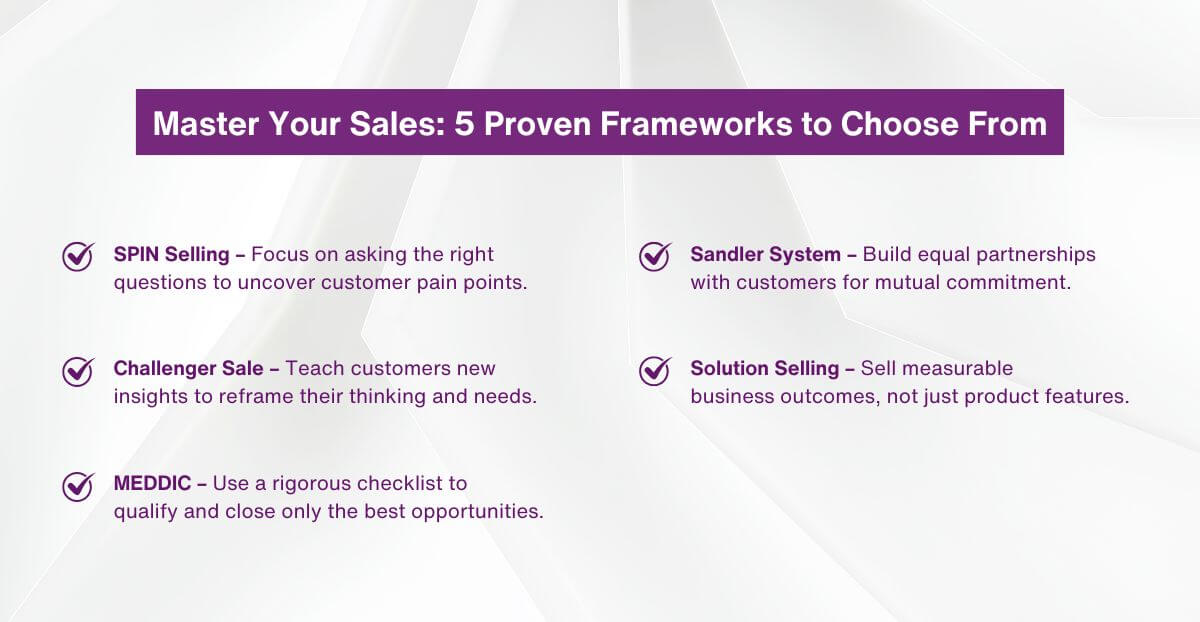
SPIN Selling, developed by Neil Rackham, relies on four types of questions—Situation, Problem, Implication, and Need-payoff—to uncover pain points and let customers build the case for your solution themselves. It moves away from aggressive pitches towards insightful, customer-led conversations, making it particularly effective for complex B2B deals involving multiple decision-makers.
In the podcast, Mr. Rahul Limaye captured the essence: “Don’t push products—explain their utility,” a principle reflected in stories like Urmila Ben Ashar, who at 77 built a food empire through genuine trust and meaningful connections.
Teams adopting SPIN see stronger engagement and lasting relationships because it transforms objections into opportunities. Success, however, depends on thorough training to keep questioning natural rather than scripted.
- Pair it with AI-driven market research, as Mr. Limaye recommended, to personalise interactions deeply.
- Demonstrate undeniable value to lift conversion rates.
- Simplify the question flow for B2C scenarios while retaining focus on perceived benefits.
This consultative approach establishes SPIN as a robust sales strategy and one of the most reliable strategies to increase sales over time.

2. The Challenger Sale: Disrupting Customer Thinking
The Challenger Sale, based on research by Matthew Dixon and Brent Adamson, trains sellers to challenge prospects’ assumptions, teach new insights, and confidently lead conversations toward bold action. Challengers tailor messages, debunk the status quo, and push decisions—thriving in high-stakes fields like enterprise technology or financial services where buyers often overlook hidden inefficiencies.
Mr. Limaye reinforced this view: “AI and technology don’t magically deliver customers—they’re tools for insight,” enabling sellers to deliver data-backed challenges that reframe problems effectively.
Execution demands preparation and courage, backed by solid industry knowledge that positions you as a thought leader rather than a mere vendor. For emerging businesses, deAsra supports and engages entrepreneurs through targeted mentoring to refine messaging and avoid generic approaches.
This sales strategy consistently grows deal sizes and margins in competitive sectors, though it suits disruptive environments better than rapid transactional sales. It ranks highly among strategies to increase sales by driving investment in transformative outcomes.
3. MEDDIC: Qualifying Opportunities Rigorously
MEDDIC stands for Metrics, Economic Buyer, Decision Criteria, Decision Process, Identify Pain, and Champion. It forces rigorous qualification to focus effort only on deals with genuine potential, originating from high-performance teams at companies like PTC.
It excels in long-cycle B2B contexts such as SaaS, manufacturing, or consulting, where mapping buyer dynamics prevents wasted resources.
Integration with feedback is seamless—Mr. Limaye advised treating feedback “as a treasure, not a chore.” deAsra supports and engages businesses with practical market research checklists to implement MEDDIC smoothly.
This disciplined sales strategy minimises risk during economic uncertainty, strengthens pipeline accuracy, and delivers higher win rates, forming a cornerstone of comprehensive strategies to increase sales.
4. Sandler Selling System: Building Mutual Commitment
David Sandler’s system views buyer and seller as equals, using a structured “submarine” process—bonding, upfront contracts, pain discovery, budget confirmation, decision, fulfilment, and post-sell—to secure commitment early and eliminate unpaid consulting.
It works brilliantly for consultative products or services, promoting transparent dialogue that aligns perfectly with Mr. Limaye’s emphasis on honesty and exceptional service as foundations for retention.
The psychological edge lets sellers disqualify poor fits quickly, preserving time and margins. deAsra supports and engages teams through detailed playbooks on goal-setting and KPI tracking.
Applied ethically, this versatile sales strategy cultivates loyalty, referrals, and repeat business through personalised communication across diverse industries.
5. Solution Selling: Focusing on Outcomes
Michael Bosworth’s Solution Selling diagnoses customer challenges holistically, then crafts tailored remedies linked directly to measurable business outcomes via “pain chains.” It shifts conversations from features to ROI, justifying premium pricing in crowded markets like healthcare, retail, or professional services.
Enhance precision by blending in AI for lead analysis, exactly as Mr. Limaye suggested. Continuous market research keeps offerings relevant.
As a core sales strategy, it converts satisfied customers into vocal advocates and fuels sustained revenue through refined feedback loops and proven strategies to increase sales.
Choosing the Right Framework for Your Business
Match frameworks to your reality: product complexity, sales cycle length, market maturity, and team capabilities. Exploratory or emotional B2C often favours SPIN or Solution Selling; intricate B2B with multiple stakeholders leans toward MEDDIC or Challenger.
Evaluate strengths and customer profiles using SWOT resources from deAsra. Remember Mr. Limaye’s core message—no sales strategy fits everyone; rigorous testing and data-driven iteration are essential.
- Layer in complementary tactics like networking, loyalty programmes, or cross-collaborations for multiplied impact.
- During economic shifts, pivot quickly as illustrated in podcast examples of product adaptation.
- deAsra supports and engages through personalised mentoring to ensure perfect alignment.
Ultimately, the most effective sales strategy remains flexible, evolving with customer feedback and market signals.
Conclusion
These five frameworks—SPIN, Challenger, MEDDIC, Sandler, and Solution Selling—offer battle-tested blueprints to elevate any sales strategy. Enriched by practical wisdom from Mr. Rahul Limaye on the deAsra and dreamBIG podcast, they stress customer-centricity, innovation, and resilience. Tailor them thoughtfully, integrate smart strategies to increase sales, and watch sustainable growth follow.
Dive deeper into tailored guidance with deAsra’s sales growth resources. Transform everyday challenges into lasting competitive advantages.

FAQs
1. What is the SPIN Selling framework, and when should I use it?
SPIN Selling deploys Situation, Problem, Implication, and Need-payoff questions to guide customers toward recognising their own needs. It shines in complex B2B scenarios requiring thorough buyer insight. This sales strategy builds commitment through dialogue, emphasises urgency via implications, and consistently improves close rates by showcasing clear value.
2. How does the Challenger Sale differ from traditional selling?
The Challenger Sale proactively teaches insights and reframes problems, contrasting with reactive traditional methods that merely respond to stated needs. It establishes sellers as authoritative guides in competitive landscapes. This sales strategy demands solid research yet secures larger, higher-value deals by surfacing latent inefficiencies.
3. Why is MEDDIC useful for B2B sales teams?
MEDDIC rigorously qualifies opportunities across Metrics, Economic Buyer, Decision Criteria, Process, Pain, and Champion elements. It eliminates low-probability pursuits in extended cycles. This sales strategy enhances forecasting precision and resource efficiency, especially when integrated with CRM systems.
4. Can the Sandler System work for small businesses?
Absolutely—the Sandler System creates early mutual commitment, enabling small businesses to maintain negotiation control and safeguard margins. This adaptable sales strategy scales smoothly, converting salespeople into trusted advisors through principled, ethical execution.
5. How to implement Solution Selling in a retail setting?
Equip staff to probe beyond immediate purchases and recommend outcome-driven bundles that solve broader customer challenges. This sales strategy elevates routine transactions into memorable experiences, generating upsells and loyalty through empathetic, personalised suggestions aligned with proven strategies to increase sales.