
10 Effective Team Management Strategies to Boost Productivity and Morale
“Delegation is not abdication. You remain the trustee of the business.” – Mr Adwait Kurlekar
As a business owner running a small or medium enterprise, have you ever felt that the moment you step out, everything pauses? You are the sales head, accountant, operations manager and delivery boy – all rolled into one. Mr Adwait Kurlekar, a strategist with over 30 years of experience, recently shared priceless insights in the deAsra Foundation’s dreamBIG series.
His session revealed effective team management strategies that actually work on the ground, especially when you have 5-15 people and no formal HR department. You can watch the full discussion here.
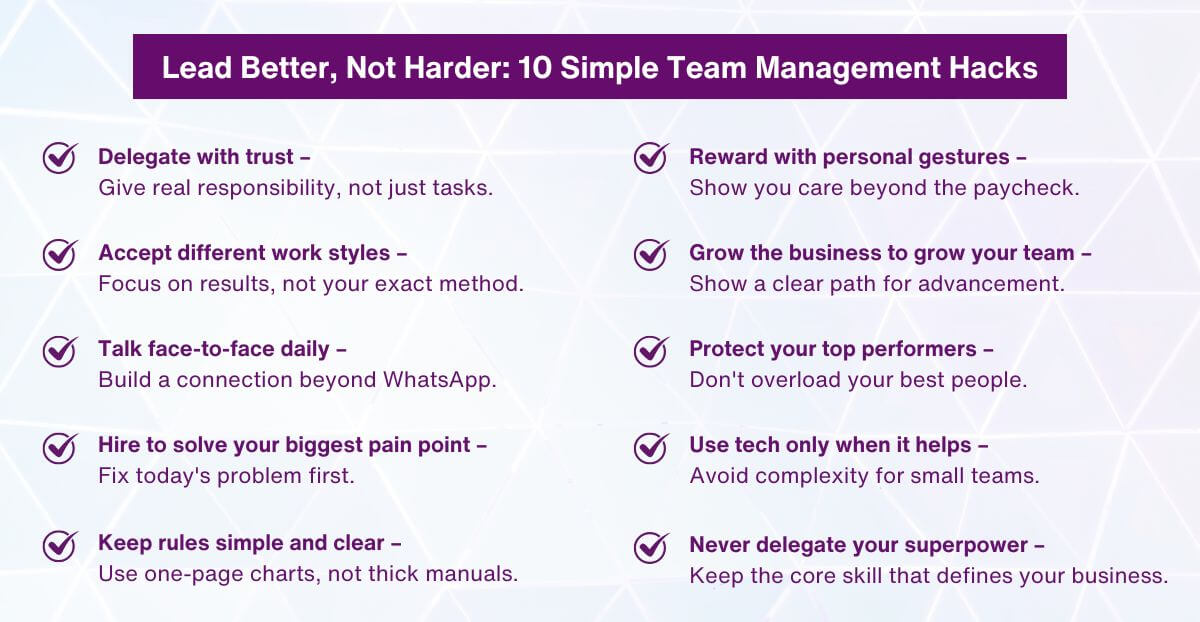
1. Delegate Trust Before Tasks
The first thing you delegate is trust. Mr Kurlekar gave a beautiful example: a kirana shop owner who works 18 hours a day must trust someone to handle cash when a family emergency arises. Start team delegation by picking one reliable person and handing over complete responsibility (not just pieces). This single act multiplies your bandwidth overnight and shows you exactly how to manage a team as a leader – by trusting first.
2. Accept the Delegation Compromise
Your team will never do things exactly the way you do. They might be slower, faster, cheaper or slightly costlier. Accept it. Mr Kurlekar says, “Employees are not your clones.” Mastering effective team management strategies means measuring outcomes, not methods. Use the Eisenhower Matrix to decide what stays with you and what goes out.
3. Use Face-to-Face Communication Daily
In small teams, WhatsApp is convenient but dangerous. Body language tells you more than words. Make “talking” your best tool. Short morning huddles or evening catch-ups build alignment faster than any software. Great leaders know how to manage a team as a leader through real conversations, not just instructions.
4. Hire for Immediate Pain, Not Future Vision
Your first hire should remove the task you hate or cannot do well – usually accounts or admin. Forget the startup cliché of “must bleed for the vision.” Small businesses are often lifestyle businesses, and that is perfectly fine. Smart team delegation begins with hiring someone who solves today’s headache.
5. Keep Documentation Dead Simple
Complex SOP manuals gather dust. Use a one-page RACI chart (Responsible, Accountable, Consulted, Informed) in plain language. This stops finger-pointing instantly. One of the most underrated effective team management strategies is clarity on who owns what.
6. Reward Quietly but Powerfully
Formal “Employee of the Month” boards rarely exist in small firms. Yet owners often pay huge medical bills or wedding expenses without hesitation. Mr Kurlekar points out that this caring behaviour builds deeper loyalty than any corporate bonus. Public praise for wins, private discussions for gaps – that is how to manage a team as a leader with fairness.
7. Grow the Business to Grow the People
Salary is never “enough.” People stay when they see personal growth because the company is growing. Share simple milestones (“We crossed ₹2 crore last year”) without revealing exact profit. Transparency + visible progress = high morale. This is a cornerstone of effective team management strategies.
8. Avoid Overloading Your Best People
High performers get more work because they deliver. This creates silent resentment. Spread responsibilities evenly. If someone consistently struggles with extra load, have an honest conversation early. Fairness matters more than capacity in small teams.
9. Adopt Technology Only When It Pays
Front-end tools (POS, QR menus, UPI) usually pay for themselves. Back-end project tools for a 10-member team? Often overkill. Start with disciplined WhatsApp groups and graduate only when chaos demands it. Practical team delegation includes delegating tool selection to the person who will use it daily.
10. Never Delegate Your Core Strength
Photography studio owner? Keep shooting the hero images yourself. Restaurant owner who cooks the signature dish? Stay in the kitchen for that one dish. Everything else can (and should) move out. Knowing how to manage a team as a leader also means knowing what only you can do.
Conclusion: Start Small, Scale Smart
Mastering effective team management strategies does not need an MBA or a fat HR budget. It needs trust, crystal-clear communication, and the courage to accept that your way is not the only way. Begin with one act of team delegation this week – hand over something you have been clutching tightly. Watch productivity rise and your own sanity return.
As Mr Kurlekar beautifully summarised: “Don’t look back over your shoulder.” Trust the process, trust your people, and watch your business (and life) transform.
For a deeper dive into what team management really means, read this insightful piece from deAsra: What is Team Management?
FAQs
1. What is the difference between delegation and abdication?
Delegation means you assign a task but remain ultimately responsible for the outcome. Abdication is washing your hands off completely. In small businesses, abdication kills trust and invites chaos because there are no layers to catch mistakes.
2. How do I stop myself from micromanaging?
Remind yourself daily of the delegation compromise – done differently is still done. Focus only on the final result and timeline. If you catch yourself saying “If I were in your place…”, pause. That doubt is the real killer of delegation.
3. My team is only 6 people. Do I still need documentation?
Yes, but keep it to one page. A simple table showing who is Responsible and who is Accountable for each major task prevents 90 % of conflicts and blame games.
4. How often should we have team meetings in a small setup?
Fix a rhythm and stick to it – daily 10-minute stand-ups or weekly 30-minute syncs. Discipline matters more than duration. Cancelled meetings send the message that alignment is optional.
5. What if I cannot pay high salaries? How do I retain people?
Build a family-like culture where people know you will stand by them in real crises. Combine it with visible business growth so they see a future. Care and growth beat a slightly higher salary from a faceless competitor almost every time.